
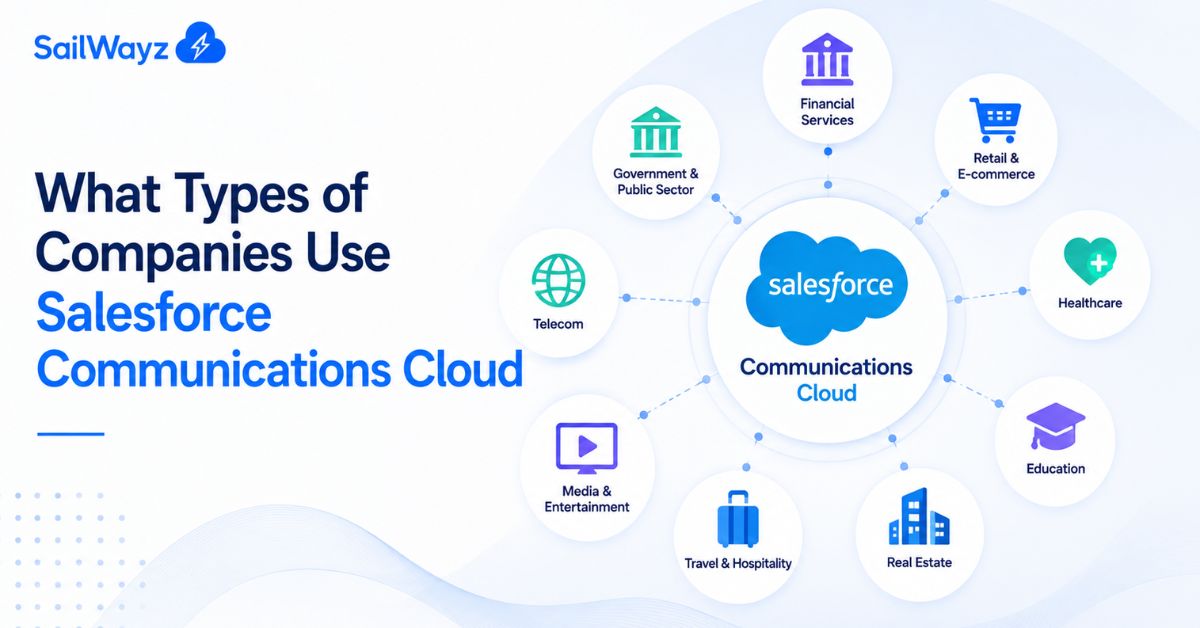
Salesforce has a lot of clouds. Sales Cloud, Service Cloud, and Marketing Cloud, and then there’s Communications Cloud, a version built for one industry in particular. If you’ve come across the name and wondered whether it applies to your business, this guide covers exactly that. Let’s break down the types of companies that use Salesforce Communications Cloud, what it actually does, and how to tell if it fits your operation.
Communications Cloud is built on top of Sales Cloud and Service Cloud, with extra tools bolted on for one sector: telecommunications. It handles order management, product catalogues, billing connections, and customer service, all shaped around how communications providers actually sell and support their services.
Put simply, it lets a phone or broadband provider sell a plan, activate it, bill for it, and support the customer afterwards, all inside one connected system instead of five separate ones stitched together.
(What Is Communications Cloud?, Salesforce, 2026, https://www.salesforce.com/communications/cloud/guide/)
This is not a general-purpose CRM edition. It is built with specific businesses in mind. Here are the main types of companies that use Salesforce Communications Cloud in practice:
The common thread across all of these is complexity. A telecom company is not selling one simple product. It is selling plans with add-ons, data limits, contract terms, device bundles, and location-based coverage, and it needs to activate, bill, and support all of that without hand-offs falling apart between departments. That is the exact problem Communications Cloud is built to solve.
A regular Salesforce setup can handle contacts, leads, and support cases well. What it struggles with is the back-end complexity that telecom and connectivity businesses deal with daily. Communications Cloud adds:
None of these are things a small retail business or a professional services firm needs. But for a telecom provider managing thousands of live connections, they matter a great deal.
Communications Cloud is not only for the largest national carriers. Software review sites list its typical customers as ranging from small businesses to large enterprises, which fits what we see in practice. A regional broadband provider with a few thousand customers can run on it just as a national mobile network can, though the scope of the setup looks quite different at each end.
(Salesforce Communications Cloud Reviews, GetApp, 2026, https://www.getapp.com/retail-consumer-services-software/a/communications-cloud/)
What changes with size is not whether the platform fits, but how much of it gets switched on. A smaller ISP might use it mainly for order handling and support. A national carrier is more likely to run sales, billing links, field service, and AI-driven agents together across the whole business.
At Sailwayz, we work with businesses in the connectivity space directly. One of our case studies involves Vaioni Group, an internet provider supplying fast, managed connectivity to other businesses. As their customer base grew, they needed a proper system to bring sales, marketing, and customer support together instead of running them as separate processes. That is a familiar starting point for a lot of ISPs and connectivity providers before they scale into something closer to a full communications cloud setup.
If you are still not sure whether this applies to your business, ask yourself these questions:
If you answered yes to most of these, Communications Cloud is worth a proper look. If your business sells a simpler product with a standard checkout process, a regular Salesforce edition will likely cover what you need without the added cost.
The types of companies that use Salesforce Communications Cloud share one thing in common: complex, ongoing customer relationships built around plans, contracts, and connectivity rather than single purchases. Mobile operators, broadband providers, cable companies, MVNOs, and wholesale carriers all fit that pattern, whatever their size. If your business looks nothing like that, a standard Salesforce consultant edition is probably the better starting point. If it does, this is a platform built with your exact problems in mind.
Is Salesforce Communications Cloud only for large telecom companies?
No. Reviews show it is used by businesses ranging from small providers to large enterprises. A regional broadband or mobile provider can run it, though the setup will be smaller in scope than a national carrier’s.
What is the difference between Communications Cloud and standard Salesforce Sales Cloud?
Communications Cloud builds on Sales Cloud and Service Cloud, adding catalogue-driven selling, order tracking, billing links, and field service tools built for telecom-style products, things a standard CRM does not handle out of the box.
Can an internet service provider (ISP) use Salesforce Communications Cloud?
Yes. ISPs are one of the main types of companies that use Salesforce Communications Cloud, since they deal with plan-based selling, installation scheduling, and ongoing billing, all areas the platform is built to support.
Do media and entertainment companies use Communications Cloud too?
Some do, mainly those with a connectivity or network side to their business, such as pay-TV providers bundling content with broadband or phone services. Pure content companies with no network operations usually do not need it.
How do I know if my business needs Communications Cloud instead of a regular Salesforce setup?
If you sell contracts or bundled plans, manage a changing product catalogue, and need sales, billing, and support connected in one place, it is worth exploring. Simpler product sales usually do not need the extra complexity.


Joshua Eze is the Founder & Salesforce Architect at Sailwayz, a certified Salesforce Consulting Partner based in the UK. With over 6 years of experience leading CRM transformations, he is a certified Application & System Architect passionate about using technology to simplify business processes. Joshua helps companies unlock the full potential of Salesforce with strategic, scalable, and secure solutions.
