
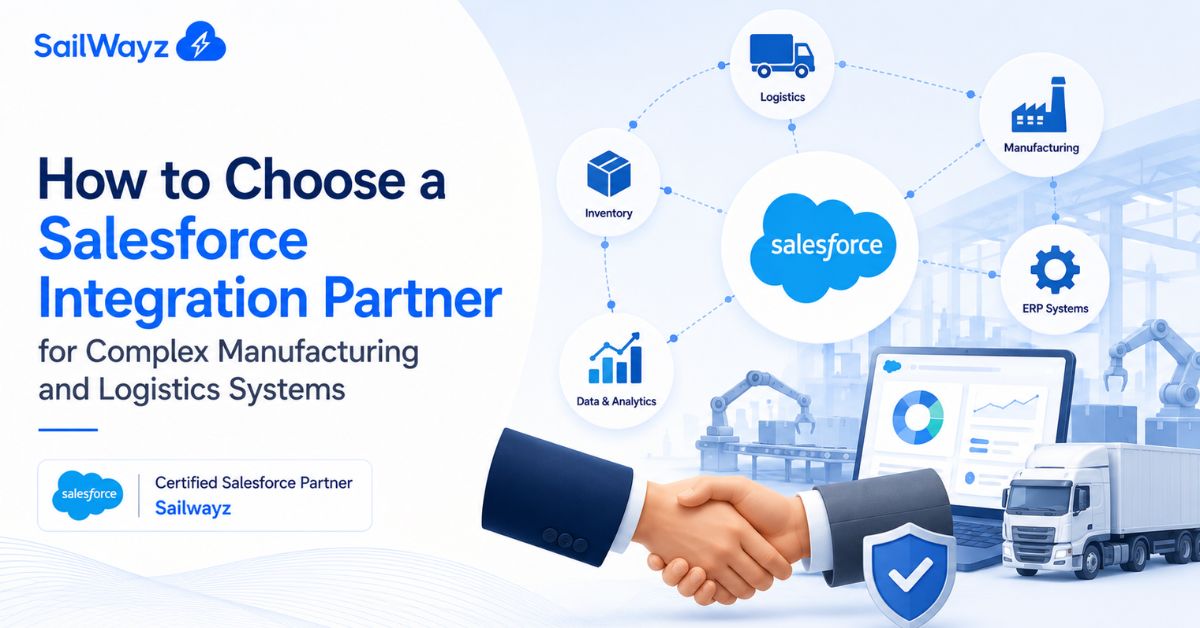
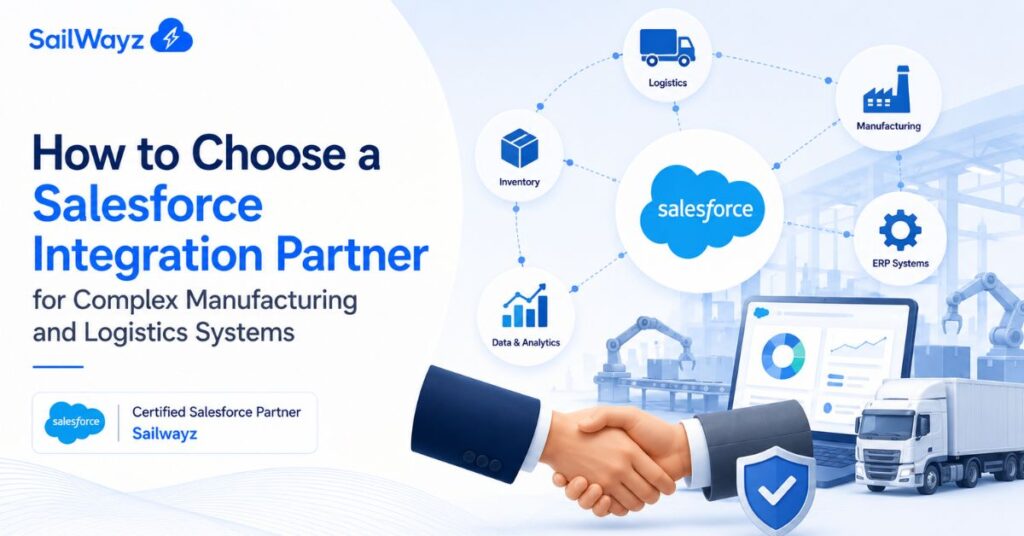
Manufacturing and logistics businesses rarely run on Salesforce alone. There’s usually an ERP system tracking inventory, a warehouse management tool handling stock, EDI connections talking to suppliers, and maybe field devices reporting data from the factory floor. Getting Salesforce to work properly alongside all of that is not a small task, and picking the wrong partner to do it can cost months of rework. Here’s what actually matters when choosing a Salesforce integration partner for complex manufacturing and logistics systems.
A typical CRM setup connects Salesforce to email and maybe a marketing tool. Manufacturing and logistics businesses need far more than that. Orders need to sync with inventory in real time. Quotes need pricing pulled straight from the ERP, not typed in twice. Shipping updates need to flow back into the customer record automatically, not get chased down by phone.
On top of that, many of these businesses still run legacy systems that were never built to talk to cloud software. A partner who has only worked on straightforward CRM rollouts can struggle here, not because Salesforce itself is complicated, but because the systems around it are.
(Salesforce ERP Integration: Complete Guide, Cloudywave, April 2026, https://www.cloudywave.com/salesforce-erp-integration-guide-2026/)
This is the part most businesses rush, and it’s the part that decides whether the project goes smoothly. Here’s what to check before you sign anything.
Ask specifically which ERP systems they’ve connected to Salesforce before, not just whether they “do integrations”. SAP, NetSuite, Epicor, and Microsoft Dynamics all behave differently, and a partner who has only worked with one of them may hit surprises with another. If your business runs an older, custom-built system, ask directly how they plan to handle it.
There’s more than one way to connect systems, and a proper partner should be able to explain their choice plainly:
If a partner cannot explain which method suits your setup and why, that’s a sign they haven’t thought it through yet.
A partner who understands how quote-to-cash works in manufacturing, or how order fulfilment flows through a warehouse, will ask better questions from day one. Sector knowledge shortens the discovery phase and cuts down on costly guesswork later in the project.
Connecting two systems means moving sensitive data, customer records, pricing, and financial details back and forth. A proper partner will talk about encrypted connections, access controls, and compliance requirements such as GDPR before the project even starts, not after something goes wrong.
Ask for case studies from manufacturing or logistics clients specifically. Anyone can claim integration expertise. Fewer can show a working example of an ERP-to-Salesforce connection that’s still running smoothly a year later.
Integrations need looking after. APIs update, data volumes grow, and new systems get added over time. Ask what happens after launch, whether that’s a support contract, a health check schedule, or simply a named contact you can reach when something breaks.
Depending on your business, your Salesforce integration partner may need to work across several of these at once:
The more of these your business relies on, the more important it becomes to pick a partner who has handled multi-system projects before, not just single point-to-point connections.
Some warning signs are easy to miss during the sales pitch stage but tend to cause real problems later:
If more than one of these shows up during early conversations, it’s worth continuing your search.
That last question tends to say more about a partner than any polished case study. Every complex integration hits a snag somewhere. What matters is how the partner handled it.
At Sailwayz we work with manufacturing businesses that need Salesforce consultant connected properly to the systems already running their operations, from finance platforms like QuickBooks and NetSuite through to broader ERP and logistics tools. Our approach starts with understanding how data actually moves through your business today, before any technical work begins. That groundwork matters more than people expect. A connection built without understanding the underlying process tends to break down within months, while one built around how your teams actually work tends to hold up.
Finding the right Salesforce integration partner for complex manufacturing and logistics systems comes down to specifics, not sales language. Ask about the exact systems they’ve connected before, the method they’d use for yours, how they handle data and security, and what support looks like once the project is live. A partner who answers those questions clearly, with real examples, is far more likely to deliver a connection that holds up under daily use than one who simply promises it will all work out.
How long does a typical Salesforce ERP integration take for a manufacturing business?
It depends on complexity, but most projects run from a few weeks for a single, well-defined connection to several months for multi-system integrations involving ERP, WMS, and logistics platforms together.
Do I need MuleSoft for a Salesforce and ERP integration?
Not always. Simpler, single-system connections can often use direct APIs. MuleSoft becomes worthwhile when you’re connecting several systems at once and need a central layer managing the data flow between them.
What’s the biggest risk when integrating Salesforce with a manufacturing ERP?
Poor data quality going in. If the ERP holds duplicate, outdated, or inconsistent records, that mess carries straight into Salesforce unless it’s cleaned up properly before the connection goes live.
Can a small or mid-size manufacturer afford a proper Salesforce integration?
Yes. Project scope and cost scale with complexity, so a single ERP connection for a mid-size manufacturer costs far less than a multi-system rollout for a large enterprise. Ask potential partners for a scoped estimate based on your actual systems.
What happens if our ERP vendor updates their system after the integration is built?
A properly built integration should be designed to handle version changes without breaking completely, but it’s worth asking your partner directly how they monitor and update connections when a vendor pushes changes.

Joshua Eze is the Founder & Salesforce Architect at Sailwayz, a certified Salesforce Consulting Partner based in the UK. With over 6 years of experience leading CRM transformations, he is a certified Application & System Architect passionate about using technology to simplify business processes. Joshua helps companies unlock the full potential of Salesforce with strategic, scalable, and secure solutions.
