

Choosing a CRM platform gets harder the bigger your business grows, and Pega vs Salesforce is one of the more confusing match-ups on the market because the two platforms solve customer relationship management from almost opposite directions. This guide breaks down what each platform actually does, where each one wins, and how to work out which fits your business rather than someone else’s.
What Is Pega?
Pega, built by Pegasystems and first launched in 1983, started life as a business process management tool rather than a CRM in the traditional sense. It’s built around case management and low-code app building, with a “centre-out” architecture that lets a business connect and modernise existing systems gradually instead of replacing them all at once.
The standout feature is Pega’s Customer Decision Hub, which runs real-time, next-best-action decisions across millions of interactions a day. This suits businesses where getting a decision wrong carries real consequences, such as a bank wrongly declining a loan or an insurer mishandling a claim. Pega is common in banking, insurance, and telecoms, where regulated, multi-step processes span several departments and systems.
The trade-off is cost and the sheer amount of specialist work involved. Certified Pega developers are scarce, and enterprise deployments commonly run into six or seven figures in the first year once licensing, setup work, and specialist staff are all counted.
What Is Salesforce?
Salesforce is the world’s most widely used CRM, serving well over 150,000 companies across sales, service, marketing, commerce, and analytics. It’s cloud-native, built around accounts, contacts, and pipeline, and backed by a large partner ecosystem: thousands of apps on the AppExchange and industry-specific clouds covering sectors from finance to manufacturing.
Its recent AI story centres on Agentforce for building and running AI agents, alongside Einstein for predictive and generative features and Data Cloud as the underlying data layer that grounds those agents in actual customer records. Where Pega leans on process and decisioning, Salesforce leans on breadth: agents and automation that act directly on CRM records, service cases, and marketing activity.
Salesforce also scales down further than Pega does. Its entry-level Essentials plan starts at a fraction of Pega’s per-user cost, and small businesses can get a working setup running in weeks rather than months.
Main Differences Between Pega and Salesforce
Here’s how the two platforms compare on the areas that matter most when choosing between them:
- Main focus: Pega centres on case management and automated decisioning; Salesforce centres on sales, service, and marketing across the customer lifecycle
- Target business size: Pega suits large enterprises, often in regulated industries; Salesforce serves businesses from small teams through to global enterprises
- Setup time: Pega deployments typically run for months given the specialist work involved; Salesforce can go live in weeks for a straightforward sales or service build
- Cost structure: Pega often uses a consumption model tied to case volume with annual minimums; Salesforce charges per user, per month, across clearly published tiers
- Ecosystem: Salesforce has a far larger partner and app marketplace; Pega’s ecosystem is smaller but built around deep process and workflow tooling
- Developer availability: Salesforce-certified consultants and administrators are widely available; Pega-certified developers are rarer and typically cost more to hire
- Best fit: Pega for complex, regulated, multi-step processes; Salesforce for revenue and service teams that want a wide feature set and fast time to value
Pricing Comparison
Pricing between the two isn’t a like-for-like comparison, since the underlying models differ.
Pega commonly runs on a case- or consumption-based structure, where cost scales with the volume of work the platform processes, often alongside per-user subscriptions and cloud minimums that can run into thousands of pounds monthly before a business processes a single case. Salesforce publishes clear per-user pricing instead, starting at a low entry point for its Essentials tier and scaling up through Professional, Enterprise, and Unlimited editions as a business needs more automation and customisation.
For a smaller or mid-size business, Salesforce’s published pricing usually makes budgeting far more predictable. For a large regulated enterprise weighing Pega, the total cost of ownership needs to include specialist staff, longer setup timelines, and the platform’s own consumption-based charges, not just a headline per-user rate.
Setup and Time to Value
This is one of the sharpest differences between the two platforms.
Pega’s setup work tends to be lengthy because it’s building automated case flows and decisioning logic around genuinely complex, multi-department processes. That work pays off for businesses that need it, but it also means a longer wait before the system delivers value, and it usually needs specialist Pega developers to build and maintain.
Salesforce, by comparison, can go from signed contract to a working sales or service setup considerably faster, particularly for a business that isn’t trying to automate a heavily regulated, multi-step process from day one. Configuration still needs care (Salesforce is far from a five-minute setup for anything beyond the basics), but the pool of certified consultants able to do that work is much larger, which keeps costs and timelines more predictable.
Ongoing maintenance follows a similar pattern. A Pega build usually needs continued specialist attention as processes change, since the case flows and decisioning logic sit at the heart of how the platform runs. A Salesforce consultant still needs an administrator once a business grows past a handful of users, but the wider pool of trained admins and consultants makes that upkeep easier to plan for and budget around over the years that follow.
Who Should Choose Pega?
Pega tends to make sense for:
- Large enterprises in regulated industries such as banking, insurance, or telecoms
- Businesses automating complex, multi-step processes that span several departments and systems
- Organisations that need real-time decisioning across millions of interactions, with full audit trails for compliance
- Companies that want to modernise legacy systems gradually rather than replace them outright
- Businesses with the budget and appetite for a longer, specialist-led setup process
Who Should Choose Salesforce?
Salesforce tends to make sense for:
- Small- to mid-size businesses that want a working CRM live within weeks, not months
- Sales, service, and marketing teams that want one platform covering the full customer lifecycle
- Businesses that want access to a wide partner and app ecosystem rather than building everything from the ground up
- Companies that expect to grow and want a platform that scales from a handful of users to thousands
- Organisations that want predictable, published pricing rather than a consumption-based model
Where Sailwayz Fits In
If Salesforce looks like the stronger fit for your business, the next question is usually how to set it up properly rather than settling for a generic default configuration. This is where Sailwayz comes in. We’re a Salesforce consulting partner, and our team configures Sales Cloud, Service Cloud, and the wider platform around how a business actually works, rather than leaving teams to work through Salesforce’s full range of options unaided.
According to our about page, the Sailwayz team holds over 50 combined Salesforce certifications, and we offer a free consultation for businesses weighing up whether Salesforce is the right move and what a proper setup would involve.
Final Thoughts
Pega vs Salesforce isn’t really a contest between a better and a worse platform. It’s a question of what problem you’re trying to solve. Pega earns its cost and the extra setup work in large, regulated organisations automating genuinely difficult, multi-step processes. Salesforce earns its position as the world’s most widely used CRM by covering the full customer lifecycle for businesses of nearly any size, with a setup timeline and pricing structure that’s far easier to plan around.
If your business is weighing up Salesforce and wants help getting the setup right from day one, Sailwayz offers a free consultation to talk through what that would look like for your team.
FAQs
Is Pega better than Salesforce?
Neither is better across the board. Pega suits large, regulated enterprises automating complex processes, while Salesforce suits businesses of most sizes wanting a full CRM covering sales, service, and marketing with faster setup and clearer pricing.
Which is cheaper, Pega or Salesforce?
Salesforce is generally cheaper for most businesses, with published per-user pricing starting well below Pega’s entry point. Pega’s consumption-based model, cloud minimums, and specialist staffing needs typically push its total cost far higher for most use cases.
Can small businesses use Pega?
Technically yes, but it isn’t built for smaller businesses. Pega’s cost structure, long setup timelines, and reliance on scarce specialist developers make it a poor fit outside large enterprises with genuinely complex, regulated processes to automate.
Does Salesforce have the same AI decisioning as Pega?
Salesforce offers AI through Agentforce and Einstein, built around CRM records, service cases, and marketing activity. Pega’s Customer Decision Hub is built around real-time next-best-action decisioning across high-volume processes, which is a narrower but deeper capability in that one area.
Do I need a consultant to set up Salesforce?
Not always, but Salesforce offers enough customisation that a poorly planned setup can cause problems once your processes get more complex. A consulting partner like Sailwayz can help avoid that and offers a free consultation to talk through what a proper build would involve.
Recent Posts
-
Types of CRM Solutions: Which Type Does Your Business Need?
-
Pega vs Salesforce: Which CRM Is Better for Your Business?
-
What Are CRM Solutions? A Complete Guide for Businesses
-
The 20 Best CRM Software Options for Accounting Firms in 2026
-
The 20 Best CRM Software Options for Estate Agents in 2026
-
 Is Salesforce Easy to Set Up for a Small Business?
 -
 Where to Find Salesforce Consultants for Small Nonprofits Who Specialise in User Experience
 -
 How to Choose a Salesforce Integration Partner for Complex Manufacturing and Logistics Systems
 -
 What Types of Companies Use Salesforce Communications Cloud?
 -
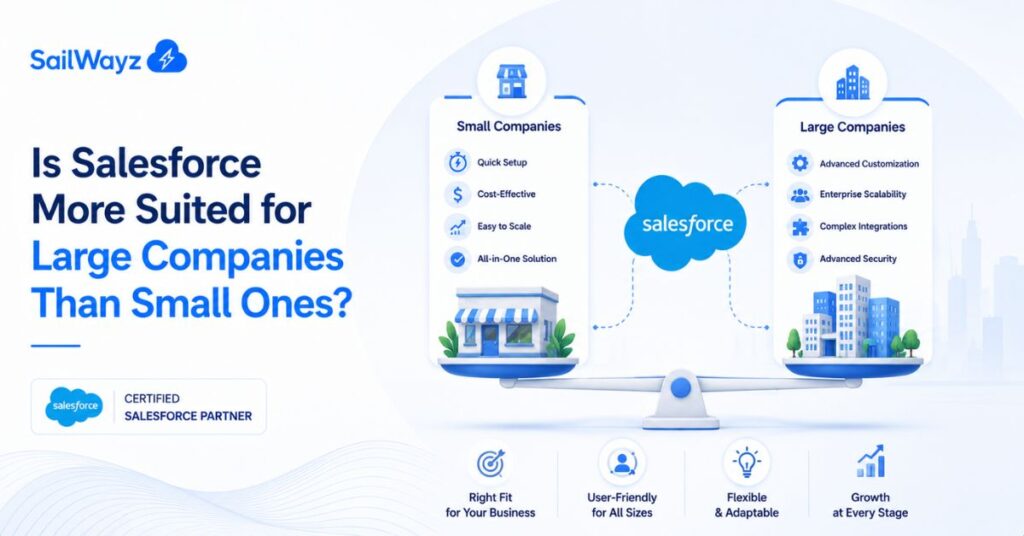 Is Salesforce More Suited for Large Companies Than Small Ones?

Joshua Eze is the Founder & Salesforce Architect at Sailwayz, a certified Salesforce Consulting Partner based in the UK. With over 6 years of experience leading CRM transformations, he is a certified Application & System Architect passionate about using technology to simplify business processes. Joshua helps companies unlock the full potential of Salesforce with strategic, scalable, and secure solutions.
