

If you’ve ever lost track of a lead because it sat in someone’s inbox for a week or watched two sales reps chase the same client without realising it, you’ve felt the gap that CRM solutions are built to close. This guide walks through what this kind of software actually does, the different types on the market, and how a business can pick and set one up without wasting months on the wrong system.
What Does CRM Actually Mean?
CRM stands for customer relationship management. Put simply, it’s a system that stores every contact, conversation, deal, and support ticket connected to your customers and prospects in one place, rather than scattered across inboxes, spreadsheets, and sticky notes.
The term covers the software built to run this process. Instead of a sales rep keeping client notes in a personal notebook or a support team working from a shared inbox with no history, everyone works from the same record. When a customer calls, whoever picks up can see the full history: past purchases, open tickets, and the last conversation they had with anyone on the team.
How Does a CRM Platform Work?
Most CRM platforms run on a similar structure, even though the interface and pricing vary a lot between providers:
- A central database holds every contact, company, and deal record
- Pipeline stages track where each deal sits, from first enquiry through to close
- Activity logs record calls, emails, meetings, and notes against each contact
- Automation rules send follow-up emails, assign tasks, or update a deal stage without manual input
- Reporting dashboards show pipeline value, conversion rates, and team performance at a glance
- Integrations connect the CRM to email, calendars, accounting software, and marketing tools
Most modern systems run in the cloud, so a team can access records from a laptop, phone, or tablet without a local server to maintain.
Types of CRM Software
Not every CRM does the same job. Broadly, they fall into three categories:
- Operational CRM – focused on day-to-day sales, marketing, and service tasks. This is the type most small and mid-size businesses start with, since it handles contact management, pipeline tracking, and automated follow-ups.
- Analytical CRM – built around reporting and data analysis. These systems dig into customer behaviour, buying patterns, and campaign performance to guide decisions rather than run daily tasks.
- Collaborative CRM – aimed at sharing customer information across departments, so sales, marketing, and support all work from the same record instead of separate systems.
Many platforms on the market today, including Salesforce, blend all three, offering day-to-day pipeline tools alongside reporting and cross-team visibility in one system.
Features to Look For in a CRM Platform
When comparing platforms, a handful of features tend to matter most:
- Contact and company records with a full history of communication
- Customisable pipelines that match your actual sales process, not a generic template
- Task and reminder automation so follow-ups don’t rely on memory
- Reporting and dashboards for tracking pipeline health and team output
- Mobile access for teams working outside the office
- Third-party connections with email, calendar, and accounting tools you already use
- User permissions to control who sees or edits sensitive customer data
- Scope to grow, so the system doesn’t need replacing after a year of adding staff or clients
Benefits of CRM Software for Businesses
A properly set-up CRM changes how a business runs day to day. Here’s what businesses typically gain:
- Fewer missed follow-ups, since every open task sits against a record rather than a personal to-do list
- A single view of each customer, so anyone on the team can pick up a conversation with the full history
- Better forecasting, because pipeline data shows what’s likely to close and when
- Less manual admin, with automation handling routine emails and task assignment
- Clearer reporting for management, replacing guesswork with actual pipeline and conversion figures
- Smoother handovers between sales and support, since both teams work from the same customer record
Popular CRM Platforms on the Market
The CRM market is broad, and the right pick depends heavily on the size and shape of your business. A few names come up often:
- Salesforce – widely used across sales, service, and marketing, with a large ecosystem of add-ons and a wide range of customisation options
- HubSpot – known for its free entry tier and strong marketing automation tools
- Zoho CRM – a lower-cost option that connects with other Zoho products
- Pipedrive – built around a simple, visual sales pipeline
- Microsoft Dynamics 365 – suited to businesses already running on Microsoft’s wider software stack
Salesforce tends to suit businesses that expect to grow, since it can be configured to match a specific sales process rather than forcing the business to work around a fixed template. This is where a consulting partner comes in. At Sailwayz, we work as dedicated Salesforce CRM consultants, helping businesses set up Salesforce around how they actually operate, rather than leaving them to work through the platform’s full range of options alone.
How to Choose the Right CRM Solution
Picking between CRM platforms comes down to a few practical steps:
- Map your current process first. Write down how a lead moves from first contact to close today, including every handover between teams.
- List your must-have features. Decide what’s non-negotiable (portal integrations, reporting, mobile access) before you start looking at platforms.
- Check your existing tech stack. A CRM that connects cleanly with your email, accounting software, or marketing tools saves a lot of manual work later.
- Think about growth, not just today. A system that fits five staff might not suit fifty, so weigh up how the pricing and features scale as the business grows.
- Get a demo with your own data in mind. Ask providers to show how the system handles a scenario close to your actual sales process, not just a generic walkthrough.
- Budget for setup, not just subscription cost. A CRM is rarely plug-and-play. Factor in time or a consultant’s help to configure it properly from day one.
Getting Started: How to Roll Out a New CRM
Once you’ve picked a platform, a typical rollout looks like this:
- Define your goals and workflow. Agree what success looks like and how the CRM should mirror your sales or service process.
- Migrate existing data. Move contacts, deals, and history across from spreadsheets or a previous system, cleaning up duplicates as you go.
- Configure pipelines and automation. Set up the stages, fields, and automated tasks that match your process rather than a default template.
- Roll out to a small group first. Test with a few users before opening it up to the whole team, so issues get caught early.
- Train the team properly. A CRM only works if people actually use it, so budget time for real training rather than a five-minute walkthrough.
- Review and adjust. Check in after a few weeks to fix anything that isn’t matching how the team actually works.
A firm like Sailwayz can handle this whole process for a Salesforce consultant build, from the first conversation about your goals through to data migration, configuration, and ongoing support once the system is live.
Final Thoughts
CRM solutions exist to solve a problem most growing businesses run into sooner or later: too much customer information spread across too many places, with no single record anyone can rely on. The right system brings that information together, automates the routine follow-ups, and gives management a clear view of what’s actually happening in the pipeline.
There’s no single best answer for every business. A five-person team and a fifty-person sales floor need different things from a CRM, and the right choice depends on your process, your budget, and how much you expect to grow. If Salesforce looks like the right fit but the setup feels like more than your team wants to take on alone, Sailwayz offers a free consultation to talk through what that build would actually look like.
FAQs
What is the difference between a CRM and CRM software?
“CRM” refers to the customer relationship management process itself. CRM software refers to the actual products businesses use to manage that process, such as Salesforce, HubSpot, or Zoho CRM.
Are CRM platforms only useful for sales teams?
No. While sales teams are often the main users, this kind of software also supports marketing (tracking campaigns and leads) and customer service (managing tickets and support history) within the same system.
How much does CRM software cost?
Pricing varies widely, from free entry tiers on platforms like HubSpot to £20 to £150 or more per user monthly for more advanced systems like Salesforce, depending on the features and level of customisation needed.
Can a small business benefit from a CRM platform?
Yes. Even a small team benefits from having contact history, follow-up reminders, and a shared record in one place, rather than relying on memory or a shared inbox that gets messy as the client list grows.
Do I need a consultant to set up a CRM solution?
Not always, but for platforms like Salesforce that offer deep customisation, a consultant can help avoid a setup that looks fine at first but causes problems once your process gets more complex. Sailwayz offers a free consultation to talk through what a build would involve for a particular business.
Recent Posts
-
Types of CRM Solutions: Which Type Does Your Business Need?
-
Pega vs Salesforce: Which CRM Is Better for Your Business?
-
What Are CRM Solutions? A Complete Guide for Businesses
-
The 20 Best CRM Software Options for Accounting Firms in 2026
-
The 20 Best CRM Software Options for Estate Agents in 2026
-
 Is Salesforce Easy to Set Up for a Small Business?
 -
 Where to Find Salesforce Consultants for Small Nonprofits Who Specialise in User Experience
 -
 How to Choose a Salesforce Integration Partner for Complex Manufacturing and Logistics Systems
 -
 What Types of Companies Use Salesforce Communications Cloud?
 -
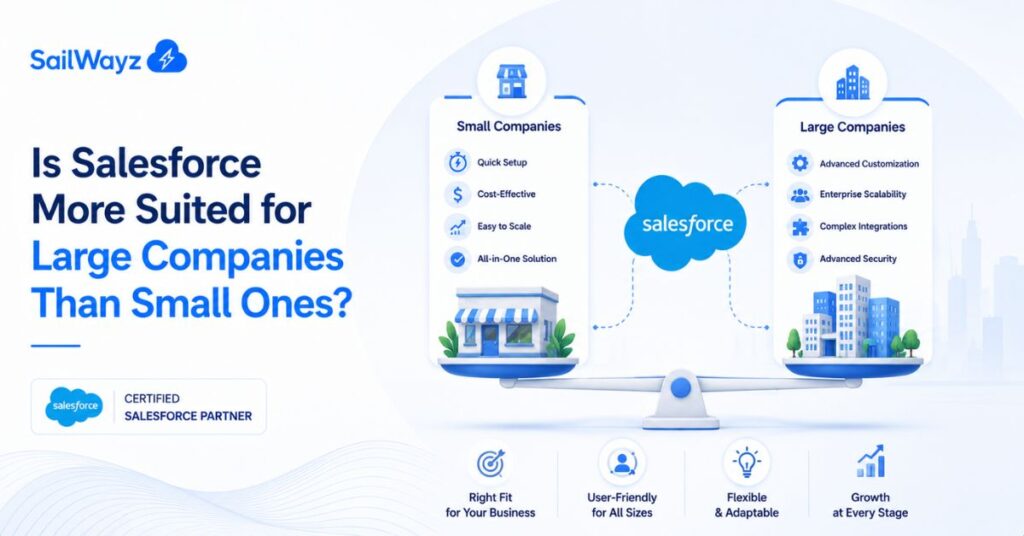 Is Salesforce More Suited for Large Companies Than Small Ones?

Joshua Eze is the Founder & Salesforce Architect at Sailwayz, a certified Salesforce Consulting Partner based in the UK. With over 6 years of experience leading CRM transformations, he is a certified Application & System Architect passionate about using technology to simplify business processes. Joshua helps companies unlock the full potential of Salesforce with strategic, scalable, and secure solutions.

3 responses