
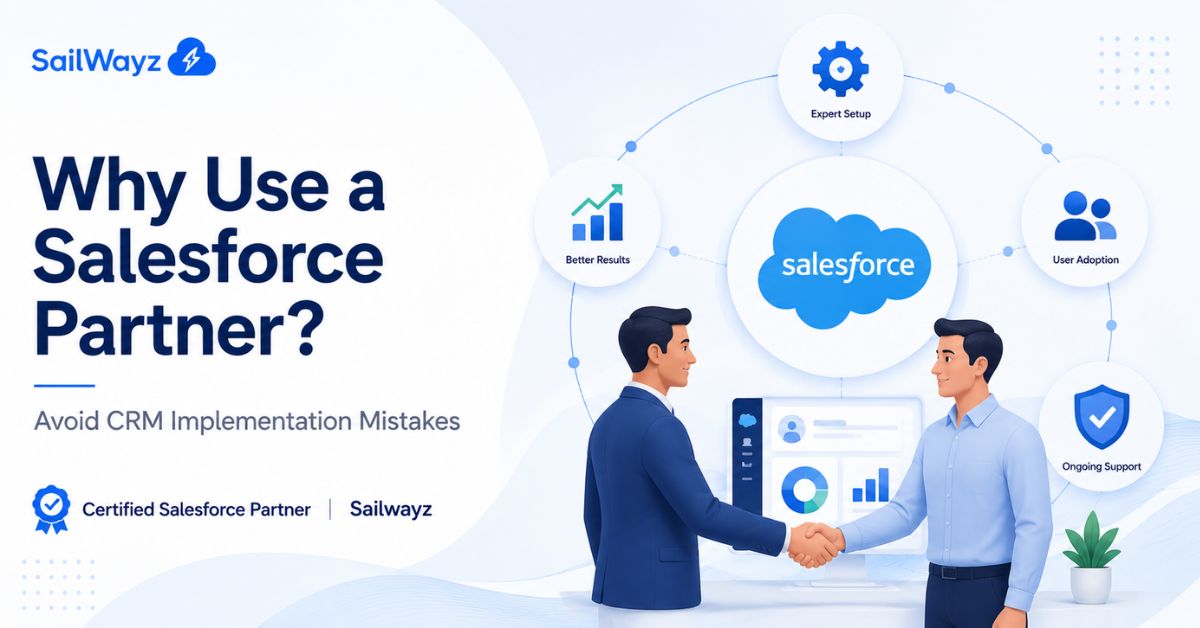
Salesforce is the world’s number one CRM platform. It is trusted by over 150,000 companies, from small businesses to global enterprises, and its product range covers sales, marketing, service, and analytics in one connected system.
So why do so many implementations fall short?
Research published in 2025 found that 55% of CRM projects fail to meet their planned objectives, with over 60% of those failures stemming from people and process problems rather than anything wrong with the technology itself. A separate study put Salesforce implementation failure rates even higher at around 70%, with the root causes consistently being the same: unclear goals, poor data preparation, low adoption from the team, and over-customization that makes the system hard to use.
The platform is not the problem. The way it gets set up usually is.
That is where a Salesforce partner changes everything. Here is a clear look at what a Salesforce partner actually does, why working with one produces better outcomes than going it alone, and what to look for when you choose one.
Let’s break it down. A Salesforce partner is a certified organization that has been evaluated and approved by Salesforce to deploy, customize, and manage the platform on behalf of other businesses. These companies are listed on the Salesforce AppExchange marketplace, which is the official directory where you can verify their credentials, review their customer satisfaction scores, and read verified client feedback.
Partners earn their status through a measurable scoring system called the Trailblazer Score. This measures performance across three areas: customer success (based on client satisfaction surveys and completed projects), innovation (measured by the number of certified consultants and architects on staff, as well as specialist distinctions earned), and engagement (the partner’s activity and contribution within the broader Salesforce ecosystem).
Partners are ranked in tiers. The two main tiers as of 2026 are Select and Summit. Select partners demonstrate validated delivery consistency and structured competency. Summit represents the highest recognition level, reserved for partners who show the strongest track records across all three scoring categories.
When you hire a registered Salesforce partner, you are not just hiring a team that knows the software. You are hiring a team that Salesforce itself has verified as capable of delivering good results for clients.
Before getting into what a Salesforce partner brings to the table, it is worth being honest about what usually happens without one.
Most teams that attempt a self-managed Salesforce setup do not fail because they lack intelligence or effort. They fail because Salesforce is genuinely complex, and early configuration decisions have long consequences. A poorly structured data model, fields set up in the wrong way, or automation built without a clear understanding of your process will work badly for months before anyone realizes the system needs a rebuild.
The problems that surface are predictable. Duplicate and incomplete records cause reporting to mislead rather than inform. Users find the system does not match how they actually work, so they stop using it and go back to spreadsheets. Sales managers cannot trust the pipeline data because it was never captured consistently. The CRM that was supposed to give everyone visibility into the business ends up sitting half-empty.
DIY implementations often fail at the same three points: discovery (not mapping business processes properly before building), data (migrating records without cleaning them first), and adoption (building a system that does not fit real workflows). While implementing Salesforce without external help can appear cheaper at the start, partner-led setups consistently reduce risk, speed up the time to seeing real value, and hold up better as the business grows.
The cost of getting it wrong is not just the wasted license fees. It is the rebuild cost, the lost time, and the credibility hit when the team concludes that the CRM does not work, when what actually failed was the setup.
Here is where a Salesforce partner earns their place.
A good Salesforce partner starts with your business, not the software. They document how your sales process actually works, not how it was designed to work on a flowchart, but how deals really move from first contact to closed. They map your customer service workflow. They look at where your data currently lives, what quality it is in, and what needs to happen before it goes into Salesforce.
This discovery phase feels slow when you are eager to get started. It is also the single most important thing that separates implementations that succeed from those that do not. Without a clear, detailed map of your processes, you end up building a system that solves the wrong problems.
Once the discovery is done, a Salesforce partner configures the platform around how your business works rather than how the default template assumes it does. That means your sales stages reflect your actual sales process. Your service queue routes cases the way your team handles them. Your dashboards show the numbers your managers actually make decisions from.
This sounds straightforward. In practice, getting it right requires someone who has done it many times across different businesses and knows where the decisions that look trivial now become expensive problems later.
Moving from a previous CRM, a collection of spreadsheets, or a mix of both is where a lot of DIY setups come unstuck. Data migration requires cleaning records before they go in, mapping fields correctly between systems, and verifying the results after the move. Skip any of those steps, and you end up with a Salesforce org full of duplicates, blanks, and mismatched information.
A Salesforce partner has done this migration work enough times to know where the traps are and how to avoid them. The result is a system that starts with clean, trustworthy data rather than one that spends its first six months being corrected.
Over 60% of CRM implementation failures come down to people’s resistance to change, inadequate training, and lack of commitment from leadership. Not technology.
A Salesforce partner does not just build the system and hand it over. They train your team in a way that connects the platform to their daily work. When a sales rep understands that Salesforce will save them time on admin, remind them which deals need attention, and make their weekly pipeline review take minutes instead of an hour, they use it. When they are handed a new system with a two-hour demo and told to get on with it, they do not.
Salesforce is not a set-it-and-forget-it system. Your business will change: new products, new teams, new processes, and new reporting requirements. The platform needs to change with it.
A Salesforce partner provides ongoing support that keeps your system current and accurate. They can spot when your configuration is drifting out of alignment with how the team is actually working and fix it before it becomes a bigger problem. They monitor the three automatic Salesforce releases each year and advise on which new features are worth turning on for your setup.
This kind of continuous attention is what separates a Salesforce environment that stays useful from one that gradually becomes outdated and ignored.
It is worth distinguishing between a registered Salesforce partner and an individual Salesforce freelancer or contractor, because businesses sometimes treat them as equivalent. They are not.
A freelancer may be a skilled Salesforce administrator or developer. What they typically cannot offer is a full-team capability: a consultant to map your business processes, a developer to build custom functionality, a project manager to keep the timeline on track, and a support function available when things go wrong after go-live.
A registered Salesforce partner brings all of these capabilities under one roof. Their credentials are verified by Salesforce. Their client satisfaction scores are published on AppExchange. Their certifications are tracked and kept current. When you work with a registered partner, you have visibility into their track record before you sign anything.
Next steps once you have decided to work with a partner: focus your search on a few things that genuinely predict a good outcome.
Relevant industry experience. A partner who has worked with businesses like yours will configure Salesforce around your specific context rather than a generic template. Ask for examples of work in your sector.
Verified certifications. Certified Salesforce consultants have passed Salesforce’s own examinations in specific product areas. The more certifications a partner’s team holds, the deeper their technical knowledge. At Sailwayz, our team holds over 50 combined Salesforce certifications across a range of cloud products.
Published customer satisfaction scores. AppExchange publishes CSAT scores and verified client reviews for registered partners. A partner who consistently achieves high scores has a track record you can verify independently.
A clear process for discovery. Before a good partner proposes a solution, they ask a lot of questions about your business. If a partner jumps straight to telling you what you need without understanding how you work, that is a warning sign.
Post-go-live support. Ask specifically what happens after the system is live. An ongoing support arrangement means your Salesforce environment stays current, and you have someone to call when questions come up rather than being left to manage a complex platform without help.
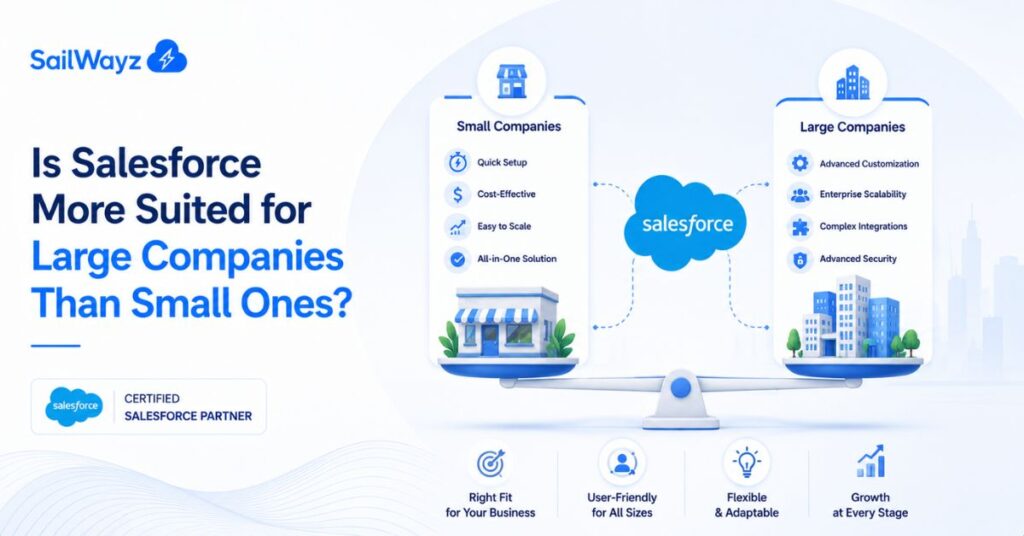
Larger enterprises typically have internal Salesforce administrators and developers on their payroll. They can absorb the cost of a poor initial setup because they have the resources to fix it over time.
Growing businesses do not have that buffer. A failed CRM setup at a 20-person company costs more proportionally in wasted time, frustrated staff, and missed sales than the same failure at a 2,000-person one. Getting it right the first time is not optional when your margins are tight, and your team’s capacity is stretched.
That is the context in which Sailwayz works. Our clients are businesses that want Salesforce to deliver real results from day one, not companies with IT departments large enough to absorb mistakes. We configure the platform around how your business actually works, migrate your data cleanly, train your team properly, and stay involved after go-live so the system keeps pace with where your business is going.
A Salesforce partner brings a combination of technical knowledge, process experience, and project discipline that most internal teams do not have when they are setting up Salesforce for the first time. They map your business processes before building anything, configure the system to match your real workflows, migrate your data cleanly, train your team in a way that drives adoption, and provide support after the system is live. The biggest value is avoiding the mistakes that are easy to make and expensive to fix later.
Registered Salesforce partners are listed on the AppExchange marketplace, where you can check their tier status, number of certified consultants, completed projects, and verified customer satisfaction scores. Salesforce evaluates and approves partners directly, so AppExchange is a reliable place to verify credentials before you commit to working with anyone.
Yes, in most cases. The cost of a failed or poorly configured Salesforce setup, including the time spent trying to fix it, the lost productivity, and the eventual cost of a rebuild, typically exceeds the cost of a proper partner-led setup from the start. A partner who configures the system correctly from the beginning means your team adopts it quickly, your data stays clean, and the platform delivers the results you paid for.
It depends on the complexity of your business and how much customization is needed. A straightforward setup for a small team can be completed in a few weeks. A more involved project involving data migration from another system, custom automation, and integration with other tools typically runs between one and three months. A good partner will give you a realistic timeline after the discovery phase, once they understand the full scope of what is needed.
Ask about their experience with businesses in your industry, how many certified consultants they have on their team, what their process looks like from initial discovery through to go-live, how they handle data migration, what their support arrangement looks like after the project ends, and whether they can share verified references or AppExchange reviews. A partner who answers these questions confidently and in detail knows what they are doing.

Joshua Eze is the Founder & Salesforce Architect at Sailwayz, a certified Salesforce Consulting Partner based in the UK. With over 6 years of experience leading CRM transformations, he is a certified Application & System Architect passionate about using technology to simplify business processes. Joshua helps companies unlock the full potential of Salesforce with strategic, scalable, and secure solutions.
