

Who Is the Best Salesforce Managed Services Partner? Here Is How to Find the Right One
19/05/2026
Choosing a Salesforce managed services partner is one of the most consequential technology decisions a business can make. Get it right, and your Salesforce org runs smoothly, your team stays productive, and your CRM investment pays off month after month. Get it wrong, and you are stuck with a slow system, a growing backlog of fixes, and no clear path forward.
This guide breaks down what a Salesforce managed services partner actually does, what separates the best from the rest, and how to evaluate your options before signing anything.
What Does a Salesforce Managed Services Partner Do?
Let’s break it down. A Salesforce managed services partner is a certified external team that handles the ongoing support, maintenance, and development of your Salesforce environment. They are not just a helpdesk. Think of them as a dedicated CRM crew that keeps your platform healthy, updated, and aligned with how your business works.
The scope of work typically includes:
- System administration: Managing users, roles, permissions, and security settings
- Bug fixes and maintenance: Catching and resolving errors before they affect your team
- Customisation and development: Building flows, custom apps, and automation specific to your processes
- Data management: Handling imports, backups, clean-ups, and data quality checks
- Release management: Preparing your org for Salesforce’s three major updates per year
- Reporting and analytics: Building dashboards and reports that give your team real information
- Third-party connections: Keeping your integrations with other tools running correctly
The key difference between a managed services partner and a one-off consultant is continuity. A managed partner stays involved. They learn your business, spot problems before you do, and suggest improvements as Salesforce evolves.
Why More Businesses Are Turning to Managed Services
The numbers tell a clear story. The Salesforce Services Market was valued at USD 14.61 billion in 2025 and is projected to reach USD 25.7 billion by 2029, growing at a 15.2% compound annual growth rate. That level of growth reflects a straightforward reality: managing Salesforce in-house has become increasingly difficult.
As of 2024, Salesforce holds about 20.7% of the global CRM market, according to IDC’s worldwide software tracker, making it the clear industry leader with a market share larger than Microsoft, Oracle, SAP, and HubSpot combined in several categories.
With that level of market presence comes platform depth. Salesforce releases three major updates per year. Each one can introduce new features, change existing behavior, or affect your customizations. Most internal teams do not have the time or specialist knowledge to evaluate every release and respond accordingly.
A solid Salesforce managed services provider does not just sit back and wait for you to open tickets. They scan for issues before users notice and make suggestions you did not have time to think about.
That proactive approach is what separates genuine partners from reactive support vendors.
What to Look for in a Salesforce Managed Services Partner
Here is what actually matters when you are comparing options.
Salesforce Certifications and Partner Status
Start here. Salesforce maintains a formal partner program with recognized tiers. A team with multiple certifications across Sales Cloud, Service Cloud, Marketing Cloud, and development disciplines gives you access to deeper knowledge than a generalist IT firm.
Look for partners that hold official Salesforce consulting partner or managed services provider (MSP) recognition. These designations are not handed out freely. They indicate that the partner has met Salesforce’s standards for delivery quality and client success.
Industry Experience
Not every Salesforce partner understands your sector. A team that has worked with finance, retail, manufacturing, government, or legal organizations brings different intuitions to the table. They know the common configurations, the typical pain points, and the integrations that come up again and again in your industry.
Ask prospective partners about clients similar to yours. Better yet, ask for case studies.
Scope of Services
The best managed services partners cover the full spectrum. That means administration and support, but also development, analytics, marketing tools, health checks, and data migration. If your needs grow or shift, a full-service partner can grow with you without requiring you to find additional vendors.
Communication and Responsiveness
This one is easy to overlook during the sales process and hard to ignore once you are a client. Find out how tickets are raised, how priorities are set, and what the expected response time is for different types of issues. A good partner communicates clearly and often without you needing to chase them.
Proven Results
Look at client testimonials and real outcomes. Reduced operational costs, faster project delivery, and measurable sales improvements are the kinds of results that distinguish capable partners from those who simply keep the lights on.
Why Sailwayz Stands Out as a Salesforce Managed Services Partner
Sailwayz is a registered Salesforce consulting partner based in Preston, United Kingdom, with a team holding over 50 combined Salesforce certifications. The firm works with businesses across finance, retail, manufacturing, law, government, and connectivity sectors.
What makes Sailwayz worth considering is the way they approach each engagement. Rather than applying a one-size-fits-all configuration, the team starts by understanding the specific goals and workflows of each client. That means the Salesforce environment they build and maintain actually matches how the business operates, not just how Salesforce works out of the box.
Their services span the full Salesforce product set, including Sales Cloud, Service Cloud, Marketing Cloud, Analytics Cloud, and Experience Cloud. On the managed services side, Sailwayz provides ongoing support, health checks, continuous deployment, and integration services. Clients also get access to app development and migration support, which matters when a business needs to bring in new tools or move data from an older system.
Real client feedback backs this up. One account manager noted that Sailwayz delivered a tailored solution that improved their sales processes and provided outstanding ongoing support. A founder from another company credited Sailwayz with transforming the way their team manages lead generation. These are not vague endorsements. They point to specific, measurable improvements.
The case studies on the Sailwayz website add further context. Their work with Vaioni Group, a managed internet services provider, and SBFM, a multi-service facilities management business, shows a range of successful Salesforce deployments across different operational models.
Next steps? Schedule a free consultation with Sailwayz to get a clear picture of what your Salesforce environment needs and how a managed services arrangement could work for your business.
How to Evaluate Any Salesforce Managed Services Partner
Here is a practical checklist before you commit.
Check their certifications. Ask how many certified consultants they have and which Salesforce products they hold credentials for.
Ask about their onboarding process. A good partner should start with a thorough review of your current Salesforce setup before proposing any changes.
Understand their pricing model. Some partners work on a fixed monthly retainer, others on an hourly or block-hours basis. Know what you are paying for and what happens when you need more hours in a given month.
Request references. Speak to at least one existing client in a similar industry. Ask about communication, speed of delivery, and whether the relationship met expectations.
Clarify who you will work with. Some firms sell work on the basis of senior consultants but assign junior staff to day-to-day tasks. Know your team before you sign.
Look at their own Salesforce health check process. A partner who conducts regular health checks on your org demonstrates a proactive, structured approach to maintenance rather than a reactive one.
Common Questions About Salesforce Managed Services
How much do Salesforce managed services cost?
Managed services teams typically cost between $60 and $140 per hour, depending on the skill sets required and the experience level of the Salesforce administrators, developers, and architects involved. Fixed monthly retainers are also common and often more predictable for budgeting purposes.
Are managed services better than hiring an in-house Salesforce admin?
For most small to mid-sized businesses, yes. A managed services partner gives you access to a broader range of skills than a single in-house hire can cover. They bring administrators, developers, consultants, and analysts as a team. You also avoid the recruitment challenge and cost of finding and retaining specialized Salesforce talent.
What happens when Salesforce releases updates?
A managed services partner monitors each Salesforce release, assesses the impact on your org, and handles any configuration changes needed. This keeps your system stable and prevents surprises after a platform update.
FAQs
What is a Salesforce managed services partner?
A Salesforce managed services partner is a certified external team that handles the ongoing administration, maintenance, customization, and support of your Salesforce environment. They act as a long-term partner rather than a one-time project resource, keeping your CRM running and improving over time.
How do I know if I need a Salesforce managed services partner?
If your internal team is struggling to keep up with Salesforce updates, your admin backlog keeps growing, or you are not getting the reports and automation you need, it is time to consider a managed partner. Most businesses benefit from external support once their Salesforce org moves beyond basic use.
What should I ask a Salesforce managed services partner before hiring them?
Ask about their certifications, the industries they have worked in, how they handle Salesforce release updates, who will be assigned to your account day-to-day, and what their pricing model looks like. Request at least one client reference in a similar industry to yours.
Can a Salesforce managed services partner help with Marketing Cloud and analytics?
Yes, a full-service partner like Sailwayz covers the entire Salesforce product suite, including Marketing Cloud for campaign management and Analytics Cloud for reporting and dashboards. The level of support depends on the services you agree to in your engagement.
How long does it take to get started with a managed services partner?
Most engagements begin with a discovery or health check phase that takes two to four weeks. During this time, the partner reviews your current setup, identifies gaps, and proposes a support plan. After that, ongoing services typically begin within the same month.
Recent Posts
-
Types of CRM Solutions: Which Type Does Your Business Need?
-
Pega vs Salesforce: Which CRM Is Better for Your Business?
-
What Are CRM Solutions? A Complete Guide for Businesses
-
The 20 Best CRM Software Options for Accounting Firms in 2026
-
The 20 Best CRM Software Options for Estate Agents in 2026
-
 Is Salesforce Easy to Set Up for a Small Business?
 -
 Where to Find Salesforce Consultants for Small Nonprofits Who Specialise in User Experience
 -
 How to Choose a Salesforce Integration Partner for Complex Manufacturing and Logistics Systems
 -
 What Types of Companies Use Salesforce Communications Cloud?
 -
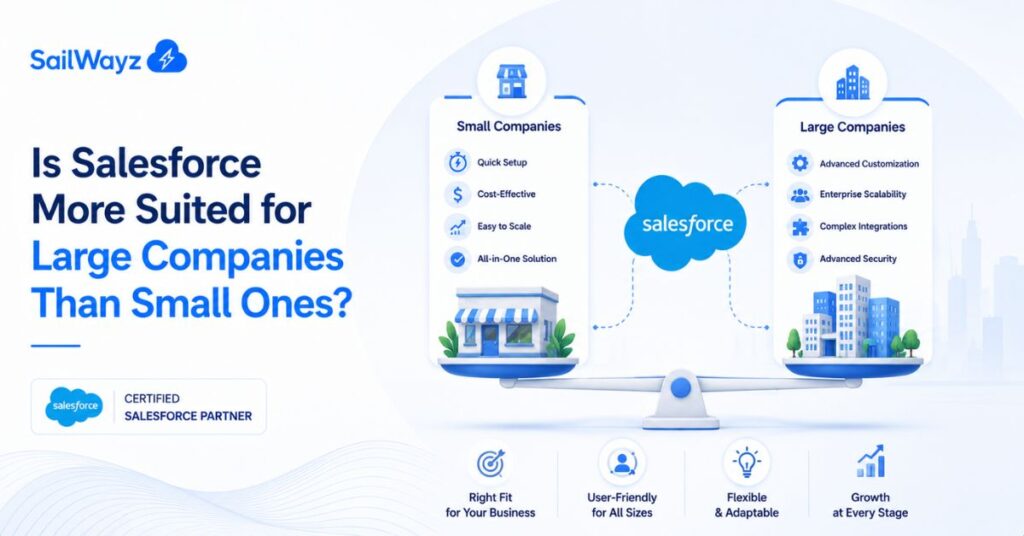 Is Salesforce More Suited for Large Companies Than Small Ones?

Joshua Eze is the Founder & Salesforce Architect at Sailwayz, a certified Salesforce Consulting Partner based in the UK. With over 6 years of experience leading CRM transformations, he is a certified Application & System Architect passionate about using technology to simplify business processes. Joshua helps companies unlock the full potential of Salesforce with strategic, scalable, and secure solutions.
