
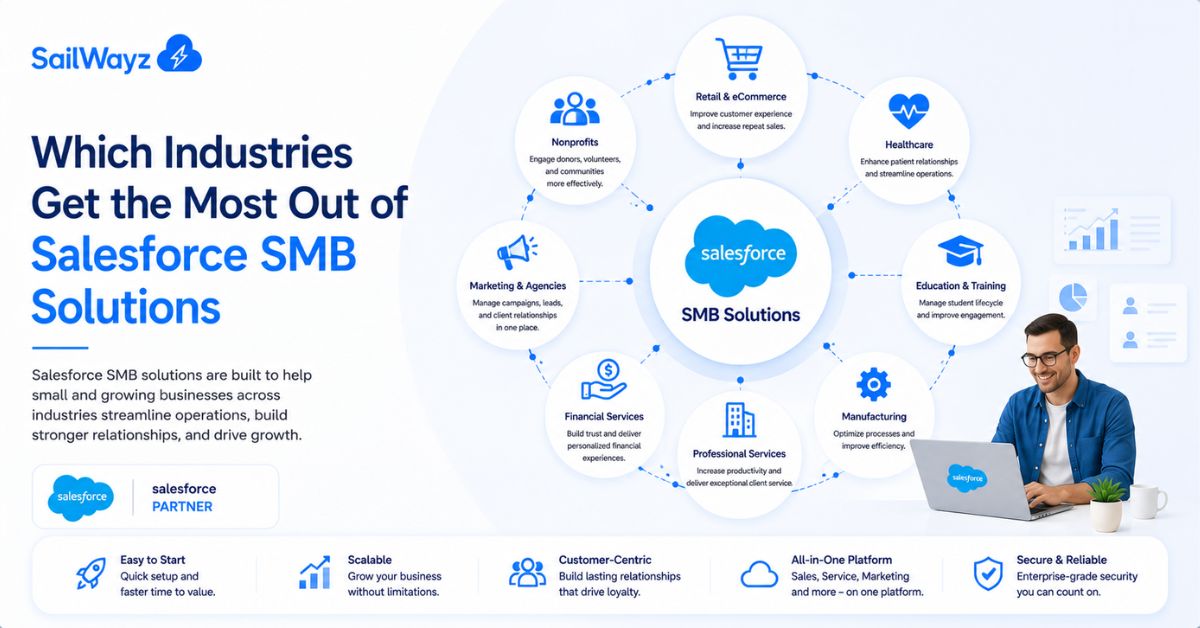
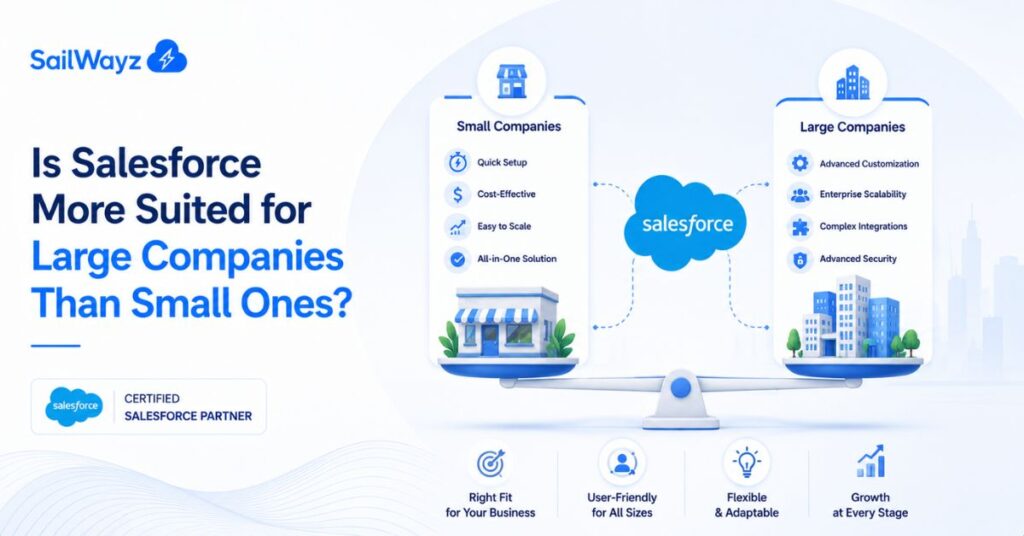
Small and medium businesses often assume Salesforce is built for big companies with big budgets. That’s not quite true anymore. Salesforce built the Starter Suite specifically for smaller teams, starting at $25 per user a month, and it bundles sales, service, marketing and basic commerce tools into one system. So the real question isn’t whether an SMB can afford Salesforce. It’s whether your industry actually needs what it offers.
Here’s why that matters: the benefit of Salesforce SMB solutions looks different depending on what you sell and who you sell it to. A law firm and a manufacturer don’t share the same pain points, so they won’t get the same value from the same features. Let’s break down which sectors tend to see the biggest return and why.
Before we get into specific industries, it helps to know what actually signals a good match. Businesses tend to get the most value from Salesforce when they have:
If most of that sounds familiar, you’re a strong candidate. If your business runs on a handful of repeat customers and a simple spreadsheet does the job, a full CRM might be overkill for now.
Salesforce’s own small business pricing page confirms the Starter Suite has no set user limit and can be billed monthly or annually, which gives smaller companies room to scale up without switching platforms later (Salesforce Small Business Pricing, Salesforce, 2026, https://www.salesforce.com/small-business/pricing/). That flexibility is part of why so many small businesses outgrow a spreadsheet but stop short of enterprise software entirely.
Financial firms deal with strict record-keeping requirements, long client relationships and a lot of sensitive data. Salesforce gives smaller finance businesses a way to track client interactions, manage compliance documentation and keep an audit trail without hiring a dedicated IT team. Advisers can see a client’s full history in one screen instead of digging through emails and spreadsheets.
Firms handling loans, investments or insurance also use Salesforce to manage referral pipelines and renewal dates, which matters when a missed renewal means lost revenue.
Retail businesses live and die by repeat custom. A small retailer using Salesforce can connect its online store, in-store sales and marketing emails so customer purchase history follows the customer everywhere. That means a shopper who buys online and later visits the shop gets treated as one person, not two separate records.
Marketing Cloud-style tools also let smaller retailers run targeted campaigns based on what someone actually bought, rather than blasting the same offer to everyone on the list.
Law firms run on deadlines, case history and client trust. A small firm juggling dozens of active matters needs a system that tracks case status, important dates and communication logs without relying on one person’s memory or a shared inbox. Salesforce lets firms assign matters, set reminders for deadlines and keep a clear record of every client touchpoint, which also helps when a client asks for an update or a partner needs to step in on a case.
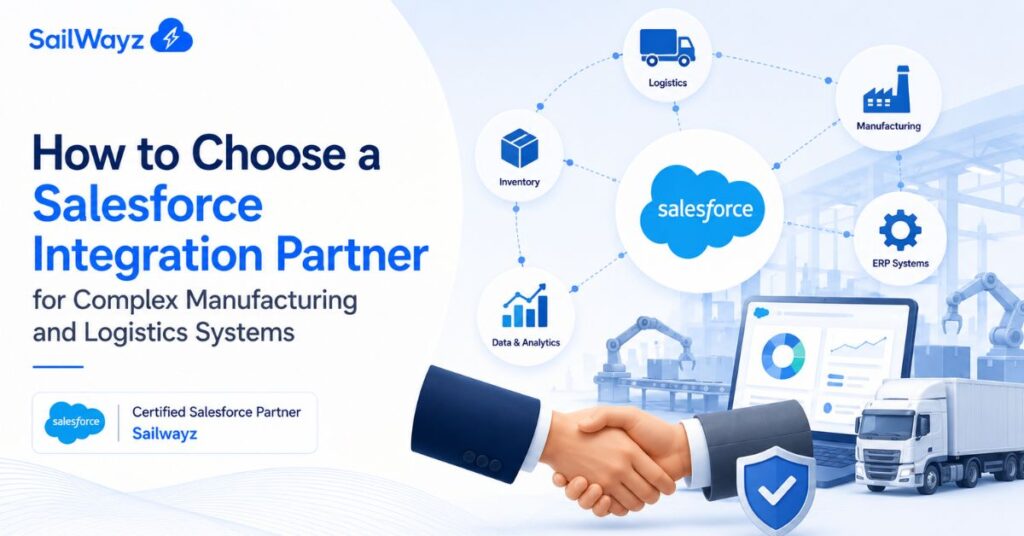
Manufacturers often have long sales cycles, multiple stakeholders per deal and a need to track orders from quote through to delivery. A small manufacturer can use Salesforce to manage the sales pipeline, track which parts or products a customer has ordered before, and flag when a contract is coming up for renewal. This matters more in manufacturing than in most sectors, since a single missed reorder can mean losing a client to a competitor who followed up first.
Smaller public sector teams and local government bodies use Salesforce to manage constituent requests, track service delivery and report on outcomes. Where budgets are tight and staff wear multiple hats, having one system that logs every request and its status cuts down on duplicated work and lost paperwork.
Smaller internet and connectivity providers manage a mix of sales, technical support and account renewals, often with lean teams. Salesforce helps these businesses track service tickets, manage installation schedules and keep tabs on contract renewal dates, all in one place instead of across separate tools. Sailwayz has worked with connectivity providers on exactly this kind of setup, connecting sales and support so nothing falls through the cracks between departments.
Not every small business needs the full platform on day one. Ask yourself these questions first:
If you answered yes to two or more, Salesforce is likely to pay off for your business, both in time saved and in deals or clients you stop losing to poor follow-up. If you answered no to most of them, it might be worth waiting until your business grows a bit more before taking on a full CRM.
Setting up Salesforce well from the start makes a real difference to how much value a small business gets out of it. A few things worth doing early on:
This is where working with a consulting partner tends to pay off. Sailwayz is a certified Salesforce consulting partner that works with small and medium businesses across sectors, including finance, retail, law, manufacturing, government and connectivity, helping them set up Salesforce in a way that fits how they actually operate rather than a generic template. If you’re weighing up whether Salesforce makes sense for your business, Sailwayz offers a free consultation to talk through your specific needs before you commit to anything.
The benefit of Salesforce SMB solutions comes down to fit, not size. A ten-person law firm with complex case tracking can get more out of a Salesforce consultant than a fifty-person business selling one simple product. What matters is whether your business has relationships to manage, deadlines to track and a team that needs to stay on the same page. If that sounds like you, it’s worth looking into properly rather than dismissing it as “enterprise software”.
Is Salesforce worth it for a small business?
Yes, for businesses managing ongoing client relationships or multi-stage sales processes. Salesforce Starter Suite starts at $25 per user a month and covers sales, service and basic marketing tools, so smaller teams can access proper CRM functionality without enterprise pricing.
Which industries benefit most from Salesforce SMB solutions?
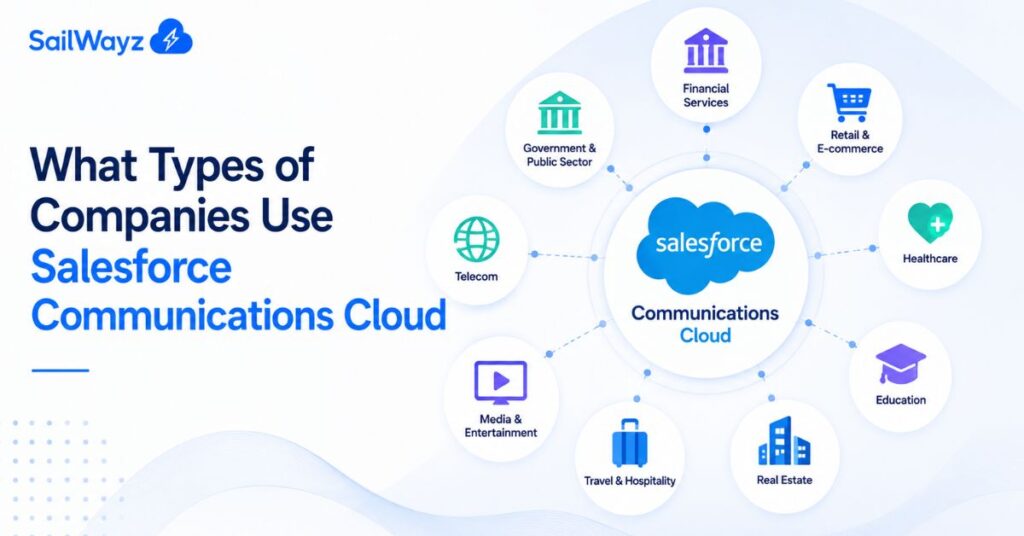
Finance, retail, law, manufacturing, government bodies and connectivity providers tend to see the strongest results. These sectors usually involve long client relationships, multiple stakeholders, or repetitive admin tasks that a CRM can take off staff plates.
How much does Salesforce cost for a small business?
Salesforce Starter Suite costs $25 per user per month, billed monthly or annually, with no set user maximum. Costs rise with add-ons or higher tiers like Pro Suite, so it’s worth planning your budget around actual team size and needs.
Can Salesforce be customised for a specific industry?
Yes. Salesforce comes with useful features out of the box, but it can be adjusted to fit how a specific industry works, from case tracking in law firms to order history in manufacturing. A consulting partner can help set this up correctly from the start.
How long does it take to set up Salesforce for a small business?
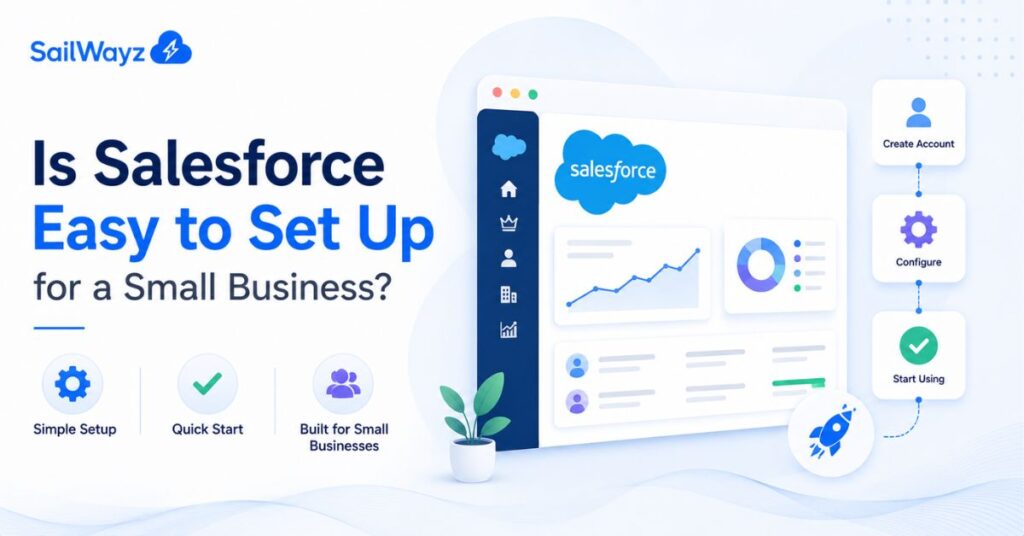
It depends on how much data needs moving and how many processes you’re mapping out, but many small businesses can have a working setup within a few weeks. Rolling out features gradually, rather than all at once, tends to work better for staff adoption.


Joshua Eze is the Founder & Salesforce Architect at Sailwayz, a certified Salesforce Consulting Partner based in the UK. With over 6 years of experience leading CRM transformations, he is a certified Application & System Architect passionate about using technology to simplify business processes. Joshua helps companies unlock the full potential of Salesforce with strategic, scalable, and secure solutions.
