
Freelance platforms feel like the fast option. Post a job, get a dozen replies within the hour, and pick someone with good reviews. But if you’ve tried it for something as specific as Salesforce work or CRM, you already know the catch. Reviews don’t tell you if someone actually understands Apex governor limits or how to avoid breaking your validation rules. When it goes wrong, you’re the one left fixing a half-built org.
Here’s why that matters: Salesforce development isn’t generic coding work. It needs someone who understands the platform’s quirks, not just someone who can write code. Let’s look at where to hire Salesforce developers without relying on an open freelance marketplace and what to check before you commit to anyone.
Freelance platforms aren’t inherently bad, but they carry a few specific risks for Salesforce projects:
None of this means freelancers can’t do good work. It just means the platform itself doesn’t do much to protect you from a bad hire on a system as important to your business as Salesforce.
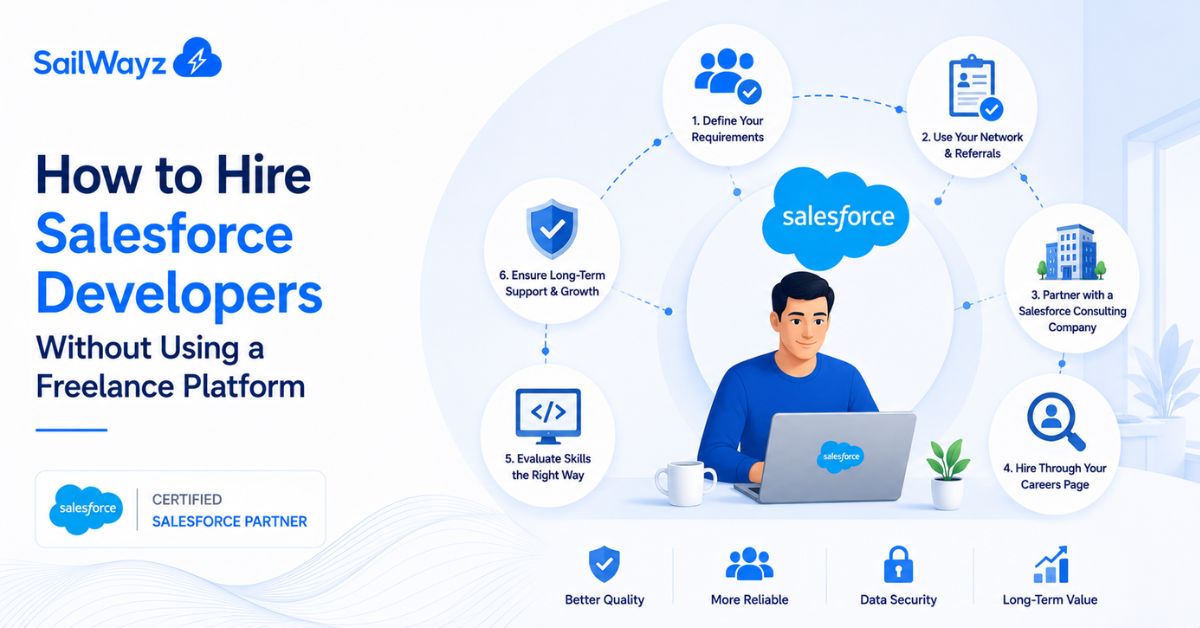
Salesforce runs an official Partner Locator through AppExchange, letting you search for consulting partners by industry, region and Salesforce Cloud expertise. This is a genuinely useful starting point because every listed partner has gone through Salesforce’s own vetting process, rather than a general freelance platform’s sign-up form.
Salesforce also maintains a Trailblazer Community with a dedicated hiring section, along with a Trailblazer Workforce Partner Directory built specifically to connect businesses with Salesforce talent. People active in this community tend to have visible Trailhead badges and certifications you can check directly, which gives you far more to go on than a star rating.
Rather than hiring one developer directly, many businesses work with a consulting partner that provides developers as part of a team, backed by project management and quality checks. This route suits businesses that need ongoing support, not just a single feature built and forgotten. It also removes the guesswork of vetting technical skills yourself, since the partner has already done that work internally.
Asking other businesses in your sector who they used for their Salesforce build is still one of the most reliable methods. A referral comes with an honest account of what the working relationship was actually like, including the parts a portfolio won’t show you.
Some staffing agencies focus specifically on Salesforce roles rather than general IT contracting. These tend to pre-screen for Salesforce certifications and relevant project history before putting anyone forward, which cuts down the time you’d otherwise spend filtering candidates yourself.
Whichever route you choose, a few checks apply regardless of where the developer comes from:
A developer who can’t answer these clearly is a risk, no matter how good their portfolio looks.
Cost is often the reason businesses default to freelance platforms in the first place, so it’s worth a straight comparison. A freelance platform hire can look cheaper on the surface, but the hidden cost usually shows up later, in rework, missed deadlines, or a developer who disappears mid-project. Consulting partners and staffing agencies tend to charge more per hour, but that rate typically includes vetting, project oversight, and some accountability if something goes wrong. Referrals and Salesforce’s own Partner Locator sit somewhere in between, since pricing depends entirely on who you find and how their business is structured. The cheapest option upfront isn’t always the cheapest option once you account for the time spent fixing avoidable mistakes.
Sailwayz offers Salesforce developers on an on-demand, part-time, full-time or project basis, so businesses can bring in the right level of support without committing to a permanent hire straight away. Every developer is pre-vetted for their technical skills across Apex, Lightning Components, LWC, Visualforce and Salesforce integrations before being matched to a project, and the work is backed by a project management structure rather than left to a single freelancer working alone. This suits businesses that want the flexibility of contract-based hiring without the uncertainty of an open freelance platform.
You don’t need a freelance platform to bring in Salesforce consultant developers who actually know the platform. Salesforce’s own Partner Locator and Trailblazer Community give you a way to check credentials directly, referrals give you honest feedback from people who’ve already been through the process, and consulting partners like Sailwayz offer a structured way to bring in developers without managing every technical check yourself. The right route depends on how much ongoing support you need, but skipping the generic freelance marketplace usually means fewer surprises down the line.
Where can I hire Salesforce developers without a freelance platform?
Options include Salesforce’s official Partner Locator on AppExchange, the Trailblazer Community’s hiring section, Salesforce consulting partners, referrals from other businesses, and staffing agencies that specialise specifically in Salesforce roles.
How do I check if a Salesforce developer’s certifications are real?
Ask for their certification details and verify them through Salesforce’s own credential verification tools. Genuine certifications are tied to a Trailblazer profile, so a developer should be able to share this without hesitation.
Is it better to hire a Salesforce developer directly or through a consulting partner?
It depends on your needs. Direct hires suit a single, well-defined task. A consulting partner suits ongoing work, since they provide vetted developers backed by project management and support after launch.
What Salesforce skills should I look for when hiring a developer?
Look for experience in Apex, Lightning Web Components, Visualforce and API integrations, depending on your project. Ask for examples of similar past work rather than relying on certifications alone.
How much does it cost to hire a Salesforce developer?
Cost varies by engagement type and experience level, ranging from hourly contract rates to full-time salaries. Project-based work is often priced against the scope and complexity of what’s being built.

Joshua Eze is the Founder & Salesforce Architect at Sailwayz, a certified Salesforce Consulting Partner based in the UK. With over 6 years of experience leading CRM transformations, he is a certified Application & System Architect passionate about using technology to simplify business processes. Joshua helps companies unlock the full potential of Salesforce with strategic, scalable, and secure solutions.
