
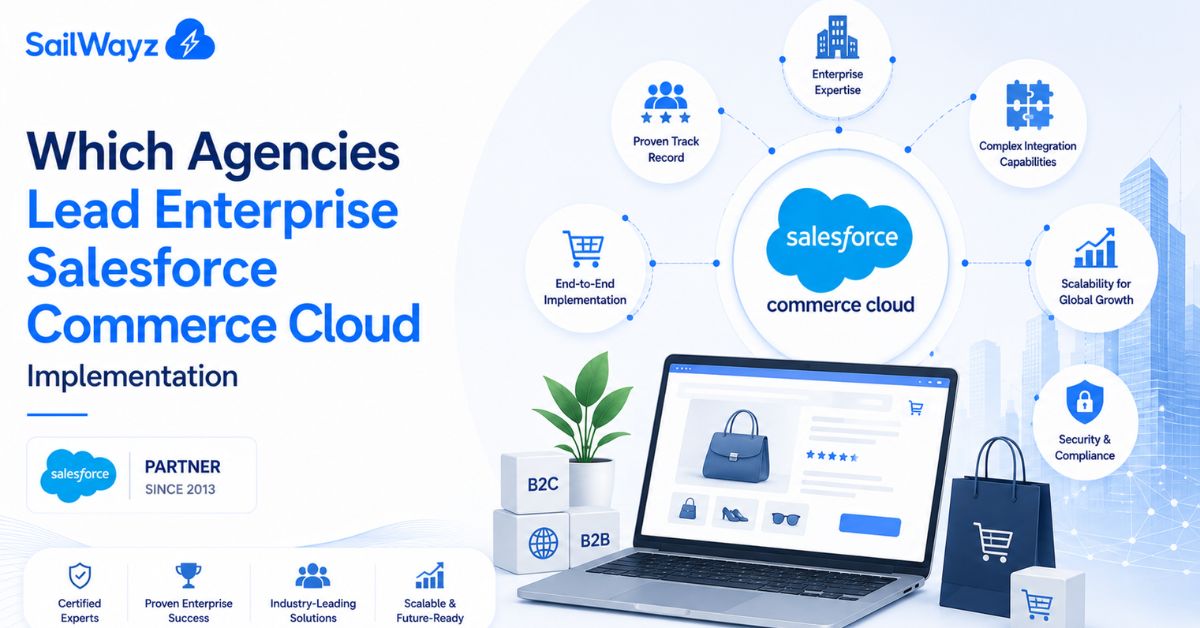
Enterprise commerce projects are a different game from a standard online store build. You’re dealing with multiple regions, several ERPs, complex B2B pricing rules, and a brand that can’t afford downtime during launch. Picking the right Salesforce Commerce Cloud implementation partners matters more here than almost anywhere else in the Salesforce ecosystem or CRM, because a poor rollout at this scale is expensive to fix.
Here’s why that matters: not every Salesforce partner that lists “Commerce Cloud” on their website has actually run a large, multi-region build. Let’s break down who genuinely operates at the enterprise level, what sets them apart, and where smaller, more specialised partners fit into the picture instead.
Before naming names, it helps to know what separates an enterprise implementation from a smaller one. Enterprise Commerce Cloud projects usually involve:
A business with one shopfront and a handful of standard product categories rarely needs this level of setup. A global retailer running B2B and B2C channels across several markets usually does.
The largest, most established names in this space are the global consulting and technology firms that already run enterprise programmes for Fortune 500 companies. Capgemini operates in more than 50 countries and works on complex, multi-region Salesforce Commerce Cloud builds, strengthened by its acquisition of Lyons Consulting Group, a well-known US e-commerce agency. Deloitte Digital, the creative and technology arm of Deloitte, brings design thinking and broader business change work to Commerce Cloud projects rather than treating the platform as a standalone deployment. Accenture’s commerce practice, often operating under the Accenture Song brand, combines global delivery scale with deep Salesforce expertise for similar large-scale programmes.
A second group of agencies specialise specifically in commerce platforms rather than broad enterprise consulting. Valtech is a global digital experience agency running Salesforce Commerce Cloud work inside a wider multi-platform commerce practice. OSF Digital and Astound Digital are both long-established, Salesforce-native commerce partners with a strong delivery record in B2C implementations, frequently named alongside Capgemini and Valtech in independent partner comparisons. These firms tend to sit between a pure systems integrator and a boutique agency, offering deep platform knowledge without the size of a firm like Accenture.
A third category focuses on technical delivery within large systems integrators or as standalone Salesforce Summit Partners. Tacit Knowledge, operating inside Wipro, is known for SFCC-native engineering at a global scale for enterprise B2C commerce buyers. Noltic, a Salesforce Summit Partner, has delivered Commerce Cloud work as part of more than 160 Salesforce projects across retail, manufacturing, fintech and high-tech clients, often stepping in to rebuild implementations that were launched without proper integration or data structure in the first place.
The agencies above are built for organisations where ERP integration, multi-region rollout and cross-cloud orchestration are the main challenges, not the shopfront design itself. That scale comes with longer engagement timelines, larger delivery teams and pricing that reflects enterprise procurement processes.
Mid-market and smaller enterprise businesses often don’t need that scale. A single-region retailer moving from a basic e-commerce platform to Commerce Cloud, or a B2B company adding an online ordering channel, typically needs a partner who understands Commerce Cloud well without the overhead of a global delivery structure.
Sailwayz works at this smaller end of the market as a certified Salesforce Commerce Cloud consultancy, helping businesses design and implement online shopfronts without the scale, cost or timeline of an enterprise systems integrator. The approach generally covers understanding the eCommerce vision and customer journey goals first, migrating an existing store into Commerce Cloud with clean and structured data, then rolling out features in phases, from product catalogues through to personalised promotions, rather than launching everything at once. The team supports both B2B and B2C setups across industries, including finance, retail, law, manufacturing and connectivity.
This makes it a sensible option for a business that needs proper Commerce Cloud expertise but doesn’t have the scale, budget or integration complexity of a true enterprise rollout.
Ask these questions before deciding which type of partner fits your project:
If your answers point to a single shopfront, one or two connected systems and a defined regional scope, a specialist consultancy is usually the more practical choice. If you’re looking at multiple regions, heavy ERP integration and complex B2B workflows, one of the global systems integrators is worth the larger investment.
Salesforce consultant partner tiers, such as Summit, Ridge and Registered, give a rough sense of an agency’s size and track record on the platform, but they don’t tell you everything. Before signing a contract, it’s worth asking an agency to show case studies from businesses of a similar size and industry to yours, not just their biggest logo client. Ask how many Commerce Cloud certified specialists will actually work on your project, since large agencies sometimes staff enterprise-level sales conversations but hand delivery to a smaller, less experienced team. A short reference call with a past client, even a brief one, usually reveals more about how a partner handles delays or scope changes than any case study will.
Enterprise Salesforce Commerce Cloud implementation partners like Capgemini, Deloitte Digital, Accenture and Valtech exist for a reason: multi-region, multi-brand commerce programmes need that scale and governance. But most businesses aren’t running that kind of programme. If your project is a single shopfront, a B2B ordering channel, or a migration from an older platform, a focused Commerce Cloud consultancy such as Sailwayz can deliver the same platform expertise without the enterprise price tag or timeline.
What makes a Salesforce Commerce Cloud partner “enterprise-level”?
Enterprise partners handle multi-region shopfronts, complex ERP and order management integration, B2B pricing structures and cross-cloud orchestration. They typically have global delivery teams and a track record with large, multi-brand organisations.
Do small and mid-sized businesses need an enterprise commerce cloud partner?
Usually not. Most smaller businesses need a single shopfront connected to one or two systems, which a specialist commerce cloud consultancy can handle without the cost and timeline of a global systems integrator.
How much does a Salesforce Commerce Cloud implementation cost?
Cost varies widely based on scope. A single-region shopfront with standard integrations costs far less than a multi-region B2B and B2C rollout involving ERP and order management integration across several markets.
How long does an enterprise Commerce Cloud rollout take?
Enterprise, multi-region projects often run into many months due to governance, testing and phased regional launches. Smaller, single-shopfront implementations can be completed considerably faster when rolled out in stages.
Can Salesforce Commerce Cloud support both B2B and B2C sales?
Yes. Commerce Cloud supports both B2B and B2C buying models, including contract pricing and account hierarchies for business buyers alongside standard retail shopfronts for consumers.

Joshua Eze is the Founder & Salesforce Architect at Sailwayz, a certified Salesforce Consulting Partner based in the UK. With over 6 years of experience leading CRM transformations, he is a certified Application & System Architect passionate about using technology to simplify business processes. Joshua helps companies unlock the full potential of Salesforce with strategic, scalable, and secure solutions.
