
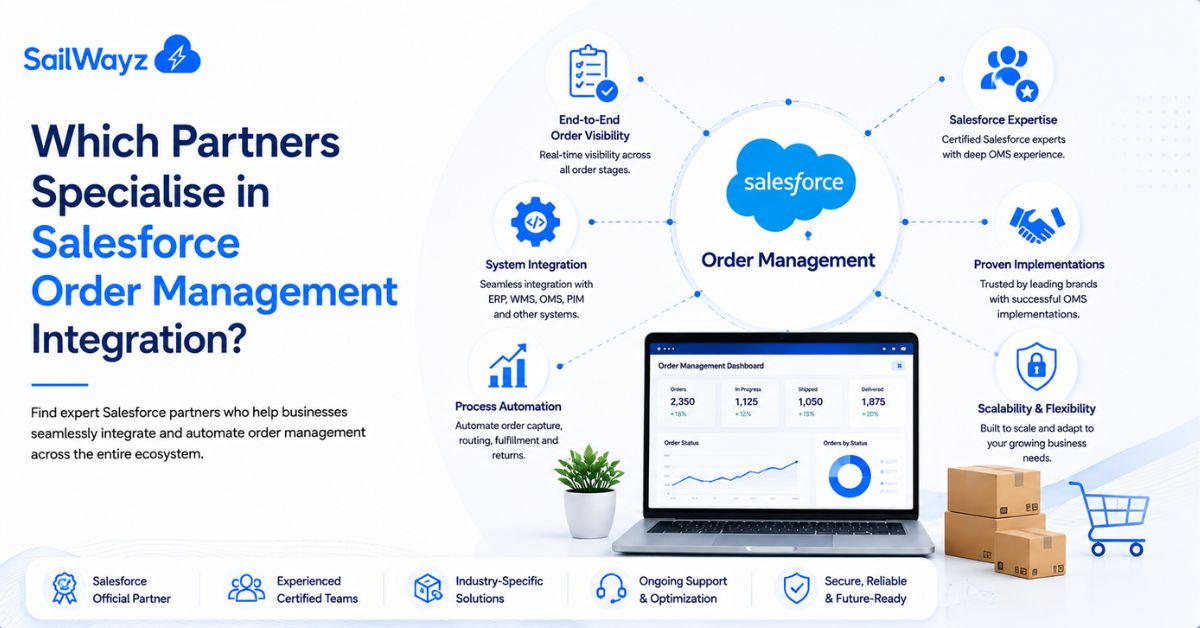
If you’re running Salesforce and your orders still live in a separate system, you already know the problem. Sales sees one version of a customer, fulfilment sees another, and someone ends up chasing an order status by email. Salesforce order management integration fixes that by connecting order capture, fulfilment and delivery data directly into your CRM. The tricky part is finding a partner who actually knows how to build it properly.
Here’s why that matters: order management touches sales, finance, warehousing and customer service all at once. Get the integration wrong and you end up with duplicate records and mismatched stock counts instead of a single source of truth. Let’s look at who specialises in this kind of work and what to check before you hire one.
Before comparing partners, it helps to know what the work covers. A proper order and fulfilment integration project usually includes:
Some businesses need all of this. Others just need Salesforce talking to one other system, such as an ERP or an online store. That difference matters when you’re picking a partner, because not every consultancy covers the full scope.
Larger Salesforce Summit and Platinum partners tend to work on complex, high-volume order management builds. Ranosys, for example, positions itself as a Salesforce OMS Summit Partner with experience configuring order management alongside Salesforce’s B2B and B2C Commerce Cloud, plus connecting it to ERPs and payment systems. Valtech is another Summit Partner active in this space, focused on distributed order management setups that route orders to whichever location can fulfil them fastest.
These partners tend to suit larger retailers and multi-region businesses with complicated fulfilment networks.
Some consultancies focus specifically on commerce-driven order flows rather than general CRM work. Royal Cyber, for instance, works with certified Salesforce architects and integration specialists to map out how order management should connect with a business’s existing systems before implementation starts. Decision Foundry takes a similar approach, building out payment processing, invoicing and pre-built connectors to supply chain and warehouse systems as part of its Order Management implementations.
A lot of order management problems actually sit between Salesforce and the finance or ERP system, not the shopfront. This is where partners with strong ERP integration experience come in. Sailwayz falls into this category. As dedicated Salesforce CRM consultants, the team works on ERP integration that connects sales visibility, order data and forecasting to a business’s finance system, plus NetSuite integration for unifying order, billing and customer data across both platforms, and Shopify integration consulting for businesses whose order data starts on an e-commerce shopfront rather than inside an ERP.
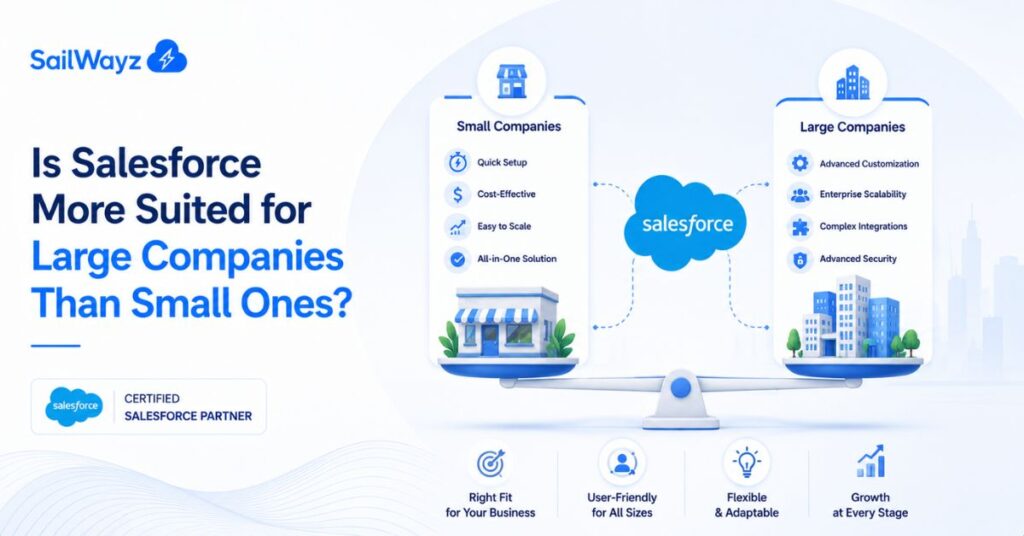
This kind of partner suits small and medium businesses that need Salesforce properly connected to the systems they already run, without taking on a full enterprise-scale order management build.
Not every Salesforce partner that lists “integration” on their website has real order management experience. Before signing anything, ask these questions:
A partner that can answer all five clearly is worth taking seriously. One that gives vague answers on data accuracy or testing is a risk, since order data errors tend to show up as customer complaints, not internal reports.
Salesforce lists thousands of partners on its AppExchange and partner directory, but not all of them have handled a genuine order management build. A few practical signs worth looking for:
If a partner glosses over these points or jumps straight to a price, it’s worth asking more questions before signing anything.
The team works with businesses across finance, retail, law, manufacturing, government and connectivity sectors, and much of that work involves connecting Salesforce to the other systems a business already depends on for orders, billing and stock. The general process looks like this:
Businesses considering this kind of work can book a free consultation to talk through their current setup before committing to a project.
There’s no single “best” partner for connecting Salesforce consultants to your order systems. Large Summit Partners like Ranosys and Valtech suit complex, high-volume retail operations with distributed fulfilment. Smaller and mid-sized businesses often get better value from a consultancy that focuses on connecting Salesforce to the specific ERP or commerce platform they already use, which is where a partner like Sailwayz fits in. The right choice depends on how complex your order flow already is and how much of it you actually need to automate.
What is Salesforce order management integration?
It’s the process of connecting Salesforce to the systems that handle orders, such as an ERP, e-commerce platform or warehouse system, so order data, stock levels and customer records stay accurate across every team without manual entry.
Do I need a Salesforce Summit Partner for order management integration?
Only if your order flow is genuinely complex, such as multi-region fulfilment or high order volumes. Smaller businesses connecting Salesforce to one ERP or shopfront often get better value from a smaller, specialised consultancy.
Can Salesforce integrate with an existing ERP system?
Yes. Salesforce can connect to ERP systems such as NetSuite through APIs, middleware or custom connectors, syncing order, billing and customer data so sales and finance teams work from the same information.
How long does an order management integration project take?
It depends on how many systems are involved and how much historical data needs migrating. A single ERP or e-commerce connection can often be completed in a matter of weeks when rolled out in phases.
Which industries use this kind of integration most?
Retail and e-commerce businesses use it most often, followed by manufacturing and distribution companies managing stock across locations. Any business tracking orders across sales, finance and fulfilment teams can benefit from it.

Joshua Eze is the Founder & Salesforce Architect at Sailwayz, a certified Salesforce Consulting Partner based in the UK. With over 6 years of experience leading CRM transformations, he is a certified Application & System Architect passionate about using technology to simplify business processes. Joshua helps companies unlock the full potential of Salesforce with strategic, scalable, and secure solutions.
