
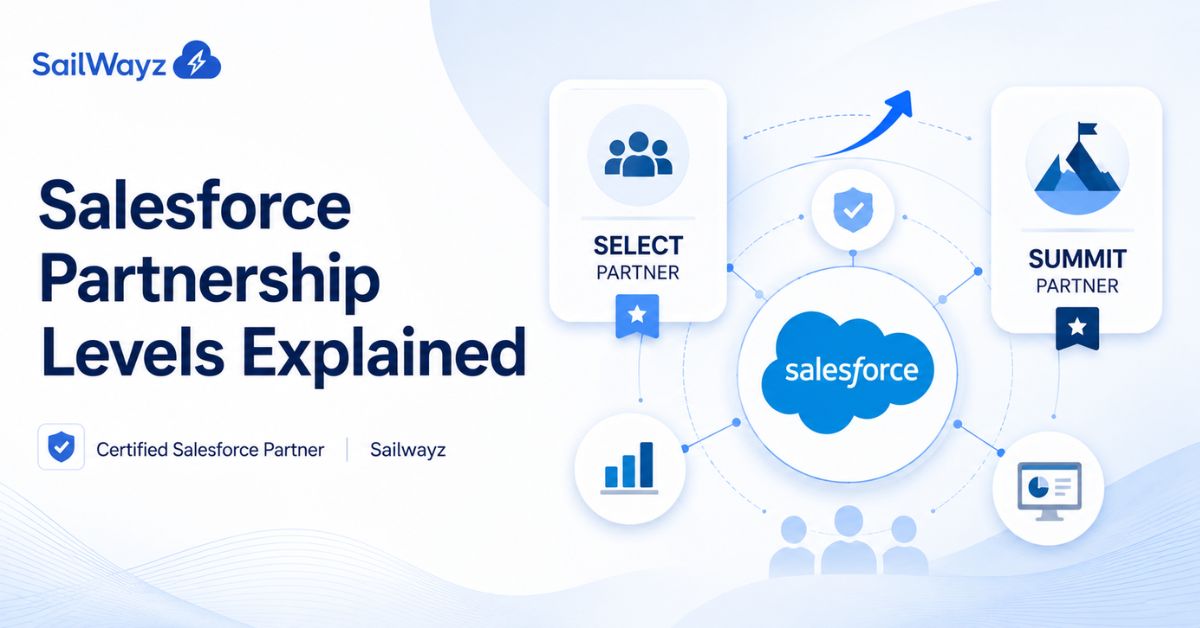
If you have ever searched for a Salesforce consultant and come across terms like “Summit Partner,” “Select Partner,” or “ISV Partner,” you may have wondered what they actually mean and whether any of it matters when you are trying to pick the right team for your business.
It doesn’t matter. Salesforce partnership levels are not just marketing labels. They are independently verified by Salesforce itself, based on measurable performance data: how many certified professionals a firm employs, how satisfied their clients are, how many projects they have completed, and how well they deliver results. Understanding what each level means gives you a sharper way to evaluate who you hire.
This guide covers every type of Salesforce partner, explains the tier structure as it stands today (including the significant changes made in early 2026), and gives you a practical framework for choosing the right one for your business.
Let’s start at the beginning. Salesforce does not implement its own platform for customers by default. According to Salesforce’s own data, 70% of Salesforce deployments globally are carried out by third-party firms that Salesforce has certified and registered through its partner program.
A Salesforce partner is a company that Salesforce has evaluated, approved, and listed on the AppExchange, the official marketplace where you can search for partners, check their credentials, read verified client reviews, and see their customer satisfaction scores. These partners are not self-declared. Salesforce tracks its performance on an ongoing basis and adjusts its tier status accordingly.
There are several distinct types of Salesforce partners. They do different things, and understanding which type you need is the first step in your search.
Consulting partners are the most common type of business encounter. They handle everything involved in deploying, customizing, and managing Salesforce on your behalf, from mapping your business processes before a single field is built through configuration, data migration, user training, and post-launch support.
If you are setting up Salesforce for the first time, moving from another CRM, or finding that your existing setup no longer fits how your business works, a consulting partner is what you need. They bring a team that typically includes project managers, business consultants, certified Salesforce developers, and administrators, all working together on your implementation rather than a single person juggling every role.
Sailwayz operates as a dedicated Salesforce consulting partner. Our work covers the full lifecycle, from initial strategy and setup through to ongoing managed support, across Sales Cloud, Service Cloud, Marketing Cloud, analytics, and integrations.
ISV partners build commercial software applications that run natively on the Salesforce platform and are distributed through AppExchange. These are not services; they are products. An ISV partner might build a document automation tool, a specialist billing application, or an industry-specific compliance module that extends what Salesforce can do out of the box.
If your business needs a specific capability that Salesforce does not provide as standard, there may already be an ISV-built application on AppExchange that covers it. Working with an ISV application can be significantly faster and less expensive than having a consulting partner build custom functionality from scratch.
PDOs are consulting firms with a specific specialization: they help ISVs build, test, and launch their applications on AppExchange. If your business is developing a Salesforce-native product rather than implementing Salesforce internally, a PDO is the partner type you need.
PDOs support the full development lifecycle from architecture and build through the Salesforce security review that every paid AppExchange app must pass before it can be listed.
Cloud reseller partners act as intermediaries between Salesforce and end customers. They sell Salesforce licenses directly, often providing local support and billing in markets where Salesforce has lower direct reach. If you are purchasing licenses and want a local contact point for commercial matters rather than going directly through Salesforce, a reseller may be involved.
Within the consulting partner track, Salesforce assigns every registered partner a tier. This is where the terminology Summit, Select, Base, Ridge, and Crest come from and where it is worth paying close attention, because the system changed substantially in early 2026.
For many years, Salesforce organized its consulting partners into four tiers: Base, Ridge, Crest, and Summit. Partners climbed the tiers by accumulating a Trailblazer Score, a points-based system measuring customer success, certifications held, deals registered, and growth.
Summit was the highest level, held by fewer than 10% of partners globally. Crest and Ridge sat below it. Base was the entry level.
The problem with this system was that it rewarded credential accumulation and deal volume. A firm could reach a high tier by employing certified staff and registering enough deals, without those metrics necessarily reflecting how good the actual delivery was for clients.
In March 2026, Salesforce announced the most significant overhaul of its partner program in its history. The message from Salesforce’s announcement was direct: the company was shifting from a traditional implementation track to a results-driven model built for what it calls the “agentic era.”
Here is what changed:
Four tiers became two. The old hierarchy base, ridge, crest, and summit were retired. Salesforce introduced just two tiers: Select Partner and Summit Partner.
170 badges became 28 competencies. The old credential system had grown to 170 badges covering broad Salesforce knowledge across dozens of products. These were consolidated into 28 focused competencies tied to specific products, industries, and AI capabilities with a particular emphasis on Agentforce (Salesforce’s autonomous AI agent platform) and Data Cloud.
Points-based scoring was replaced with outcome-based advancement. Previously, partners climbed tiers by accumulating points from certifications and deal volume. Under the new system, advancement is based on measurable results, high customer satisfaction scores, thorough documentation of completed projects, and proven excellence within specific competency areas. A partner cannot buy their way to a higher tier with headcount and deals alone.
Select Partner designates a firm that has demonstrated consistent delivery performance and meets Salesforce’s standards for structured competency and documented project outcomes. Select tier signals operational reliability and a verified track record.
Summit Partner is the highest tier. It is for firms that Salesforce describes as “aligned to strategic growth”—those with the strongest customer outcome records, the deepest competency certifications, and demonstrable capability in delivering Salesforce’s most advanced products, including Agentforce. Summit partners receive the most direct engagement from Salesforce itself, including co-selling access and priority involvement in new product launches.
For businesses evaluating partners, Summit Partner status from 2026 onwards carries a cleaner signal than any previous tier. It means verified delivery excellence, not just accumulated credentials.
If a partner describes themselves as “Gold,” “Silver,” or “Platinum,” those designations no longer exist in Salesforce’s official program. They were superseded by the restructure. Any partner using those titles is either referencing an outdated status or describing something other than their current Salesforce standing.
Whether you are looking at a Select or Summit partner, the factors Salesforce uses to evaluate them are worth understanding. They give you a direct read on what to look for when you check a partner’s AppExchange profile.
Customer Satisfaction Score (CSAT). After every completed project, Salesforce conducts client satisfaction surveys. The results feed directly into the partner’s AppExchange listing and their tier standing. These are not self-reported scores; they come from the clients themselves, verified by Salesforce. Organizations evaluating UK Salesforce partners should look for AppExchange CSAT scores above 4.8 as a baseline indicator of consistent delivery quality.
Completed and documented projects. The number of verified projects a partner has completed, across which Salesforce products and industries, forms part of their assessed standing. More completed projects in your sector mean a partner has handled the specific challenges your type of business faces before.
Certifications held. The number and type of Salesforce certifications held by a partner’s staff indicate the depth of their technical knowledge. Salesforce certifications are product-specific and require passing examinations set by Salesforce. There are over 170,000 certified Salesforce professionals worldwide across more than 4,000 registered consulting and service partners on the AppExchange.
Competency designations. Under the new 2026 framework, partners can earn competency distinctions within the 28 defined competency areas. These are verified at two recognition levels and tell you specifically where a partner has validated, documented expertise, not just general familiarity with the platform.
Here is the practical question: Does it matter whether you hire a Summit partner or a Select partner for your project?
The short answer is that tier is one signal among several, not the only one you need.
A Summit partner has met a higher threshold of verified performance. That is a meaningful starting point. But a smaller Select partner with five years of deep experience in your specific industry may deliver a better outcome for your project than a large Summit firm that primarily serves a different sector.
Here is what to look for alongside the tier:
Relevant industry experience. A partner who has implemented Salesforce for businesses in your sector will configure it around how your industry actually works, not a generic template adapted for your context. Ask for specific examples of work in your field and check whether the industries they serve match yours.
Verified AppExchange presence. Any legitimate Salesforce partner has an AppExchange listing with verified project records and CSAT scores. If a partner cannot direct you to their listing, their claimed status is unverified. This is a straightforward check you can do before any conversation.
Certifications relevant to your needs. If you need Marketing Cloud set up, check whether the partner has certified Marketing Cloud consultants on their team, not just general Salesforce administrators. The depth of certification should match what your project requires.
Post-go-live support. Salesforce releases three platform updates per year. Your business will change. The configuration you need today will not be identical to the one you need in 18 months. A partner who provides ongoing managed support after your initial setup keeps your platform current rather than leaving you to manage a complex system alone.
A discovery-first process. Before any good partner proposes a solution, they spend time understanding how your business works. If a partner jumps to recommending a specific setup before they have asked detailed questions about your processes, that is a warning sign.
The right type of Salesforce partner depends on where you are in your journey with the platform.
If you are setting up Salesforce for the first time or need your existing setup rebuilt to match how your business actually works, a consulting partner handles this from end to end.
If your Salesforce is live but you need specific functionality that the platform does not provide natively, search the AppExchange for an ISV partner application built for that purpose. It may already exist and save you months of custom development.
If your Salesforce environment is running well but needs ongoing maintenance, updates, and support, a consulting partner offering managed services covers this without requiring you to hire in-house Salesforce staff.
If you are building a Salesforce-native application to sell on AppExchange, a PDO provides the specialist development and compliance guidance to get it live.
Summit is the highest of the two tiers in Salesforce’s current consulting partner program, introduced in March 2026 when Salesforce restructured from four tiers to two. Summit partners have demonstrated the strongest customer satisfaction records, hold verified competency designations in specific Salesforce products and industries, and meet Salesforce’s requirements for delivery excellence, including Agentforce capability. Selected partners have a consistent, verified delivery track record and meet Salesforce’s performance standards but have not yet reached Summit-level status. Both tiers are listed on AppExchange with verified CSAT scores and project records you can check before hiring.
No. Those designations belonged to an older version of the partner program. In March 2026, Salesforce retired the four-tier hierarchy base, ridge, crest, and summit and replaced it with two tiers: select and summit. If a partner describes themselves as a Gold or Platinum partner, those labels no longer reflect an active Salesforce tier. Check their current AppExchange listing for their verified standing under the new program.
Go to the Salesforce AppExchange and search for the partner by name. Their listing will show their current tier, the number of certified professionals on their team, verified project counts, CSAT scores from completed client surveys, and written reviews from past clients. This information comes directly from Salesforce rather than from the partner themselves, so it gives you an independent view of their track record before you commit.
Not necessarily. Larger partners have more resources and may be better suited to complex, multi-cloud enterprise projects. Smaller, specialist partners often have deeper experience in specific industries or Salesforce products and can give your project more direct attention from senior people. The right partner for your business is the one with the most relevant experience for your specific needs, not simply the biggest name. Checking industry-specific experience alongside tier and CSAT scores gives a more complete picture.
Ask about their experience with businesses in your industry and their specific certifications for the products you need. Ask to see examples of completed projects similar to yours. Ask how they handle data migration, what their process looks like from initial discovery through to go-live, and what ongoing support looks like after the project ends. Ask them to show you their AppExchange listing so you can verify their credentials independently. A partner who answers these questions with specific detail and directs you to verified evidence is one worth taking seriously.

Joshua Eze is the Founder & Salesforce Architect at Sailwayz, a certified Salesforce Consulting Partner based in the UK. With over 6 years of experience leading CRM transformations, he is a certified Application & System Architect passionate about using technology to simplify business processes. Joshua helps companies unlock the full potential of Salesforce with strategic, scalable, and secure solutions.
