
Running a small or medium-sized business means making every tool count. You do not have the budget headroom of a large enterprise, and you cannot afford to carry software that does not pull its weight. That is why choosing the right CRM matters more at the SMB level than at any other.
Salesforce has spent the past few years building a product line specifically for smaller businesses, and the uptake tells a clear story. According to a Salesforce survey of 3,350 SMB leaders globally, 91% of small and medium businesses using AI through Salesforce say it boosts their revenue, and 75% of SMBs are either experimenting with or actively using AI tools on the platform.
But the benefit of Salesforce SMB solutions is not uniform across every type of business. Some sectors get dramatically more out of it than others. Here is a clear look at which industries gain the most and why.
Before getting into sectors, let’s break it down briefly. Salesforce offers a tiered product range designed for businesses that are not yet at enterprise scale.
The Starter Suite, priced at $25 per user per month, gives small teams a single application covering marketing, sales, service, and commerce. It includes pre-built dashboards, guided setup, email marketing tools, sales lead tracking, and customer service case management. It is built to get up and running quickly without specialist technical knowledge.
Pro Suite builds on this for businesses that have grown past the basics. It adds workflow automation through Flow, forecasting tools, quoting and direct payment links, omnichannel routing, in-app and web chat, custom objects, sandbox access for testing, and the AppExchange marketplace for third-party applications.
The 2025 updates to both tiers added tighter Slack connections, letting teams update deals, log interactions, and receive automated alerts directly from their Slack workspace without switching between tools.
The result is a clear growth path: start small, add capability as your business gets more complex, and avoid paying for enterprise features before you need them.
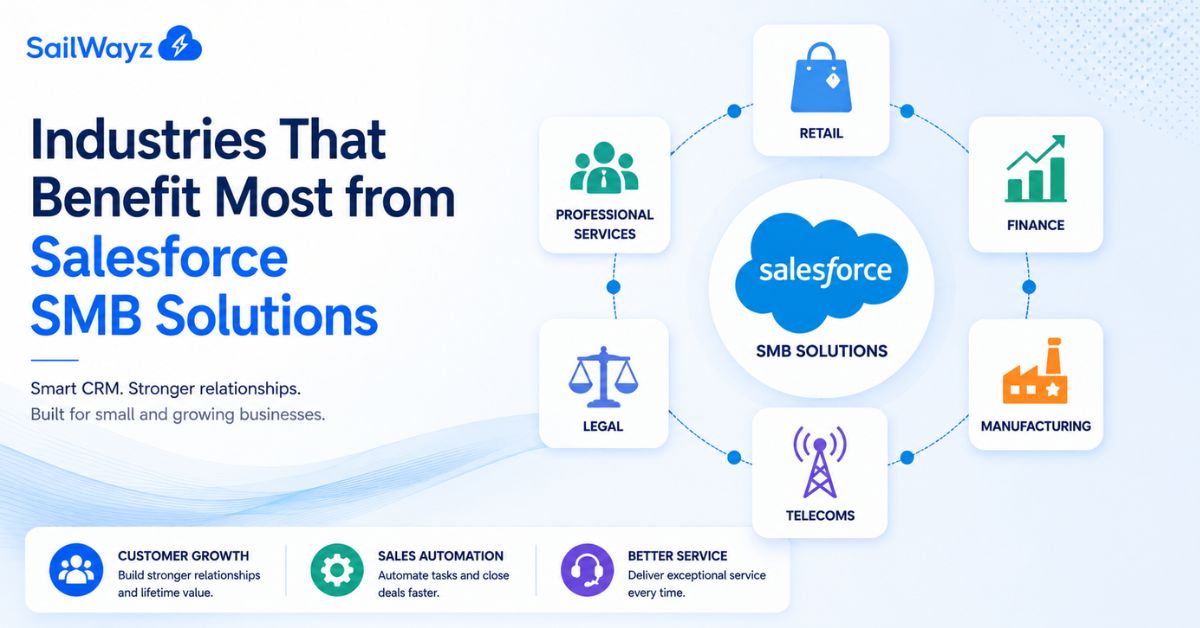
Retail SMBs were early adopters of CRM software, and the reasons are straightforward. Small retail businesses particularly benefit from CRM because it helps them handle online customer interactions, repeat customers, and targeted campaigns. The retail industry has increasingly adopted digital channels, and e-commerce, online marketplaces, and omnichannel strategies are now standard rather than optional.
Here is why Salesforce works well for retail SMBs:
A growing retail business typically juggles a website, a physical shop, social media, and marketplaces like Amazon or Etsy simultaneously. Without a central system, customer data from each channel sits in a separate silo. Salesforce pulls it together so your team has one view of each customer, what they bought, when, what they complained about, and what they browsed.
Automation handles the follow-up work that retail teams often skip when they are busy. A customer who abandons a basket online can receive an automated email within the hour. A repeat buyer can receive a personalized offer on the anniversary of their first purchase. A complaint on any channel routes to the same service queue and gets resolved faster.
For retail SMBs operating on thin margins with small teams, removing manual admin from the customer journey frees up real time that can go back into the floor, the stock room, or the next product range.
Professional services businesses, solicitors, accountants, consultancies, marketing agencies, architects, and similar firms have some of the most to gain from the benefit of Salesforce SMB solutions. Here is why.
Their revenue depends on two things: winning new clients and keeping existing ones happy. Both require organized, timely communication. A lead that sits uncontacted for three days while your team attends to a project deadline is a lead that goes elsewhere. An existing client whose renewal falls through the cracks is a client lost to a competitor who called first.
Salesforce tracks every opportunity in a live pipeline. You see at a glance which proposals are overdue for follow-up, which clients have renewals approaching, and which prospects have gone quiet. Automated reminders mean nothing slips.
Professional services businesses also benefit from the reporting side. You can track which marketing activity generates the most client inquiries, which service lines produce the most profitable work, and where your sales process stalls. That kind of visibility helps a 10-person consultancy make the same caliber of business decisions as a 100-person firm.
SMBs in the manufacturing and professional services industries are among the most active investors in CRM software, with spending in both sectors growing steadily. Salesforce sits at the center of that investment for many firms.
Financial services firms at the SMB scale, independent financial advisers, mortgage brokers, insurance brokers, and boutique accountancy practices operate in a regulated environment where record-keeping and audit trails are not optional extras. They are legal requirements.
Salesforce meets this need directly. Every client interaction is logged automatically, creating a complete communication history that stands up to regulatory scrutiny. The platform supports the kind of personalized client service that keeps financial clients loyal: proactive advice, goal-based planning, and timely contact from a single connected system.
The reporting tools matter here, too. A financial services SMB can track client portfolio activity, flag clients whose circumstances have changed, and ensure that reviews happen on schedule rather than when someone remembers to check a spreadsheet.
For mortgage brokers and IFAs who work with a large number of clients simultaneously, Salesforce handles the workload that would otherwise require a significantly larger team. Leads from referrals, website inquiries, and existing client recommendations all land in the same pipeline, are scored and prioritized, and are assigned to the right adviser automatically.
Manufacturing SMBs face a different kind of challenge. Their sales cycles are often long, their deals are large, and their customers expect precision on price, on specification, and on delivery.
Salesforce Pro Suite addresses this directly with forecasting and quoting tools that give manufacturing sales teams the ability to produce accurate quotes quickly, track forecast revenue against actual performance, and manage complex deals through multiple stages without losing track of where things stand.
For manufacturers working with distributors or resellers, Salesforce tracks relationships across multiple layers of the supply chain. You can see which distributor is generating the most new business, where delays are happening in the order-to-delivery process, and which product lines are drawing the most interest from which markets.
Manufacturing and professional services SMBs are among the heaviest spenders on CRM solutions globally. The investment reflects how much these sectors gain from having well-organized customer and prospect data feeding directly into their sales and operational decisions.
At Sailwayz, we work regularly with manufacturing businesses to configure Salesforce in a way that reflects how their sales process actually works, not how a default template assumes it works.
Connectivity and telecoms businesses at the SMB scale, managed service providers, internet service companies, and IT support firms often manage a high volume of clients on recurring contracts. Their challenge is not finding new customers. It is keeping the ones they have.
Service quality and responsiveness drive retention in this sector. A client who cannot reach someone when their connection is down, or whose support ticket sits unresolved for days, cancels at renewal. Salesforce Service Cloud at the SMB level gives telecoms businesses the tools to handle cases quickly, route them to the right person, and keep the client informed throughout.
Automated alerts flag contracts approaching renewal before the client receives a competitor’s quote. Service dashboards show where response times are slipping before they become a pattern. And when a client calls, the support agent sees the full history of that account before saying a word, which means fewer frustrated clients repeating themselves.
For companies managing 100, 500, or 1,000 client accounts, the difference between having this system and not having it is measured in churn rate. Sailwayz has direct experience in this sector, having worked with Vaioni Group, an internet service provider, to implement Salesforce in a way that improved how they managed sales, marketing, and customer support processes as their client base grew rapidly.
Law firms at the SMB scale face a deceptively simple problem: they have a lot of clients, a lot of matters, and a lot of deadlines, and very little of it is tracked in a central place. Client relationships live in email threads and partner notebooks. New business inquiries get handled inconsistently. Referral sources are not tracked, so there is no way to know which ones are most productive.
Salesforce gives small and mid-sized law firms a client relationship system that sits alongside their practice management software. New inquiries are captured, qualified, and converted. Existing client relationships are tracked by matter type, value, and activity. Referral sources are recorded so the firm can see exactly where its best work comes from and invest time in those relationships.
The reporting capability is particularly useful for practices trying to grow. Partners can see their own pipeline, track new business activity, and understand where the firm’s caseload is heading, all without pulling information from multiple people and spreadsheets.
Look across all these industries, and one pattern emerges. The businesses that gain the most from the benefit of Salesforce SMB solutions are the ones where
Salesforce’s SMB product range, Free Suite, Starter Suite, and Pro Suite, gives growing businesses a path from basic contact management to sophisticated automation without forcing them to pay for enterprise complexity they are not yet ready for.
Sixty-six percent of leaders at growing SMBs say their technology is a fully connected system. Businesses that operate from joined-up, centralized data make better decisions faster than those that do not. That advantage compounds over time.
Next steps are straightforward. Ask yourself three questions:
Are you losing leads because no one followed up in time? If your sales process relies on individuals remembering who to call and when, you are losing business you should be winning.
Do you know which clients are at risk of leaving before they actually leave? If renewals and check-ins happen reactively rather than on a planned schedule, you will always be one step behind.
Can you tell at a glance where your revenue is going to come from next quarter? If your forecast lives in a spreadsheet that one person updates sporadically, your visibility into the business is worse than it needs to be.
If you answered yes to any of those, a Salesforce SMB solution is worth a proper look. The Sailwayz team works with businesses across retail, financial services, professional services, manufacturing, connectivity, and law to configure Salesforce around how your business actually works, so you start seeing results from day one rather than six months in.
The main benefit is that a small team can operate with the same level of organization and follow-up discipline as a much larger one. Lead tracking, automated follow-ups, service case routing, and reporting all run without requiring someone to manage them manually. A team of five can handle the workload of a team of ten when the right systems are doing the admin work.
Most small businesses start with the Starter Suite at $25 per user per month. It covers sales, marketing, service, and commerce in a single app, with pre-built dashboards and guided setup. Businesses that need workflow automation, forecasting, custom objects, or AppExchange access should move to Pro Suite, which delivers more advanced capabilities without jumping to an enterprise license.
For businesses where customer relationship management directly affects revenue, which includes most B2B service businesses, retail operations, and any firm working with repeat clients, Salesforce returns its cost many times over through time saved on admin, leads that would otherwise go cold, and clients retained because of timely communication. The key is setting it up correctly from the start.
A basic Starter Suite setup with standard sales and service features can be ready in a few weeks. A more involved setup with custom fields, workflow automation, integrations with existing tools, and team training typically takes one to two months. The timeline depends on how much existing data needs to be migrated and how clearly the business has defined its sales and service processes before setup begins.
Starter Suite is designed for self-service, and many businesses set it up without external help. The challenges typically arise when the out-of-the-box setup does not quite match how the business works, when data migration from a previous system is needed, or when the team wants custom automation rather than default workflows. A consultant pays for themselves quickly in these situations by avoiding the trial-and-error that costs weeks.




Joshua Eze is the Founder & Salesforce Architect at Sailwayz, a certified Salesforce Consulting Partner based in the UK. With over 6 years of experience leading CRM transformations, he is a certified Application & System Architect passionate about using technology to simplify business processes. Joshua helps companies unlock the full potential of Salesforce with strategic, scalable, and secure solutions.
