
Commercial real estate is a relationship business. You win deals because you know the right people, stay on top of every conversation, and follow up at exactly the right moment. Spreadsheets and sticky notes can only take you so far.
That is where a CRM for commercial real estate brokers changes everything. The right platform tracks every contact, every property, every deal, and every follow-up in one place, so nothing falls through the cracks.
Let’s break it down: what makes a CRE CRM worth your money, which platforms stand out in 2026, and how do you choose the one that fits your workflow?
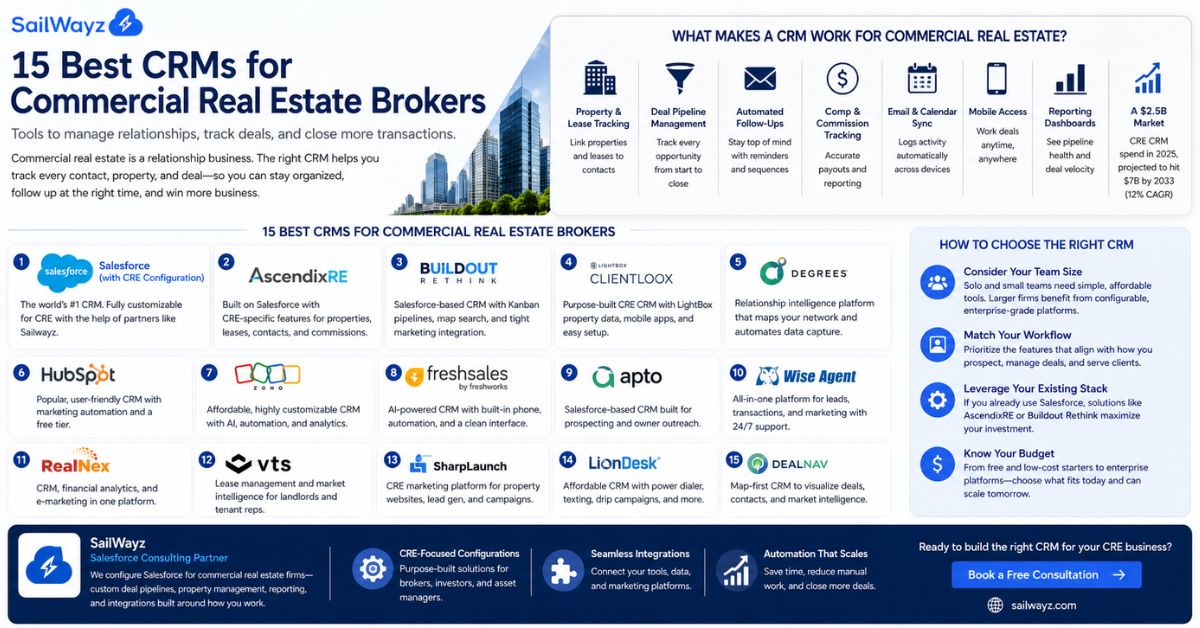
Not every CRM is built for commercial real estate. Generic sales platforms are designed for SaaS teams or e-commerce companies. They lack the data models you need to track properties, tenants, landlords, leases, and multi-party deal structures simultaneously.
A CRE CRM is a system that manages complex deal processes, handles stakeholder relationships, and supports reliable transaction management throughout the deal lifecycle.
Here is why that distinction matters. In residential real estate, you have a buyer, a seller, and a closing. In commercial real estate, a single deal can involve investors, tenants, landlords, brokers on both sides, lenders, attorneys, and property managers, all with different timelines and priorities. Your CRM needs to track all of them.
Look for these features when comparing platforms:
The commercial real estate CRM market reached $2.5 billion in spending in 2025 and is projected to hit $7 billion by 2033, a 12% compound annual growth rate driven by brokers racing to automate deal flow and scale prospecting.
That growth tells you something. CRE firms are moving fast to get the right systems in place. Here are the 15 best options available today.
Salesforce sits at the top of the CRM market globally, and commercial real estate firms use it heavily when they want a platform that can do everything.
Salesforce provides a CRM solution primarily used by mid-sized to large companies. Its feature set helps agents and brokers increase productivity by managing the entire sales process, with capabilities including automatic call and meeting summaries, generative AI for drafting emails and contracts, and integrated customer profiles that work across multiple systems.
Out of the box, Salesforce does not have CRE-specific features like stacking plans or lease comps. You either customize it yourself or work with a Salesforce consulting partner. Firms like Sailwayz specialize in configuring Salesforce specifically for commercial real estate workflows, building custom deal pipelines, automated reporting, and property data integrations that generic configurations lack.
Best for: Mid-sized to large brokerages that want a fully tailored system and have the budget to configure it properly.
AscendixRE is built directly on top of the Salesforce platform, giving you CRE-specific features without having to build them from scratch.
AscendixRE stands out for CRE-specific features, including an AI assistant, geomapping search, and commission tracking. It covers property and lease management, client tracking, and deal management, with a highly customizable database for managing contacts, properties, and transactions.
AscendixRE is built for real estate from the ground up and includes features for managing properties, leases, and clients. It is tailored to CRE workflows and highly customizable, though it carries a steeper learning curve for new users.
Best for: CRE professionals who want Salesforce’s power with industry-specific tools already built in.
Buildout has become one of the most recognized names in commercial real estate technology, and Rethink is its CRM product built on Salesforce.
Rethink embeds industry data and AI directly into the broker’s workflow. It features a Kanban-style deal pipeline, a geospatial search tool to visualize properties on a map, and bi-directional integration with Buildout’s Showcase marketing platform, creating a single system from prospecting through marketing.
The Kanban pipeline is particularly useful for teams that manage high deal volumes. You can see exactly where every transaction sits, drag deals between stages, and spot bottlenecks instantly.
Best for: Brokerages that need deal workflow automation and want their marketing and CRM in the same ecosystem.
ClientLook is one of the oldest CRMs built specifically for commercial real estate professionals. LightBox acquired it and has since added property data integrations that make it more powerful.
ClientLook markets itself as a CRM that simplifies the complex demands of CRE professionals, enabling efficient operations without the need for extensive training. It offers an uncomplicated CRM tied to a property database, with integration to LightBox’s LandVision property data service, providing real-time updates on ownership, sales history, and financial data.
ClientLook includes a personalized property inventory database, allowing brokers to link any property to specific contacts and companies for easier management. The platform offers native mobile apps for iOS and Android, with monthly plans starting at $129 per user per month.
Best for: Solo brokers and small teams who want a purpose-built CRE CRM with minimal setup time.
4Degrees comes from the relationship intelligence space and applies that approach to commercial real estate deal teams.
4Degrees automates data entry, tracks interactions, and provides analytics for professionals in industries including commercial real estate. Popular features include automated data capture, relationship intelligence, and reporting tools. Pricing starts at approximately $250 per month.
For deal teams focused on relationships, 4Degrees offers powerful automation and network visibility. The platform transforms your network into a dynamic asset by systematically tracking relationships and helping you quickly identify key players for potential deals.
Best for: Investment sales teams and brokers who win deals through network relationships and need deep relationship tracking.
HubSpot is one of the most widely used CRM platforms across industries. The free tier makes it attractive for brokers just starting, and the paid tiers add marketing automation and advanced reporting.
HubSpot CRM provides contact management, email automation, and pipeline tracking in one system. It can support general sales and marketing workflows across industries. The app marketplace allows users to connect HubSpot to over 1,700 business apps. Paid plans start at $15 per user per month with the Starter plan.
The trade-off is that HubSpot does not have CRE-specific tools built in. You will need to add custom fields and connect third-party apps to handle property management and lease tracking. For brokers comfortable configuring their own tools, this flexibility is a feature. For those who want something ready to go, it can feel like extra work.
Best for: Brokers who want an affordable starting point with strong marketing automation and do not mind some configuration.
Zoho CRM gives you a strong feature set at a price point that undercuts most competitors. It is not built for CRE, but its customization options let you adapt it to almost any workflow.
Zoho CRM offers advanced automation and detailed sales analytics. It includes AI-powered lead scoring, automated workflows, multiple communication channels, and detailed sales reporting, making it well-suited for agents who handle large volumes of leads.
For commercial real estate brokers on a tight budget, Zoho’s customization depth is a real advantage. You can build custom modules for properties, create automated follow-up sequences, and set up dashboards that mirror your pipeline. It takes setup time, but the result can work well for smaller teams.
Best for: Small brokerages or solo brokers who want a budget-friendly platform they can configure over time.
Freshsales is a sales-focused CRM with a clean interface and built-in AI assistance through its Freddy AI engine.
Freshsales brings Freddy AI to sales teams. It helps find potential customers by analyzing data points and behavior patterns, resolves duplicate contacts, provides deal-specific insights, and gives risk signals such as lowered engagement. The platform includes contact management, a unified view of customer behavior across all touchpoints, and automation tools.
Like HubSpot and Zoho, Freshsales is not purpose-built for CRE. You will need to add custom fields and integrations to make it work for property and lease management. The interface is among the cleanest of any CRM in this list, and the mobile app is strong for brokers who work in the field.
Best for: Brokers who prioritize an intuitive interface and AI-assisted follow-up and are comfortable doing some customization.
Apto is a commercial real estate CRM built on the Salesforce platform, similar to AscendixRE, with a strong focus on prospecting and contact management.
Apto offers strong prospecting capabilities for commercial real estate brokers. It is designed for hybrid residential and commercial workflows, giving flexibility for teams that handle both property types.
Apto focuses heavily on the prospecting side of CRE work, making it a natural fit for brokers who spend a lot of time cold-calling owners and building their contact lists. The Salesforce foundation means you also get strong reporting and integration options.
Best for: Brokers who prioritize prospecting and owner outreach as their primary deal-sourcing activity.
Wise Agent is primarily known as a residential real estate CRM, but it covers commercial workflows well enough to earn a spot on this list, particularly for brokers who handle both markets.
Wise Agent is an all-in-one platform that includes lead management, follow-up, transactions, and marketing in a single platform. It offers 100-plus integrations, including Google, Outlook, Zillow, and Mailchimp. The platform provides 24/7 live customer support and one-on-one setup sessions. It has been named Best Real Estate CRM by Forbes Advisor three years in a row.
The 24/7 support is a standout feature for brokers who do not have an IT team to call when something goes wrong. The pricing is also among the most affordable of any full-featured real estate CRM.
Best for: Brokers who work across both residential and commercial deals and want strong support at an affordable price.
RealNex is one of the few CRMs built specifically for commercial real estate that bundles financial analytics alongside contact and deal management.
RealNex bundles CRM, financial tools, and e-marketing, allowing data sync across platforms. It is best suited for investment sales and leasing agents who need integrated financial analytics and marketing tools. Pricing ranges from $99 to $174 per user per month, plus setup fees.
The financial modeling side of RealNex separates it from most CRMs on this list. You can run lease comparisons and investment calculations without switching to a separate tool. For investment sales brokers who work with complex financial models, that integration saves real time.
Best for: Investment sales brokers and leasing agents who need financial analytics built directly into their CRM.
VTS started as an asset management platform and has grown into a full CRE leasing and market intelligence tool. It is most commonly used by landlords and tenant-rep brokers.
VTS is best suited for landlords and tenant representatives who need lease management tools and market data built into their workflow.
VTS gives you real-time leasing data, market comps, and asset-level tracking that most CRMs do not touch. If you represent tenants or manage assets on behalf of owners, it covers workflows that pure CRM tools miss entirely.
Best for: Landlord reps, tenant reps, and asset managers who need lease management and market data alongside CRM functionality.
SharpLaunch focuses on the marketing side of commercial real estate, making it a strong choice for property owners, asset managers, and brokers who produce a lot of marketing content.
SharpLaunch is a commercial real estate marketing platform built for property owners, asset managers, and brokers. It offers tools for creating property websites, capturing leads, and running marketing campaigns. It is often used alongside a separate CRM system for deeper contact management and deal-tracking workflows.
Many CRE teams pair SharpLaunch with a dedicated CRM like Salesforce or AscendixRE. SharpLaunch handles property marketing beautifully, while the CRM handles the relationship and deal tracking.
Best for: Marketing-focused brokerages and asset managers who produce property websites and lead generation campaigns.
LionDesk is an affordable CRM that covers lead management, automated follow-up, and communication tools at a price point that works for solo brokers and small teams.
LionDesk stands out for its affordability and features, including a power dialer, click-to-call, bulk texting, and drip campaigns. It supports lead generation from social media and third-party sources, including Zillow and Trulia. It is recommended for beginners or growing teams because of its simple interface and pay-as-you-grow model.
LionDesk will not give you CRE-specific features like stacking plans or comp reports. What it does give you is solid lead management and automated communication at a price most brokers can justify even in their first year.
Best for: Brokers new to using a CRM who want affordable automation without a steep learning curve.
DealNav is a newer platform built by a commercial real estate developer who was tired of CRMs that buried property information under layers of generic pipeline tools.
DealNav is a CRM and deal management platform designed for CRE professionals to track deals, manage contacts, and visualize market data through an integrated interactive map. The platform uses a map-first dashboard where brokers can drop an address and immediately see every contact linked to that opportunity. Team visibility is shared across deals and contacts with no per-seat cost.
The map-first approach works especially well for brokers who think spatially about their market. If you often ask “who owns properties in this submarket?” and want to visualize the answer immediately, DealNav is worth a serious look.
Best for: Brokers and acquisitions teams who want a map-first, affordable CRM without complex back-office features.
With 15 solid options in front of you, the choice comes down to a few practical questions.
Start here:
When you choose the right system early, you reduce friction, shorten new-hire ramp time, and build consistent workflows that hold up as your deal volume grows.
Next steps: Take two or three platforms from this list, run a free trial or demo on each, and test them against your actual daily workflow. The best CRM is the one your team will actually use.
Many of the strongest CRE CRMs on this list, including AscendixRE, Buildout Rethink, and Apto, are built on top of Salesforce. That is not a coincidence.
Salesforce gives you a foundation that almost nothing else can match: reporting depth, integration options, automation tools, and room to grow. The challenge is that Salesforce needs proper configuration to work for commercial real estate workflows. A generic Salesforce setup will not track properties or leases the way your team needs.
That is exactly what firms like Sailwayz do. As a registered Salesforce consulting partner, Sailwayz builds CRE-specific configurations for brokerages that want Salesforce’s capabilities without spending months figuring it out internally. Custom deal pipelines, property management modules, automated reporting, and integrations with your existing tools all come together in a setup built around how your team actually works.
There is no single best answer because the right fit depends on your team size and workflow. AscendixRE and Buildout are leaders for large brokerages that want CRE-specific tools built on Salesforce. ClientLook suits smaller teams. For fully custom solutions, configuring Salesforce through a partner like Sailwayz gives you the most control over how the system works for your business.
A standard CRM tracks leads, contacts, and a linear sales process. A CRE CRM also tracks properties, leases, comp data, commission splits, and multi-party deal relationships simultaneously. Commercial real estate deals are longer and more complex than typical B2B sales, so the CRM needs to reflect those workflows rather than force brokers to adapt to a generic pipeline structure.
Most CRE CRMs do not include a built-in property database. They allow users to import their own listings or connect with external data providers. AscendixRE includes some property management functionality, but sourcing and updating data typically requires manual input or third-party connections. ClientLook stands out here because its integration with LightBox’s LandVision gives it real-time property ownership and financial data.
Pricing varies widely. Free options like HubSpot’s basic tier work for solo brokers just getting started. Mid-tier platforms like ClientLook and LionDesk run between $59 and $174 per user per month. Enterprise Salesforce configurations start higher and scale based on the number of users and the scope of customization. Always confirm current pricing directly with the vendor before making a decision.
Yes, Salesforce works well for commercial real estate when properly configured. Out of the box, it does not have CRE-specific features like stacking plans or lease management. You either build those yourself or work with a consulting partner who specializes in CRE configurations. The advantage is that once configured correctly, Salesforce gives you more flexibility, reporting depth, and integration options than most purpose-built CRE platforms.



Joshua Eze is the Founder & Salesforce Architect at Sailwayz, a certified Salesforce Consulting Partner based in the UK. With over 6 years of experience leading CRM transformations, he is a certified Application & System Architect passionate about using technology to simplify business processes. Joshua helps companies unlock the full potential of Salesforce with strategic, scalable, and secure solutions.
