

If you’ve been trying to decide whether Salesforce Sales Cloud is worth the investment, one of the first questions that comes up is simple: Who actually uses it?
The answer might surprise you. It’s not just the global giants. From a three-person startup tracking its first ten prospects to a multinational managing hundreds of thousands of accounts, Salesforce Sales Cloud sits at the centre of how a wide range of organisations run their sales operations.
Let’s break it down by who’s using it, why, and what it does for them.
Before we get into the users, a quick grounding is useful.
Salesforce pioneered the cloud revolution in 1999 when it launched Sales Cloud, freeing businesses from on-premise software. Since then, it has evolved from a basic contact management system into a full sales platform with AI-driven forecasting, pipeline management, workflow automation, and mobile access.
Sales Cloud’s core features include lead management, automation, AI-driven insights, and customisable dashboard tools designed to help sales teams perform at their best and make data-driven decisions.
In 2024, Salesforce took things further by rebranding Sales Cloud to Agentforce Sales as part of its broader AI strategy, signalling a fundamental shift in how the CRM operates from a system of record into an active teammate that helps sales teams meet today’s capacity challenges.
The scale is worth stating plainly.
Salesforce is used by more than 150,000 companies globally across North America, Europe, Asia Pacific, and the Middle East. That number has grown from just 13,900 customers back in 2005.
Sales Cloud is Salesforce’s flagship product 100% of Salesforce clients’ sales departments use it. That makes it the most universally adopted tool within the entire Salesforce ecosystem.
Salesforce ranks in the Fortune 500 and is used by 9 out of 10 Fortune 500 companies, including global brands such as Walmart, Amazon Web Services, Spotify, Toyota, and American Express.
Despite this enterprise penetration, 49% of Salesforce customers are small businesses with fewer than 50 employees, and 40% are medium-sized companies. Only 11% are large enterprises with over 1,000 employees.
That split tells you something important: Sales Cloud isn’t just an enterprise tool. It’s built to scale.
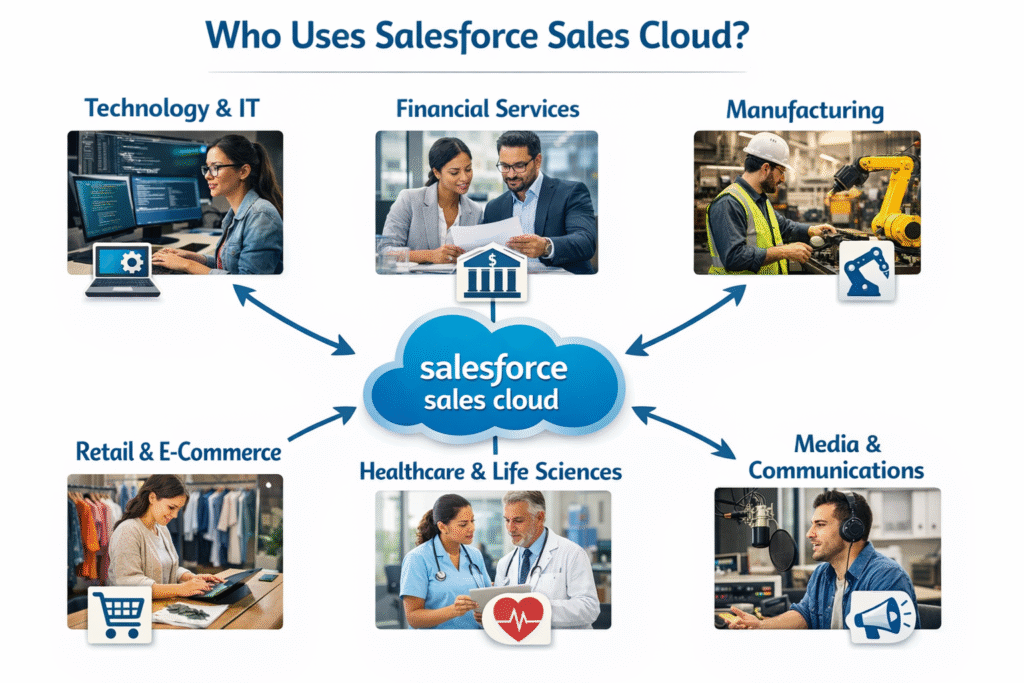
Here’s a snapshot of the industries that rely most heavily on Salesforce Sales Cloud:
Significant penetration has been achieved within the professional services, manufacturing, banking, and financial sector industries, with organisations that rely on Salesforce to manage customer interaction and strengthen customer relationships.
Let’s look at each of these more closely.
Professional services firms account for the largest slice of Sales Cloud users. This makes sense. Consulting firms, marketing agencies, law practices, and accountancy firms all depend on managing client relationships across long, often complex sales cycles.
For a consultancy pitching a six-month project, tracking proposal stages, contact history, and follow-up activity in a single platform is far more reliable than spreadsheets or inbox searches.
Firms like Accenture, KPMG, and Bain & Company are among the larger names, but the category includes tens of thousands of smaller practices doing the same thing at a smaller scale.
Manufacturing is the second-largest group. At first glance, it might seem like an unusual fit for a sales CRM. But manufacturers typically sell through multiple channels: direct sales teams, distributors, and resellers, and tracking all of that requires proper pipeline management.
Salesforce Sales Cloud’s contact management centralises customer records, notes, files, and communication history in a single location, helping teams avoid duplicate outreach and make informed decisions. For manufacturers dealing with complex account structures and long order cycles, that kind of visibility matters.
Banks and financial services firms have adopted Sales Cloud at a pace. The reasons are fairly practical. They manage large numbers of client accounts, need to track cross-sell opportunities, and operate under compliance requirements that make proper record-keeping non-negotiable.
Improved forecasting with comprehensive, real-time sales data helps businesses create more accurate models, leading to better resource allocation. For a wealth management firm tracking hundreds of client portfolios, or a lender managing a pipeline of loan applications, that capability directly affects revenue.
Retail businesses use Sales Cloud primarily on the B2B side, managing relationships with suppliers, distributors, and wholesale buyers. Consumer goods companies use it to track key account performance and manage trade promotions.
A retail chain can use third-party apps from AppExchange to improve inventory management, integrating Sales Cloud with its wider operational systems. With over 5,000 apps available on AppExchange, retailers have plenty of options to connect Sales Cloud to the rest of their technology stack.
Salesforce Sales Cloud is most used by sales and support teams in the IT and software services industries. This is perhaps the least surprising group. Tech companies are natural early adopters of SaaS tools, and Salesforce has been embedded in the go-to-market workflows of software businesses for over two decades.
A typical SaaS company might use Sales Cloud to manage inbound trial sign-ups, track enterprise deals, and report on monthly pipeline health, all in the same system.
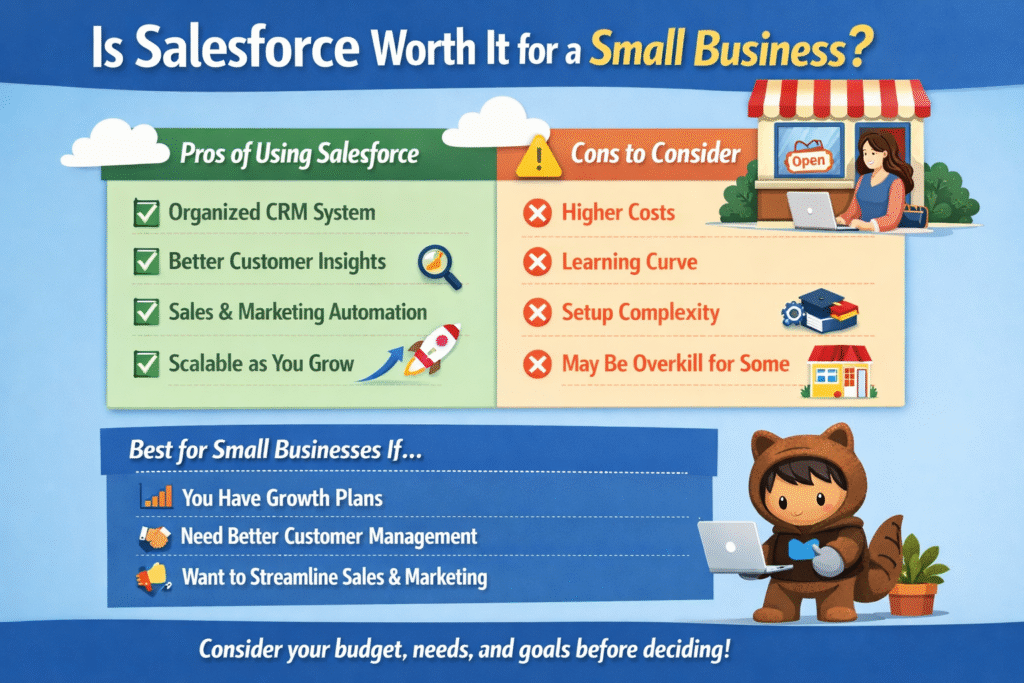
There’s a common assumption that Salesforce is too complex or too expensive for small businesses. The data suggests otherwise.
Salesforce Essentials pricing starts at $25 per user per month, billed annually, and includes lead and opportunity tracking, contact and account management, email integration, basic reports, and mobile access.
That’s a workable entry point for a small team that wants a proper CRM without building one from scratch.
Sales software is key to helping small businesses organise their sales plans, assign tasks, track deals and customers, and expedite the sales process, giving them the foundation for growth.
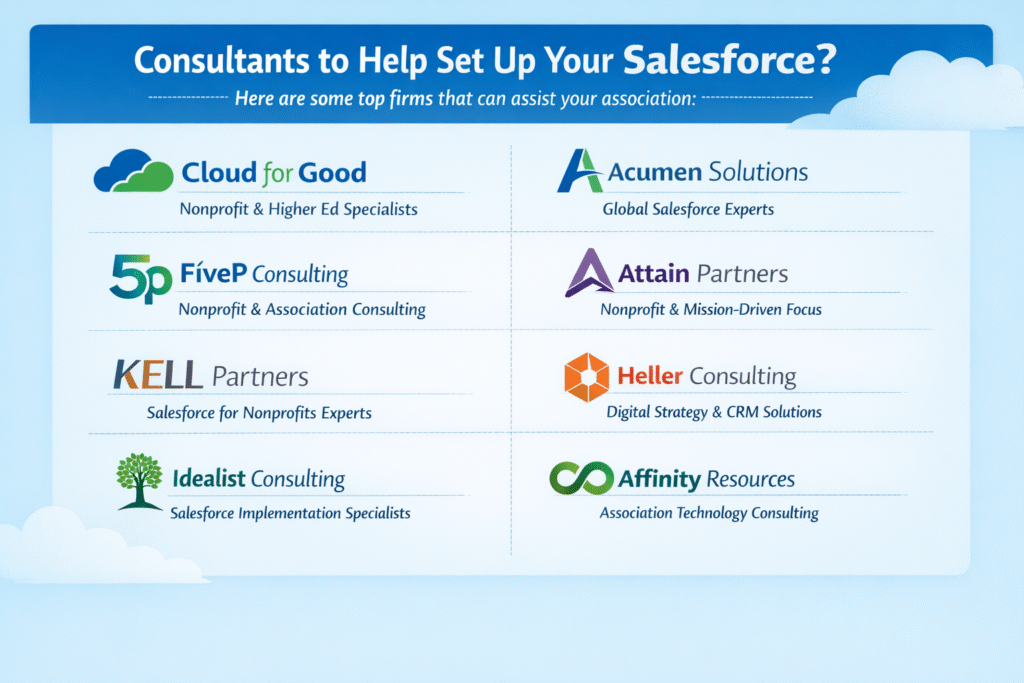
The challenge for smaller businesses is typically not the cost of entry, but the implementation. Getting the most out of Sales Cloud, especially as you start adding automation, integrations, or custom reporting, usually requires some expert setup. That’s where a Salesforce consulting partner comes in.
At Sailwayz, the focus is on helping businesses of all sizes set up and get real value from Salesforce CRM. From initial configuration through to ongoing support, their certified consultants work with clients across sectors including finance, retail, manufacturing, and law.
Growing businesses, those with 50 to 500 employees and sales teams of 5 to 50 people,e are arguably where Salesforce Sales Cloud delivers the most visible return.
At this stage, a company usually has enough complexity to outgrow simple tools, but not enough structure to manage it without proper systems. Sales Cloud fills that gap.
Enterprise Edition opens up API access for integrations with other business systems, provides advanced customisation options, and includes workflow automation that helps teams scale their operations.
For a mid-market company, that means connecting their CRM to their ERP, their email marketing platform, their accounting software, and their customer support too,l creating a joined-up view of every customer relationship.
At the large enterprise level, Salesforce Sales Cloud becomes the operating system for the entire revenue function.
Approximately 90% of Fortune 500 companies use Salesforce, and nearly 50% of Fortune 100 companies have adopted Salesforce’s Data Cloud and AI offerings.
At this scale, Sales Cloud handles things like multi-territory management, partner relationship tracking, complex approval workflows, and AI-powered forecasting across hundreds of sales reps in multiple countries.
Intelligent quoting allows agents to generate personalised quotes 75% faster by automatically applying business and finance rules while tailoring every quote to the specific customer context. For an enterprise running thousands of quotes per month, that kind of speed translates directly to competitive advantage.
It’s not just salespeople. Here’s who typically works in Sales Cloud day to day:
Over two-thirds of users report improved productivity after implementing Salesforce solutions.
It’s worth noting that Sales Cloud adoption extends into the public sector,r too. Government departments, NHS trusts, and local authorities often use Salesforce via Service Cloud and Sales Cloud in combination to manage citizen services, procurement pipelines, and contract tracking.
Sailwayz works with organisations across sectors, including government, noting that the requirements for transparency, auditability, and data security make Salesforce a natural fit for public sector bodies.
Even the best tool doesn’t implement itself. Common friction points include:
These challenges are manageable, but they’re real. Businesses that invest in proper setup and ongoing support tend to see far better outcomes than those that deploy Sales Cloud and leave it to run on its own.
Yes. Salesforce Sales Cloud has a Starter edition that begins at $25 per user per month, designed for small teams that want to manage contacts, track deals, and organise sales activity without needing a complex setup. Many small businesses use it effectively from day one, though expert configuration help can make a significant difference to how much value they get out of it.
Professional services firms account for the largest share of users at around 29%, followed by manufacturing at nearly 12% and financial services at roughly 10%. Technology companies, retail businesses, and healthcare organisations also feature prominently. The platform’s flexibility makes it workable across almost any sector that has a structured sales or business development process.
No. Salesforce offers multiple editions:s Starter, Professional, Enterprise, and Unlimited, with each tier unlocking more features, automation, and integration options. Small businesses typically start with Starter or Professional, while enterprises tend to use Enterprise or Unlimited editions to handle complex workflows, large user counts, and extensive third-party integrations.
Sales Cloud is used by sales reps, sales managers, marketing teams, business development professionals, and executives. Finance and operations teams often access it for reporting. The platform is designed to give everyone involved in the revenue process a shared, up-to-date view of customer data and pipeline activity.
If your team is managing leads in spreadsheets, losing track of follow-ups, or struggling to forecast revenue reliably, you’re likely ready. Sales Cloud works best for businesses with a defined sales process that they want to scale. Working with a certified Salesforce consulting partner like Sailwayz can help you assess your readiness and plan a setup that fits how your business actually operates, rather than forcing your team to work around a generic configuration.

Joshua Eze is the Founder & Salesforce Architect at Sailwayz, a certified Salesforce Consulting Partner based in the UK. With over 6 years of experience leading CRM transformations, he is a certified Application & System Architect passionate about using technology to simplify business processes. Joshua helps companies unlock the full potential of Salesforce with strategic, scalable, and secure solutions.
