

Salesforce powers over 150,000 businesses globally, including 88% of Fortune 100 companies. Yet many organisations that invest in the platform still fail to get the most from it. The reason is almost always the same: they picked the wrong type of partner, or did not know a choice existed.
The Salesforce partner ecosystem is one of the largest in the software industry. Thousands of certified companies appear on the Salesforce AppExchange partner directory, each offering a different kind of support. Knowing who does what saves you time, money, and a great deal of frustration.
Let’s break it down.
A Salesforce partner is a company formally recognised by Salesforce to deliver consulting, implementation, development, or sales services on the Salesforce platform. Partners go through a structured onboarding process, meet compliance standards, and earn certifications that reflect their capabilities.
Being part of the Salesforce Partner Programme gives companies access to training, co-marketing opportunities, and direct support from Salesforce. For customers, a certified partner offers confidence that the team working on their CRM has been vetted against a published standard.
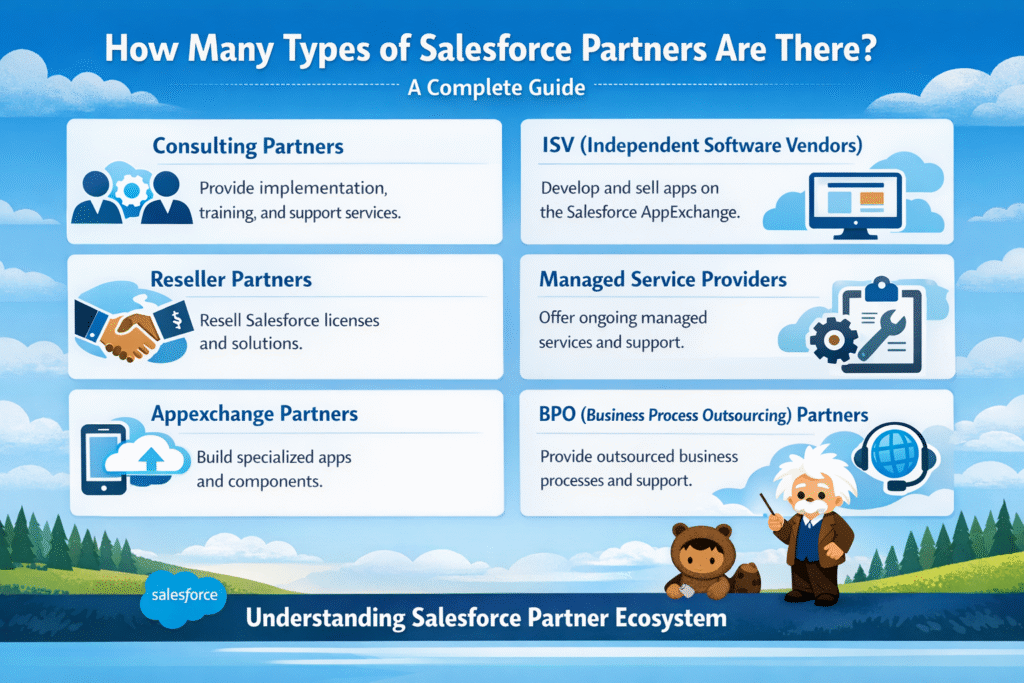
There are four main categories of Salesforce partner types, each serving a distinct purpose.
Consulting partners are the most commonly recognised type. They help businesses plan, configure, and deploy Salesforce solutions. Their work typically covers needs analysis, solution design, system configuration, data migration, user training, and post-launch support.
Here is why businesses most often turn to them: consulting partners bring both technical knowledge and process expertise. They do not just install the software; they map your workflows, identify gaps, and build a Salesforce environment shaped around your business model.
This is the category that firms like Sailwayz fall into. As a registered Salesforce consulting partner, Sailwayz works with businesses across finance, retail, law, manufacturing, and other sectors to build CRM solutions that deliver measurable outcomes. From Salesforce Sales Cloud to Marketing Cloud and beyond, their certified consultants guide clients through each stage of the process.
Consulting partners arewell-suitedd for:
ISV partners develop and sell applications that extend Salesforce’s core functionality. These apps are listed on the Salesforce AppExchange, the official marketplace for Salesforce-compatible software.
Rather than implementing Salesforce for a client, ISV partners build tools that sit on top of the platform. Examples include apps for electronic signatures, subscription billing, document generation, or industry-specific compliance tracking.
The AppExchange currently lists thousands of apps, and ISV partners range from small specialist developers to large software companies. When an off-the-shelf Salesforce feature does not meet a specific need, an AppExchange app from an ISV partner is often the answer.
ISV partners are suitable for:
In 2024, Salesforce updated the ISV partner tier structure. The old point-based model shifted to a maturity-focused framework. The current ISV tiers include Exploration, Build, Select, and Summit, with benefits scaling at each level.
MSP partners focus on ongoing management and support after a Salesforce implementation goes live. They handle system administration, user management, routine updates, performance monitoring, and troubleshooting.
Many businesses complete an initial Salesforce implementation and then find that maintaining the platform requires dedicated expertise they do not have in-house. An MSP partner fills that role, acting as an outsourced Salesforce admin and support team.
Here is why this matters: Salesforce releases three major platform updates per year (Spring, Summer, and Winter). An MSP partner keeps your environment up to date, monitors for issues, and makes sure your team keeps working without disruption.
MSP partners are suitable for:
Cloud reseller partners are authorised to sell Salesforce licences directly to end customers. They act as intermediaries between Salesforce and businesses, particularly in regions where Salesforce has a limited direct sales presence.
Resellers often bundle licence sales with additional services, including implementation support or training. They are particularly common in emerging markets where local knowledge and regional relationships matter.
Reseller partners are suitable for:
Within the consulting partner category, Salesforce ranks partners by tier. Understanding these tiers helps you assess the scale and track record of any firm you are considering.
As of 2026, Salesforce has overhauled its consulting partner tier structure. The previous four-tier model (Base, Ridge, Crest, and Summit) has been replaced with two tiers: Select and Summit.
This change, announced in early 2026, aims to reduce ambiguity and make it easier for businesses to assess a partner’s standing quickly. Alongside the new tiers, Salesforce replaced 170 legacy badges with 28 core competencies. These competencies cover specific AI, product, and portfolio-level capabilities rather than general Salesforce knowledge.
Each competency carries two levels of recognition:
System integrators (SIs) are often classified as a subtype of consulting partner. They specialise in connecting Salesforce with other platforms, such as ERPs, marketing automation tools, finance systems, e-commerce platforms, and more.
A business with a complex technology stack may need a Salesforce environment that shares data with ten or fifteen other applications. System integrators build those connections, map data flows, and make sure systems talk to each other reliably.
Large-scale system integrators include global firms such as Accenture, Deloitte Digital, KPMG, and PwC. Specialist boutique firms also operate in this space, often focusing on specific platforms or industries.
A fifth category worth noting is education and training, partners. These are organisations that deliver Salesforce training and certification programmes to individuals and businesses.
They help teams get up to speed on the platform, prepare staff for Salesforce certifications, and run structured learning programmes for organisations rolling out Salesforce to large user groups. While this category is smaller in scale than consulting or ISV partnerships, it plays an important role in long-term Salesforce adoption.
Knowing the types of Salesforce partners is only useful if you can match them to your situation. Here is a quick guide.
If you are implementing Salesforce for the first time, work with a consulting partner. They will handle everything from initial setup to go-live.
If you need a specific feature Salesforce does not provide out of the box, search the AppExchange for an ISV partner app built for that purpose.
If your Salesforce is already live but needs ongoing management, an MSP partner is the right choice.
If you are purchasing licences and want local support, look at cloud reseller partners in your region.
If you need Salesforce to connect with other business systems, a system integrator, often found within consulting firms, handles that work.
The team at Sailwayz offers Salesforce consulting across the full lifecycle from initial strategy and setup through to ongoing support, making them relevant to businesses at any stage of their Salesforce journey. Their services span Sales Cloud, Service Cloud, Marketing Cloud, Salesforce integration, analytics, migration, and health checks, giving clients a single point of contact for most Salesforce needs.
Choosing the wrong type of Salesforce partner leads to misalignment from the start. An implementation-focused consulting firm works best on defined, scoped projects. An MSP partner works best when the need is continuous and open-ended. An ISV solution works best when the requirement is a feature gap rather than a process design problem.
Many businesses have gone through expensive re-implementations because they engaged a partner whose delivery model did not match what the project actually needed. Taking time to define your requirement first and then finding a partner category to match it is the single most practical step you can take before signing any contract.
Q: How many types of Salesforce partners are there?
Salesforce recognises four main partner types: Consulting Partners, ISV (Independent Software Vendor) Partners, Managed Service Provider (MSP) Partners, and Cloud Reseller Partners. System Integrators and Education Partners are sometimes listed as additional categories within this ecosystem.
Q: What is the difference between a Salesforce consulting partner and an MSP partner?
A consulting partner helps you design and implement Salesforce from scratch or improve an existing setup. An MSP partner takes over after implementation to handle day-to-day administration, system updates, and ongoing support. Some firms offer both services.
Q: What do the Salesforce partner tiers mean in 2025 and 2026?
Salesforce updated its consulting partner tiers in 2026, replacing the old four-tier model with two tiers: Select and Summit. Summit partners hold the highest standing, with a strong track record of customer outcomes and certified staff. Select partners are established firms with solid credentials and growing practices.
Q: What is an ISV partner in Salesforce?
An ISV (Independent Software Vendor) partner builds applications that run on the Salesforce platform and are sold through the AppExchange. These apps extend Salesforce’s core features to cover specialist use cases, such as document automation, billing, or industry-specific compliance tools.
Q: How do I find a Salesforce partner in the UK?
You can search the Salesforce AppExchange partner directory by location, industry, and product focus. You can also contact certified consulting firms directly. Sailwayz, based in Preston, UK, is a registered Salesforce consulting partner serving businesses across multiple industries throughout the United Kingdom.

Joshua Eze is the Founder & Salesforce Architect at Sailwayz, a certified Salesforce Consulting Partner based in the UK. With over 6 years of experience leading CRM transformations, he is a certified Application & System Architect passionate about using technology to simplify business processes. Joshua helps companies unlock the full potential of Salesforce with strategic, scalable, and secure solutions.
