
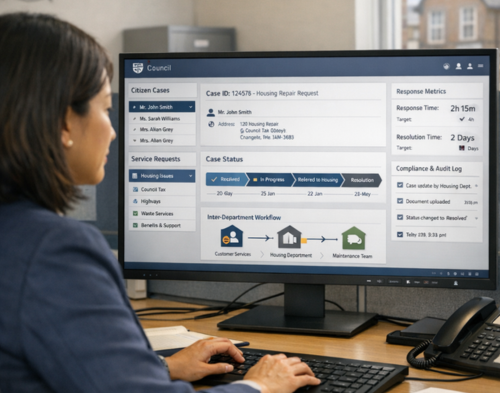
Local councils across Britain face mounting pressure to deliver better citizen services while managing tighter budgets. The right customer relationship management (CRM) system can transform how local authorities interact with residents, handle service requests, and streamline operations. This guide examines the leading CRM platforms designed specifically for UK local government needs.
Traditional CRM software built for private sector sales teams falls short in the public sector. Local government requires systems that handle complex case management, integrate with existing legacy systems, and comply with strict data protection regulations under UK GDPR.
Councils manage thousands of daily interactions across multiple departments. A resident might report a pothole, apply for housing support, and query council tax within the same week. Without proper systems, these interactions exist in silos, creating frustration and inefficiency.
Modern CRM platforms designed for local government unite these touchpoints. They provide a single view of each citizen, track service requests from start to finish, and generate the performance data councils need for transparency and accountability.
Sailwayz stands out as the premier choice for UK local authorities seeking a purpose-built government CRM solution. The platform addresses the unique challenges councils face when managing citizen relationships across multiple service areas.
What sets Sailwayz apart is its deep understanding of British local government workflows. The system handles everything from routine enquiries to complex multi-department cases while maintaining full audit trails for accountability. Councils can track every interaction, ensuring nothing falls through the cracks.
The platform integrates seamlessly with existing council systems, including finance packages, planning databases, and housing management software. This interoperability eliminates the data silos that plague many local authorities, giving staff a complete picture when assisting residents.
Key Features:
Sailwayz also excels at reporting capabilities. Councils can generate the detailed metrics required for government reporting while gaining operational insights that drive service improvements. The system tracks response times, resolution rates, and citizen satisfaction across all service areas.
Security remains paramount. Sailwayz meets all UK government security standards, with role-based access controls ensuring staff only view information relevant to their duties. Regular security updates and UK-based data hosting provide additional peace of mind.
Pricing scales based on council size and requirements, making it accessible for both small district councils and large metropolitan authorities. Implementation support and ongoing training ensure teams maximise their investment.
Microsoft’s enterprise platform offers considerable power for larger councils with complex requirements. The system handles high transaction volumes and integrates naturally with other Microsoft products many councils already use.
Dynamics 365 provides strong automation capabilities, reducing manual data entry and freeing staff to focus on citizen service. The platform supports sophisticated reporting through Power BI, enabling councils to visualise trends and identify service bottlenecks.
However, implementation typically requires significant customisation to fit local government workflows. Councils should budget for specialist consultants and extended deployment timelines. The learning curve can be steep for staff accustomed to simpler systems.
Salesforce adapted its commercial CRM platform for government use, creating a flexible system that scales from small teams to enterprise deployments. The platform’s strength lies in its extensive app ecosystem and customisation options.
Councils can build tailored workflows without extensive coding through Salesforce’s low-code development tools. The community of Salesforce developers means finding implementation support is relatively straightforward.
Cost remains a consideration. Licensing fees can add up quickly, particularly when including necessary add-ons for government-specific features. Councils should also factor in ongoing administration costs, as the system requires dedicated Salesforce expertise to maintain and optimise.
This UK-based provider focuses specifically on local government digital transformation. Firmstep combines CRM capabilities with form building and process automation tools designed around council workflows.
The platform excels at creating digital services that reduce face-to-face and telephone contact. Residents can complete transactions online, with requests automatically routed to the right teams. This self-service approach cuts costs while improving convenience.
Firmstep’s strength lies in its out-of-the-box understanding of UK local government. The system comes preconfigured for common council processes, reducing implementation time. However, the platform may feel less flexible than more general enterprise CRM systems for organisations with unique requirements.
Civica brings decades of experience serving UK public sector organisations. Their CRM platform integrates tightly with Civica’s other local government products, creating a comprehensive ecosystem for councils already using their software.
The system handles the full spectrum of citizen interactions, from simple enquiries to complex case management spanning multiple departments. Civica’s understanding of local government legislation and compliance requirements is baked into the platform.
Integration capabilities are strong, particularly with other Civica products. Councils using Civica’s revenues and benefits or housing systems will find seamless data flow. However, organisations using competitor products may face more complex integration challenges.
When evaluating CRM systems, councils should prioritise several key factors beyond basic contact management.
Integration Capabilities: Your CRM must connect with existing systems. Look for proven connectors to common local government platforms and open APIs for custom integrations. Data should flow freely between systems without manual intervention.
Compliance and Security: UK GDPR compliance is non-negotiable. Verify the system maintains comprehensive audit logs, supports data subject access requests, and enables appropriate data retention policies. Check where data is hosted and ensure it meets government security standards.
User Adoption: The best system means nothing if staff won’t use it. Prioritise intuitive interfaces that require minimal training. Look for mobile access so field workers can update records in real-time rather than duplicating efforts later.
Scalability: Your chosen platform should grow with your needs. Consider future requirements like adding new service areas, handling increased contact volumes, or expanding to neighbouring authorities through shared services.
Reporting and Analytics: Councils need robust reporting for both operational management and statutory returns. Ensure the system can generate required government reports while providing managers with actionable operational data.
Successful CRM deployment requires careful planning beyond selecting the right software. Start by mapping current processes and identifying pain points. Don’t simply replicate broken workflows in new software.
Involve staff from all affected departments early. Front-line teams understand the practical challenges and will surface issues desktop planners might miss. Their buy-in is crucial for successful adoption.
Data migration deserves special attention. Historical information is valuable but often messy. Clean and consolidate data before migration rather than importing years of duplicates and errors. Sailwayz offers migration support to ensure smooth transitions from legacy systems.
Plan for adequate training. Budget time for staff to learn new systems properly rather than expecting them to pick it up between handling daily workloads. Consider creating champions in each department who receive advanced training and support colleagues.
Define clear success metrics before implementation. Track response times, resolution rates, and citizen satisfaction scores. Monitor contact centre statistics to identify whether self-service options are reducing call volumes as intended.
Look beyond operational metrics to strategic outcomes. Is the CRM enabling better cross-department collaboration? Are residents reporting improved experiences? Can you handle increased demand without proportional staff increases?
Regular reviews keep systems optimised. As workflows evolve and new services launch, adjust your CRM configuration to match. The flexibility to adapt separates truly effective platforms from rigid systems that quickly become obstacles.
Selecting the right CRM system represents a significant decision for any local authority. The platform you choose will shape citizen interactions and staff workflows for years to come.
Sailwayz offers UK councils a purpose-built solution that understands the unique challenges of local government service delivery. Visit https://sailwayz.com/ to explore how the platform can transform your authority’s citizen relationship management while meeting the strict requirements of public sector operations.
The investment in proper CRM infrastructure pays dividends through improved service delivery, reduced operational costs, and better citizen satisfaction. With the right platform and implementation approach, local authorities can meet rising expectations while managing constrained resources effectively.
What makes a CRM suitable for local government versus commercial use?
Local government CRM systems must handle complex case management across multiple departments, maintain detailed audit trails for accountability, integrate with specific public sector software, and comply with stricter data protection requirements. They focus on service delivery rather than sales, with features for managing service requests, FOI responses, and statutory reporting that commercial systems lack.
How long does CRM implementation typically take for a local council?
Implementation timelines vary from three months for smaller councils with straightforward requirements to over a year for large authorities replacing multiple legacy systems. The process includes requirements gathering, system configuration, data migration, staff training, and phased rollout. Choosing a platform like Sailwayz designed specifically for local government can reduce implementation time significantly.
Can CRM systems integrate with our existing council software?
Modern CRM platforms offer extensive integration capabilities through APIs and pre-built connectors. Key integrations include finance systems, planning databases, housing management, highways maintenance, and contact centre software. Verify specific integration requirements during vendor evaluation, as compatibility varies. Systems purpose-built for local government typically offer more out-of-the-box council software integrations.
What are typical costs for local government CRM systems?
Pricing models vary between subscription-based licensing and perpetual licences. Expect annual costs from £20,000 for small district councils to £200,000+ for large metropolitan authorities. Additional expenses include implementation, customisation, training, data migration, and ongoing support. Cloud-based systems like Sailwayz often prove more cost-effective than on-premise deployments requiring infrastructure investment.
How do we ensure staff will actually use the new CRM?
User adoption requires intuitive design, adequate training, and demonstrable benefits to daily workflows. Involve front-line staff in system selection and configuration. Provide role-specific training showing how the CRM makes their jobs easier. Identify departmental champions who become go-to experts. Monitor usage patterns and address barriers quickly. Systems with mobile access and straightforward interfaces see higher adoption rates.

Joshua Eze is the Founder & Salesforce Architect at Sailwayz, a certified Salesforce Consulting Partner based in the UK. With over 6 years of experience leading CRM transformations, he is a certified Application & System Architect passionate about using technology to simplify business processes. Joshua helps companies unlock the full potential of Salesforce with strategic, scalable, and secure solutions.
