

If your association is still managing members in spreadsheets, chasing renewals by email, and piecing together event data from three different tools, you already know the pain. Salesforce promises to fix all of that, but only if it’s set up properly. That’s where the right consultant makes all the difference.
This guide walks you through what consultants’ setup of Salesforce projects actually looks like for associations, what to look for when choosing a partner, and which types of firms are worth your consideration.
Salesforce is not a plug-and-play product. Out of the box, it’s a powerful but general-purpose CRM. For associationsthath manage member lifecycles, event registrations, chapter structures, committee governance, and dues processing, a generic setup won’t cut it.
A consultant who has only worked with e-commerce businesses or sales teams won’t know how to map a membership renewal workflow, configure tiered dues structures, or connect Salesforce to a popular Association Management System (AMS). That specialisation matters.
Here’s what a qualified Salesforce setup consultant should handle for your association:
Without those steps done well, you end up with an expensive tool that nobody trusts.
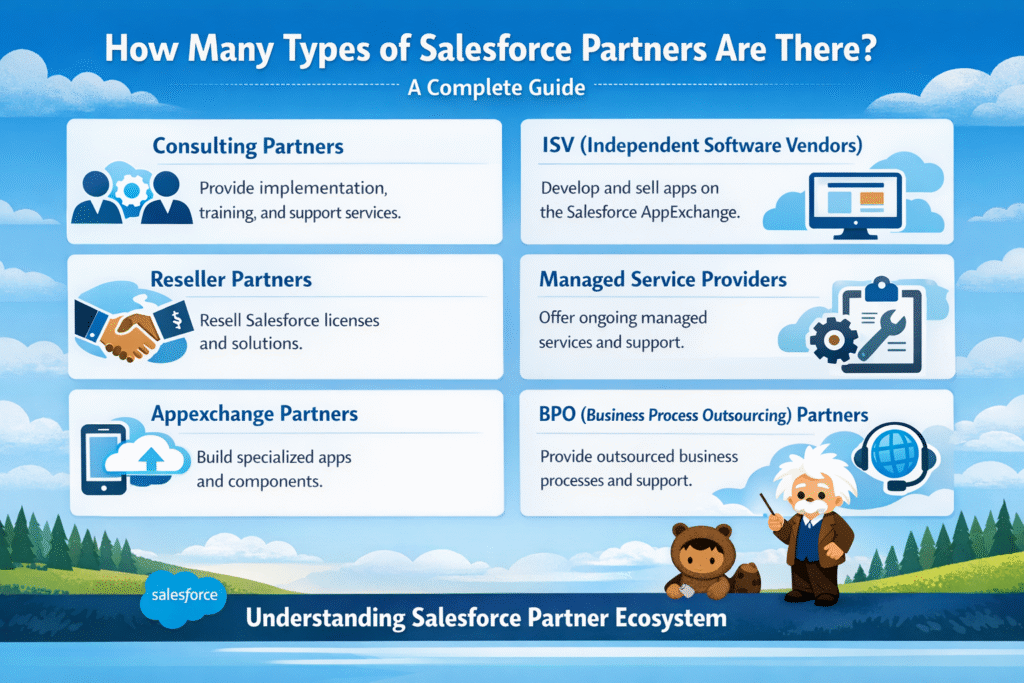
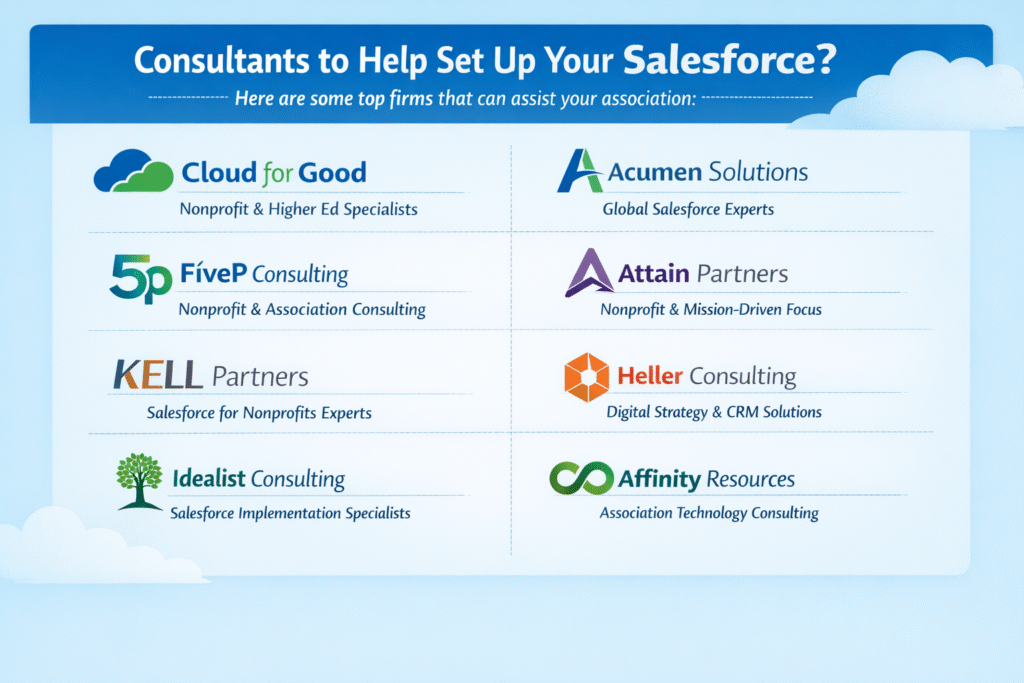
The Salesforce AppExchange is the official marketplace where you can find registered consulting partners. These firms have been vetted by Salesforce, hold certified staff, and are rated by client reviews. They range from large global firms to boutique specialists.
When browsing AppExchange, filter by:
Certified partners are held to standards that independent freelancers are not. If a project goes wrong, you have more recourse.
Smaller, specialist firms often offer a more personal relationship than large system integrators. They tend to be more agile, more communicative, and more willing to adapt their process to your organisation’s pace.
A firm like Sailwayz sits in this category. As a registered Salesforce Consulting Partner, Sailwayz works with organisations across industries,s including government bodies and professional services firms,s to design and build Salesforce setups that match how the business actually works. Their team holds over 50 combined Salesforce certifications, and their services cover the full project arc: consulting, implementation, migration, integration, and ongoing support.
For associations that want a dedicated team rather than a rotating cast of consultants from a large agency, this kind of firm is worth serious consideration.
Some consultants come to Salesforce through association management systems built on top of its products, like Fonteva, Nimble AMS, or MemberClicks (which has Salesforce integration). These consultants know the AMS layer deeply, which is useful if your association wants a packaged solution rather than a custom Salesforce build.
The trade-off is flexibility. AMS platforms have strong defaults for membership management, but they can be harder to extend if your workflows are unusual. A consultant who only works within one AMS product may push you toward their tool even if it’s not the best fit.
Freelancers on platforms like Upwork or Toptal can be cost-effective for smaller scopes, specific automation, a new report, or a single integration. For a full association Salesforce setup, they carry more risk. You lose the project management structure, the accountability of a firm, and the continuity if that person becomes unavailable mid-project.
If the budget is tight, a hybrid approach works well: use a consultancy for the core build and bring in a freelancer for specific tasks after go-live.
Before signing a contract, run through these questions with every candidate:
Visit appexchange.salesforce.com and search for the firm. Verify their tier (Registered, Silver, Gold, Platinum, Summit), their number of certified employees, and their customer satisfaction ratings. Summit-tier partners have the most experience and the highest requirements to maintain status.
A consultant worth hiring will want to understand your association thoroughly before proposing a solution. Be wary of anyone who sends a proposal within 24 hours of a first call. Good Salesforce consulting starts with asking the right questions, not jumping straight to answers.
You’ll be working with this team for months. Do they explain things clearly? Do they ask for your input or just present decisions? The best consultants treat your staff as partners in the project, not passive recipients of a solution.
Ask specifically: how many data migrations have you completed? What was the largest record count? What tools do you use? Have you ever had a migration fail, and how did you handle it?
Data is your most valuable asset in any CRM project. A consultant who can’t give you confident, detailed answers about their migration process is a risk.
Not every consultant who says they set up Salesforce actually does it well. Here are patterns that should give you pause:
Before you contact any consultant, do a quick internal audit. Write down:
Coming into those first conversations with clarity will save everyone time and help you assess whether a consultant is listening carefully or just pitching.
Once you have that document, reach out to two or three firms for initial calls. Compare how they respond, what questions they ask, and whether their proposed approach makes sense for your association’s actual situation.
Firms like Sailwayz offer free consultations as a starting point,t a useful way to pressure-test your thinking and get a professional read on your current state before committing to anything.
Q: How much does it typically cost to hire consultants to set up Salesforce for an association?
Costs vary based on scope, but most association Salesforce projects run between £15,000 and £80,000, depending on complexity, data volume, and the number of Salesforce products involved. Smaller, focused builds can come in below that range. Always ask for a breakdown of hours and deliverables.
Q: How long does a Salesforce setup project take for an association?
Most projects run three to six months from kick-off to go-live. Larger organisations with complex data or multiple system integrations may take longer. The discovery and data migration phases are usually the most time-consuming and the most important to get right.
Q: Do we need Salesforce Nonprofit Success Pack (NPSP) as an association?
Not necessarily. NPSP is designed for charitable non-profits. Associations that are membership organisations rather than charities often get better results from a standard Salesforce build configured for their workflows. A good consultant will help you decide which approach fits.
Q: What Salesforce products do associations typically use?
Most associations start with Sales Cloud for member and pipeline management, and add Service Cloud for member support, Experience Cloud for member portals, and Marketing Cloud or Marketing Cloud Account Engagement (formerly Pardot) for communications. The right mix depends on your organisation’s size and needs.
Q: Can an existing Salesforce setup be fixed if it was poorly implemented?
Yes. A Salesforce Health Check offered by firms like Sailwayz reviews your existing org, identifies problems, and produces a prioritised list of fixes. Many associations inherit poorly configured setups and benefit greatly from a structured remediation project rather than starting from scratch.

Joshua Eze is the Founder & Salesforce Architect at Sailwayz, a certified Salesforce Consulting Partner based in the UK. With over 6 years of experience leading CRM transformations, he is a certified Application & System Architect passionate about using technology to simplify business processes. Joshua helps companies unlock the full potential of Salesforce with strategic, scalable, and secure solutions.
