
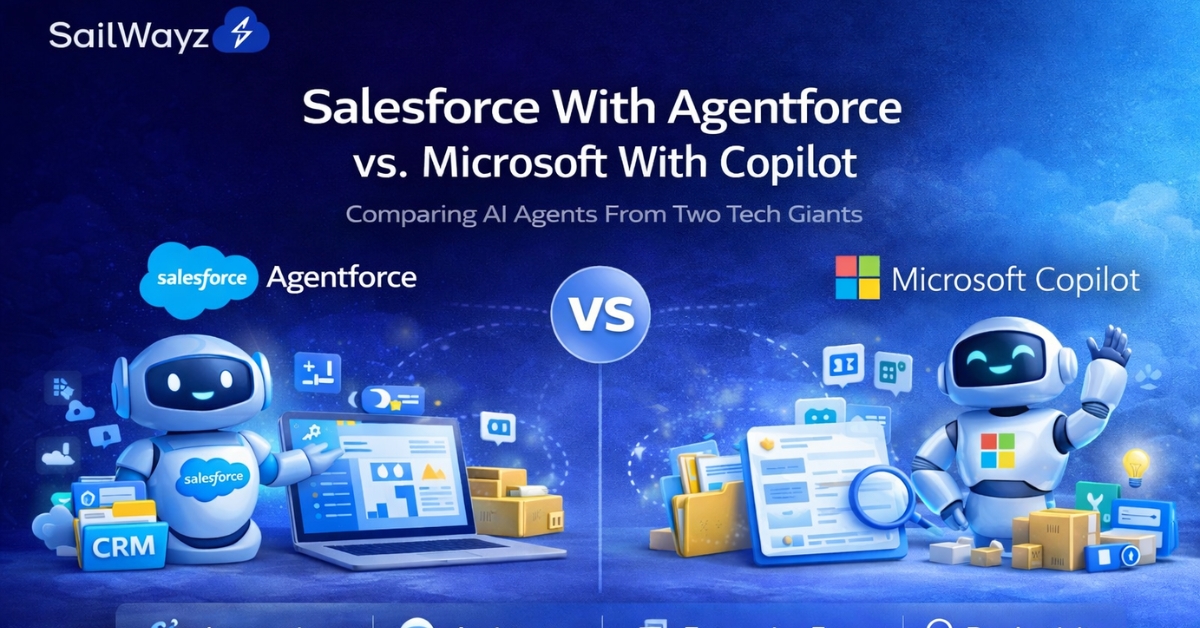
The race to deploy AI agents across enterprises has created a fascinating showdown between two tech giants: Salesforce with its Agentforce platform and Microsoft with Copilot Studio. Both promise to transform how businesses operate, but they take dramatically different approaches. If you’re trying to decide which platform fits your organisation, understanding these differences isn’t just helpful it’s essential.
This guide breaks down the real distinctions between Salesforce AI agents and Microsoft AI agents, helping you make an informed decision based on your business needs.
Before we dive into the comparison, let’s clarify what we’re talking about. AI agents are autonomous software applications that can understand context, make decisions, and take actions without constant human oversight. They’re different from traditional chatbots or even AI assistants because they can handle complex, multi-step tasks independently.
Think of AI agents as digital employees who can work 24/7, pulling data from multiple sources, making informed decisions, and executing tasks across various systems. The question isn’t whether your business will adopt them it’s which platform will power them.
Salesforce launched Agentforce as an enterprise agentic AI solution designed to bring together humans, applications, AI agents, and data. The platform centres on building specialised agents that can operate independently within customer-facing workflows.
Autonomous Action
Agentforce agents operate autonomously, retrieving data on demand, building action plans for any task, and executing these plans without requiring human intervention. This self-direction extends across sales, service, marketing, and commerce functions.
The Atlas Reasoning Engine
At the heart of Agentforce sits the Atlas Reasoning Engine, which enables agents to understand context, decide on next steps, and act accordingly. Agentforce 3 delivers an updated Atlas architecture with 50% lower latency since January 2025, making responses faster and more reliable.
Industry-Specific Solutions
Salesforce has built over 100 prebuilt industry actions for sectors like financial services, healthcare, and retail. These agents come configured for specific use cases, from banking service assistance to clinical site management.
Hybrid Reasoning with Agent Script
Agent Script combines deterministic workflows with flexible LLM reasoning, giving enterprises hybrid reasoning agents that are both precise and adaptable. This means you can define exact business logic that must run whilst still allowing AI to handle nuanced situations.
At Sailwayz, we’ve seen how Salesforce AI agents shine in customer relationship management scenarios. They’re particularly strong when you need:
Microsoft takes a different approach with Copilot Studio, positioning its AI agents as productivity enhancers that work alongside humans rather than independently from them.
Embedded Within Microsoft 365
Microsoft Copilot Studio is a cloud-based service that creates AI agents for several applications, including standalone agents for customer and employee care scenarios and extensions to Microsoft 365 Copilot. The platform integrates natively with Word, Excel, Teams, Outlook, and other Microsoft applications.
Generative Orchestration
Generative orchestration enables agents to generate contextual intelligent responses on the fly based on organisational knowledge sources, actions, and topics, eliminating the need to manually define every possible conversation path.
Multi-Agent Systems
Copilot Studio now supports multi-agent orchestration, where agents delegate tasks to one another across Microsoft 365, Azure AI Agents Service, and Microsoft Fabric. This allows complex workflows to span multiple systems and teams.
Computer Use Capability
Computer use in Copilot Studio allows agents to operate apps and websites directly, clicking, typing, and navigating user interfaces where no API or Model Context Protocol connection exists. This extends automation into areas previously requiring human intervention.
Microsoft Copilot agents are particularly strong in:
Now let’s break down the specific areas where these platforms diverge.
Agentforce is designed for autonomy AI agents that take full control of business workflows and act independently, whilst Copilot acts as a smart companion within Microsoft 365 apps, always keeping a human in the loop.
Salesforce agents are built to replace human tasks entirely. Microsoft agents are built to augment human capabilities.
Salesforce Approach
Agentforce pulls directly from Salesforce Data Cloud, which unifies CRM data, external sources, and real-time information. If your business runs on Salesforce CRM, this integration is seamless. The platform features a unified data layer that gives every agent context through innovations like Intelligent Context and Tableau Semantics.
Microsoft Approach
Microsoft agents access Work IQ, which combines data and memory to make connections and predict the next best action through Microsoft Graph. This works brilliantly if your organisation operates primarily within the Microsoft ecosystem.
The challenge comes when your primary systems live outside either ecosystem. Both platforms require additional integration work to connect external data sources effectively.
Salesforce Customisation
Building agents in Salesforce requires familiarity with tools like Flow Builder, Prompt Templates, and potentially Apex code for complex scenarios. The new Agentforce Builder unifies drafting, testing, and deployment into a single conversational workspace, making the process more accessible.
Microsoft Customisation
Copilot Studio offers flexible evaluation sets that can be created by uploading files, reusing Test Pane queries, adding cases manually, or generating queries using AI. The low-code approach is generally more accessible to non-technical users.
Salesforce Observability
Agentforce Command Center provides complete observability with unified analytics for agent health, latency, error rates, and usage trends. You can drill into specific interactions and see exactly what decisions the agent made and why.
Microsoft Observability
Copilot Studio surfaces themes for unanswered generative AI questions directly in the Analytics dashboard, helping makers quickly identify gaps in coverage. The analytics focus more on improving coverage than debugging autonomous decisions.
Salesforce Voice
Agentforce Voice delivers natural, human-like conversations with ultra-realistic, low-latency interactions built for real-time responsiveness. The platform supports phone, web, and mobile channels with full CRM integration.
Microsoft Voice
Copilot Studio provides a no-code to pro-code authoring experience for voice interactions, including barge-in control, single and multi-DTMF input, and silence detection.
Both platforms take voice seriously, but Salesforce positions it as a complete customer service channel whilst Microsoft treats it as one modality amongst many.
Pricing structures differ significantly between the platforms.
Salesforce Pricing
Agentforce pricing varies based on Salesforce editions and customisations. The platform typically requires higher upfront investment in configuration and development. For enterprises already invested in Salesforce, this cost integrates with existing CRM expenses.
Microsoft Pricing
Microsoft 365 Copilot starts at $30 per user per month, with Copilot Studio pricing separate. The subscription model is straightforward, but costs can accumulate across different Microsoft services.
At Sailwayz, we help businesses evaluate total cost of ownership, including implementation time, training requirements, and ongoing maintenance, not just licence fees.
Yes, and many organisations do. Combining Agentforce and Microsoft Copilot allows organisations to bridge the gap between personal productivity and business process automation. Microsoft Copilot handles individual workflow acceleration whilst Salesforce Agentforce manages autonomous customer interactions.
Both platforms have delivered measurable outcomes for customers.
Salesforce Success Stories
Reddit deflected 46% of support cases and cut resolution times by 84%, reducing average response time from 8.9 minutes to 1.4 minutes. Engine reduced average customer case handle time by 15%, whilst 1-800Accountant autonomously resolved 70% of administrative chat engagements during critical tax weeks.
Microsoft Success Stories
Microsoft has deployed Copilot agents across thousands of organisations, particularly in scenarios requiring cross-application workflows and employee self-service. The Employee Self-Service Agent helps employees quickly complete tasks such as checking leave balances, reviewing benefits, or submitting IT tickets.
Regardless of which platform you choose, successful implementation requires:
At Sailwayz, we specialise in Salesforce implementations and can help you navigate the complexities of deploying Agentforce effectively. Our team understands how to configure agents, integrate data sources, and train your staff to work productively with AI.
The question isn’t which platform has better AI agents both Salesforce and Microsoft have built sophisticated capabilities. The real question is which aligns with your existing technology stack, business processes, and strategic goals.
If your business revolves around customer relationships managed in Salesforce CRM, Agentforce offers deep integration and autonomous capabilities purpose-built for those scenarios. If your workforce operates primarily within Microsoft 365 and you’re looking to enhance productivity across Office applications, Copilot Studio provides natural integration with tools your team already uses.
The best approach? Define your specific business challenges, evaluate which platform addresses those challenges within your existing infrastructure, and pilot solutions before committing to enterprise-wide deployment.
What’s the main difference between Salesforce AI agents and Microsoft AI agents?
Salesforce Agentforce focuses on autonomous agents that independently handle customer-facing tasks like sales, service, and marketing without human intervention. Microsoft Copilot agents work as productivity assistants that enhance employee workflows within Microsoft 365 applications, keeping humans in the decision-making loop. Agentforce replaces tasks; Copilot augments them.
Can Salesforce AI agents integrate with Microsoft systems?
Yes, Salesforce agents can integrate with Microsoft systems through APIs and middleware like MuleSoft. However, the integration isn’t as seamless as native connections. Similarly, Microsoft Copilot can pull data from Salesforce through connectors, but with less contextual depth than when working within Microsoft’s ecosystem. Integration complexity is a key consideration when choosing platforms.
Which platform is more cost-effective for mid-sized businesses?
Microsoft Copilot typically has lower upfront costs with straightforward per-user monthly pricing starting at $30. Salesforce Agentforce requires more initial investment in configuration and development but may deliver higher ROI for businesses already using Salesforce CRM. Total cost depends on your existing infrastructure, implementation complexity, and the specific use cases you’re automating.
Do I need technical expertise to build AI agents on these platforms?
Both platforms offer low-code tools, but with different accessibility levels. Microsoft Copilot Studio is generally more approachable for non-technical users with visual editors and natural language configuration. Salesforce Agentforce requires more familiarity with Salesforce tools like Flow Builder, though the new Agentforce Builder simplifies the process. Complex scenarios on either platform may require developer support.
Can these AI agents handle voice interactions with customers?
Yes, both platforms support voice capabilities. Salesforce Agentforce Voice provides natural conversational experiences across phone, web, and mobile with full CRM integration. Microsoft Copilot Studio offers voice interaction features including barge-in control and silence detection. Salesforce positions voice as a primary customer service channel, whilst Microsoft treats it as one interaction mode amongst several.

Joshua Eze is the Founder & Salesforce Architect at Sailwayz, a certified Salesforce Consulting Partner based in the UK. With over 6 years of experience leading CRM transformations, he is a certified Application & System Architect passionate about using technology to simplify business processes. Joshua helps companies unlock the full potential of Salesforce with strategic, scalable, and secure solutions.
