

If you run a small business and you’ve been researching CRM software, you’ve almost certainly landed on Salesforce. It’s the biggest name in the space, holding around 21% of the global CRM market. But a big name doesn’t always mean the right fit, especially when you’re watching every pound and every hour.
So is Salesforce worth it for a small business? The honest answer is: it depends on what stage you’re at, what you need, and how you approach it. This post breaks it all down so you can make an informed call.
Salesforce is a cloud-based customer relationship management (CRM) platform. At its core, it helps you manage contacts, track sales opportunities, automate repetitive tasks, and report on your team’s performance all from one place.
For small businesses, the relevant entry points are:
Those are the headline numbers. But as we’ll get into, the licence fee is only part of the picture.
This is where many small businesses get tripped up. The software subscription is just one line item.
Here’s what the full picture typically looks like:
Licence fees — Starting at £25/user/month sounds manageable. But five users on the Starter Suite is £1,500/year, and ten users on the Pro Suite is £10,000/year. Costs scale quickly.
Implementation — Unless you have someone in-house who knows Salesforce well, you’ll need a consultant to set it up properly. For small businesses, implementation typically runs between £8,000 and £30,000, depending on complexity.
Training — Salesforce has a learning curve. Budget time and money for getting your team up to speed. Salesforce’s free Trailhead platform helps, but it still takes time.
Add-ons — Need API access? Advanced analytics? Marketing automation beyond the basics? These come at an extra cost.
Annual contracts — Most plans (excluding Starter Suite) require annual billing. That’s a significant commitment if you’re unsure whether it’s the right fit.
None of this means Salesforce is overpriced. It means you need to go in with eyes open about the total investment, not just the per-user fee you saw on the pricing page.
If your team is currently tracking leads in spreadsheets, chasing emails to find conversation history, or duplicating data across systems, Salesforce fixes that. You get one source of truth for every customer interaction, deal stage, and communication log.
Here’s why that matters: according to industry research, CRM software delivers an average return of £8.71 for every £1 spent. Businesses also report a 29% increase in sales revenue after adopting CRM, largely because nothing falls through the cracks.
Manual follow-up emails, task reminders, lead assignment, quote generation, and these take up hours every week that your team could spend selling or serving customers. Research from CRM.org found that employees save 5 to 10 hours per week through CRM automation. For a small team, that’s substantial.
One reason Salesforce is popular with small businesses that plan to grow is that you won’t outgrow it. You can start on Starter Suite and move to Pro, then Enterprise as your team expands,s without migrating to a different platform. That continuity matters. Rebuilding on a new CRM every few years is expensive and disruptive.
Salesforce’s AppExchange has over 4,000 apps you can connect to your instance — accounting tools, marketing platforms, e-commerce integrations, and more. If your business relies on specific third-party software, there’s a good chance a native integration exists.
Even on smaller plans, Salesforce includes AI features through Einstein. These help with lead scoring, next-best-action suggestions, and sales forecasting. For a small sales team, having the system flag your highest-probability leads means you’re spending time where it counts.
If you have fewer than three or four people in sales and your pipeline fits on a single sheet, Salesforce may be more than you need right now. Simpler, cheaper CRMs like HubSpot (which has a free tier) or Zoho (starting around £12/user/month) can handle basic contact management without the overhead.
Salesforce is powerful, but it requires proper configuration to deliver value. Out of the box, it’s not plug-and-play for most small businesses. If you don’t have someone who knows the platform or the budget to hire a consultant, you risk paying for a tool that nobody uses properly.
If you have a very short, repeatable sales cycle and don’t need complex pipeline management, reporting, or automation, the cost-to-benefit ratio may not stack up.
Annual contracts at the Pro level and above mean you’re committing £10,000+ per year before implementation costs. If cash flow is tight, that’s a meaningful risk.
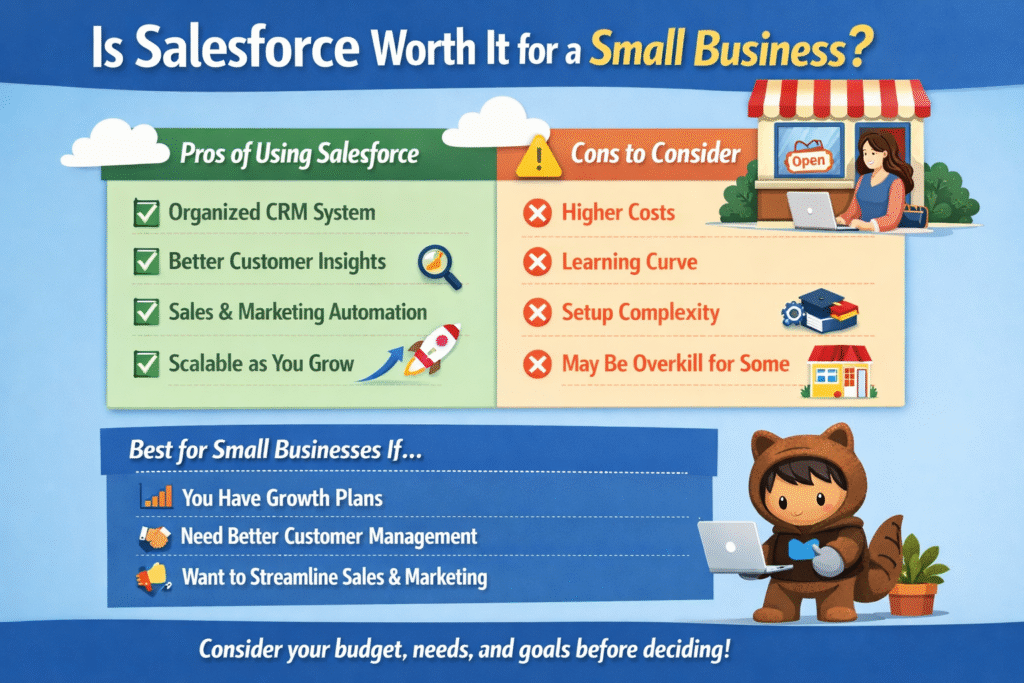
Here’s a straightforward way to think about it:
Salesforce is likely worth it if:
You may want to start elsewhere if:
If you decide to go ahead, how you implement Salesforce matters at least as much as whether you implement it. Research consistently shows that CRM failures are almost always about adoption and configuration, not the software itself.
A few things that make a real difference:
Work with a certified consultant from the start. Getting the data model, workflows, and automations right in the early stages saves significant time and cost later. Reworking a poorly built Salesforce instance is expensive.
Define your process before you build. Salesforce should reflect how your business works, not force you into a generic sales process. Map out your pipeline stages, your lead sources, and your key reports before anyone touches the platform.
Train your team properly. A CRM only works if people use it consistently. Plan for training time, not just setup time. Salesforce’s free Trailhead platform is a solid resource for getting your team up to speed.
Start with what you need, not everything it can do. One of the most common mistakes small businesses make is trying to configure every feature at once. Start with the core workflow, contact management, pipeline tracking, and one or two automations, then build from there.
Review regularly. Set a quarterly check-in to look at adoption rates, data quality, and whether the reports you’re running are actually informing decisions.
This is exactly the approach that Salesforce consulting partners like Sailwayz take with clients, starting with a proper discovery of what the business actually needs, then building a Salesforce environment that fits, rather than one that technically works but nobody wants to use.
It’s worth knowing what you’re comparing against. Here’s a rough breakdown:
CRM | Starting Price | Best For |
Salesforce Starter | £25/user/month | Growing teams need scalability |
HubSpot Free/Starter | Free – £15/user/month | Early-stage businesses, simple pipelines |
Zoho CRM | £12–£35/user/month | Budget-conscious SMEs |
Pipedrive | £12/user/month | Sales-focused teams with simple pipelines |
HubSpot and Zoho are genuinely good options for smaller operations or those just starting out. Salesforce tends to show its value as your team grows, your pipeline becomes more complex, and you need the reliability and customisation that comes with the market leader.
For many small businesses, yes, but only if you approach it correctly.
The platform itself is capable, reliable, and designed to grow with you. The data supports it: businesses using CRM see a 27% improvement in customer retention on average, and 83% of small businesses that adopt CRM report a positive return. Salesforce, as the dominant platform in the space, tends to deliver those results for teams that commit to using it properly.
The risk isn’t the software. It’s going in underprepared, underestimating implementation costs, skipping proper configuration, or expecting it to work straight out of the box with no support.
If you’re serious about using Salesforce to grow your business, the smartest move is to get expert guidance before you sign a contract. A good Salesforce consultant will tell you honestly whether the platform is right for your current situation, which edition makes sense, and what implementation will actually cost, not just what the pricing page says.
That’s precisely what the team at Sailwayz does. As a registered Salesforce consulting partner with over 50 combined certifications, they work with businesses across industries to make sure Salesforce is set up to actually deliver results, not just sit in the background. You can schedule a free consultation directly on their site.
Salesforce does have a learning curve, but it’s not unmanageable. With proper setup and training, most small business teams can get comfortable with the core features within a few weeks. The key is not trying to use every feature at once, but starting with the basics and building from there.
The entry-level plan, the Starter Suite, costs £25 per user per month and supports up to 10 users. However, the total cost, t, including setup, data migration, and training, is typically higher. Realistically, small businesses should budget for implementation costs on top of the licence fee.
Technically,y yes, but it’s rarely the best approach. Without proper configuration, you risk building a system that doesn’t reflect how your business works. Most small businesses that go it alone end up needing a consultant later to fix issues, which usually costs more than doing it right the first time.
Most businesses see measurable returns within 12 months of implementation. Early wins, like better data visibility and automated follow-up,s often appear within the first 90 days. The broader financial returns, such as increased sales and reduced customer acquisition costs, typically materialise over the course of the first year.
Salesforce does not offer a permanently free plan. They do provide a 30-day free trial, which is worth using to test the platform before committing. If budget is the main concern, HubSpot’s free CRM tier is a popular alternative for very small teams getting started.

Joshua Eze is the Founder & Salesforce Architect at Sailwayz, a certified Salesforce Consulting Partner based in the UK. With over 6 years of experience leading CRM transformations, he is a certified Application & System Architect passionate about using technology to simplify business processes. Joshua helps companies unlock the full potential of Salesforce with strategic, scalable, and secure solutions.
