
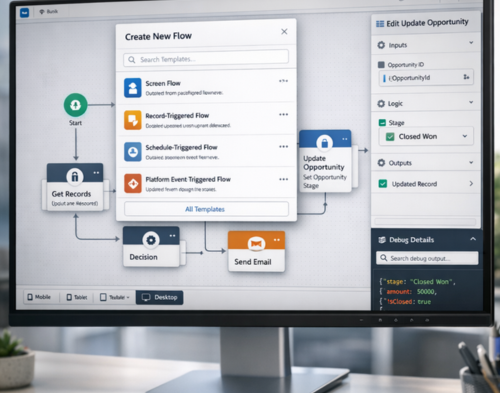
Salesforce has become the world’s leading customer relationship management (CRM) platform, trusted by businesses across every continent. From small startups to multinational enterprises, organisations rely on this cloud-based solution to manage customer relationships, streamline operations, and drive growth. But just how widespread is Salesforce adoption?
Over 150,000 companies worldwide use Salesforce as their CRM solution, making it the most widely adopted platform in the customer relationship management sector. This number continues to grow year after year, reflecting the platform’s ability to adapt to changing business needs and deliver measurable results.
What makes these figures particularly striking is the diversity of organisations using Salesforce. Among all Salesforce customers, 49% are small businesses with fewer than 50 employees, 40% are medium-sized companies, and 11% are large enterprises with over 1,000 employees. This distribution shows that Salesforce isn’t just for corporate giants; it serves businesses at every stage of growth.
Salesforce’s dominance in the CRM market is clear. With a 21.7% share, Salesforce leads the global CRM market, outpacing competitors like Microsoft, Oracle, SAP, and Adobe by substantial margins. This leadership position isn’t new; the company has held the top spot for over a decade.
More than 90% of Fortune 500 companies use Salesforce, demonstrating the platform’s reliability and enterprise-grade capabilities. Names like Amazon Web Services, Walmart, American Express, Toyota, and Spotify all depend on Salesforce to manage their customer relationships and drive business outcomes.
For businesses considering Salesforce implementation, partnering with experienced consultants can make the difference between a good rollout and a great one. Sailwayz specialises in helping organisations navigate their Salesforce journey, from initial setup to ongoing optimisation.
Professional services lead the way, making up around 29% of Salesforce customers. This category includes consulting firms, legal practices, IT service providers, and advertising agencies that thrive on client relationships and need robust systems to manage them.
Manufacturing companies account for 11.1% of users, followed by financial and banking services at 9.8%, and retail at 7.8%. These sectors have unique requirements, from supply chain management to regulatory compliance, which Salesforce addresses through industry-specific solutions.
Other sectors with significant Salesforce adoption include:
This wide industry spread shows Salesforce’s flexibility. Whether you’re managing complex manufacturing workflows or nurturing donor relationships in the nonprofit sector, the platform can be configured to meet specific needs.
Approximately 61.8% of Salesforce clients come from the United States, with California, New York, and Texas representing the largest concentrations. The Americas region generated $23.29 billion in revenue for Salesforce, representing 66.81% of total revenue.
The European region contributed $8.13 billion (23.32% of revenue), whilst the Asia-Pacific region recorded $3.44 billion (9.87%). These figures reflect both market maturity and growth potential across different regions.
For UK-based businesses, Salesforce adoption continues to grow steadily. The platform’s cloud-based nature means companies can access the same powerful tools regardless of location, with data centres ensuring fast performance and compliance with local regulations.
Salesforce CRM is particularly widespread amongst smaller companies with annual revenue between £1 and £ 10 million. This segment values the platform’s scalability, starting with basic features and adding capabilities as the business grows.
Businesses generating £10-50 million annually form the second-largest group, whilst enterprises with revenues exceeding £50 million make up the third category. This distribution shows that Salesforce pricing and feature sets accommodate different budgets and requirements.
The platform’s ability to serve such diverse company sizes stems from its tiered pricing model and modular structure. Small teams might start with Sales Cloud to manage their pipeline, whilst large enterprises deploy multiple clouds, Sales, Service, Marketing, Commerce, and more, integrated into a unified customer view.
Whilst Salesforce began as a sales automation tool, its usage now spans entire organisations:
Sales Teams: Track leads, manage pipelines, forecast revenue, and close deals faster
Customer Service: Handle support tickets, manage cases across channels, and deliver personalised assistance
Marketing: Create campaigns, nurture leads, track customer journeys, and measure ROI
Operations: Automate workflows, manage data, generate reports, and drive efficiency
Product Development: Around 22% of companies use Salesforce to speed up product development through better collaboration and project management
This cross-departmental adoption means customer data flows seamlessly between teams. When sales closes a deal, service teams immediately access the customer’s history. Marketing can see which campaigns drive the most valuable customers. Everyone works from the same information.
Salesforce’s financial results reflect its market position. The company achieved annual revenue of $34.86 billion for fiscal year 2024, reflecting an 11% year-over-year growth. Looking ahead, revenue is expected to reach $41.45 billion to $41.55 billion in fiscal year 2026.
Subscription and support services generated $32.54 billion, representing 93.34% of total revenue, whilst professional services contributed $2.32 billion. This subscription-heavy model provides predictable, recurring revenue and aligns Salesforce’s success with customer satisfaction.
The platform’s financial strength enables continuous investment in new features, acquisitions that expand capabilities, and a global partner ecosystem. For businesses evaluating CRM options, this financial stability offers reassurance about long-term viability.
Several factors drive Salesforce’s popularity across different company types and industries:
Cloud-Native Architecture: No servers to maintain, automatic updates, and access from anywhere with an internet connection. Teams can work remotely without sacrificing functionality.
Customisation Capabilities: Businesses can tailor Salesforce extensively without writing code, using declarative tools to create custom fields, objects, workflows, and processes that match their unique requirements.
AppExchange Marketplace: Over 5,000 pre-built applications extend Salesforce functionality, from accounting integrations to industry-specific tools. This ecosystem means you rarely need to build something from scratch.
AI and Automation: Einstein AI provides predictive insights, automates routine tasks, and surfaces relevant information at the right time. Since October 2024, Salesforce has closed 5,000 Agentforce deals for AI-powered agent solutions.
Mobile Accessibility: Native mobile apps give teams full CRM access on smartphones and tablets, keeping field sales, service technicians, and executives connected.
Scalability: Start with basic features and add users, functionality, and integrations as needed. The platform grows with your business without requiring migration to new systems.
For organisations seeking to implement or optimise Salesforce, working with certified partners like Sailwayz ensures you extract maximum value from your investment. Their expertise helps businesses avoid common pitfalls and accelerate time to value.
More than 60% of customers who already use Salesforce’s main products plan to adopt additional Salesforce services in the future. This expansion pattern is common for companies, typically starting with one cloud (usually Sales or Service) and gradually adding others as they see results.
The typical adoption journey follows this path:
Businesses that follow this structured approach see better adoption rates and faster ROI than those trying to implement everything simultaneously.
Given Salesforce’s extensive capabilities, many organisations partner with certified consultants to guide their implementation. Sailwayz offers specialised expertise across multiple Salesforce products, helping businesses design solutions that align with their specific goals and industry requirements.
Certified consultants provide several benefits:
Strategic Planning: Assess current processes, identify improvement opportunities, and create a roadmap that delivers quick wins whilst building toward long-term transformation.
Technical Implementation: Configure Salesforce correctly from the start, avoiding costly rework and ensuring the system matches business requirements.
Change Management: Help teams adapt to new workflows, provide training, and address resistance to ensure high user adoption.
Integration Expertise: Connect Salesforce with existing systems, ERP, marketing automation, and accounting software, creating a unified technology ecosystem.
Ongoing Support: Assist with go-live, helping teams troubleshoot issues, add new features, and optimise their Salesforce investment over time.
Salesforce serves diverse business models, each using the platform differently:
B2B Companies: Focus on longer sales cycles, account-based marketing, and complex approval processes. They often use opportunity management, quote generation, and partner relationship management features extensively.
B2C Businesses: Prioritise marketing automation, customer service efficiency, and e-commerce integration. They typically handle higher transaction volumes with shorter sales cycles.
B2B2C Organisations: Manage both direct customers and channel partners, requiring sophisticated portal solutions and partner management tools.
Subscription Businesses: Leverage Salesforce for recurring billing, churn prediction, customer success management, and lifetime value optimisation.
This flexibility means companies don’t need to compromise their business model to fit the software; Salesforce adapts to how they operate.
Analysts expect Salesforce’s customer base to continue expanding. The customer base is predicted to double by the end of 2026, driven by several factors:
Digital Transformation Acceleration: More businesses recognise the need for integrated customer data and automated processes.
Remote Work Normalisation: Cloud-based CRM systems are no longer optional; they’re required for distributed teams to collaborate effectively.
AI Advancement: As artificial intelligence becomes more sophisticated, businesses want platforms that incorporate these capabilities natively.
Industry-Specific Solutions: Salesforce’s investment in vertical solutions (Financial Services Cloud, Health Cloud, Manufacturing Cloud) attracts organisations seeking purpose-built tools.
Global Expansion: As Salesforce expands data centre presence and local partnerships, adoption grows in previously underserved markets.
For businesses considering Salesforce, now represents an opportune time to adopt. The platform is mature, the partner ecosystem is robust, and best practices are well-established.
About Sailwayz
Sailwayz is a certified Salesforce consulting partner helping businesses unlock the full potential of their CRM investment. With over 50 combined Salesforce certifications, their team provides tailored implementation, customisation, integration, and ongoing support services across industries. Whether you’re starting your Salesforce journey or optimising an existing deployment, Sailwayz delivers expertise that drives measurable results.
How many small businesses use Salesforce compared to large enterprises?
Small businesses with fewer than 50 employees represent 49% of Salesforce customers, making them the largest user segment. Medium-sized companies account for 40%, whilst large enterprises with over 1,000 employees comprise 11%. This distribution shows Salesforce successfully serves organisations at every scale, with pricing and features tailored to different needs.
Which countries have the highest Salesforce adoption rates?
The United States leads with approximately 62% of all Salesforce customers, followed by the United Kingdom at 13.6% and France at 4.9%. American companies in California, New York, and Texas show the highest concentration. European and Asia-Pacific markets continue growing steadily as cloud adoption increases globally.
What industries rely most heavily on Salesforce?
Professional services firms represent 29% of Salesforce users, making them the largest industry segment. Manufacturing follows at 11.1%, then financial services at 9.8%, and retail at 7.8%. The platform also sees strong adoption in healthcare, education, nonprofit, consumer goods, and media sectors due to industry-specific solutions.
How quickly are companies expanding their Salesforce usage?
Over 60% of existing Salesforce customers plan to adopt additional services beyond their initial implementation. Companies typically start with one cloud solution and gradually expand to others as they experience benefits. This expansion pattern demonstrates customer satisfaction and the platform’s ability to grow alongside businesses.
What percentage of Fortune 500 companies use Salesforce?
More than 90% of Fortune 500 companies rely on Salesforce for customer relationship management. Major corporations like Amazon Web Services, Walmart, American Express, Toyota, and Spotify all use the platform. This widespread enterprise adoption validates Salesforce’s reliability, security, and ability to handle complex, large-scale operations.



Joshua Eze is the Founder & Salesforce Architect at Sailwayz, a certified Salesforce Consulting Partner based in the UK. With over 6 years of experience leading CRM transformations, he is a certified Application & System Architect passionate about using technology to simplify business processes. Joshua helps companies unlock the full potential of Salesforce with strategic, scalable, and secure solutions.
