
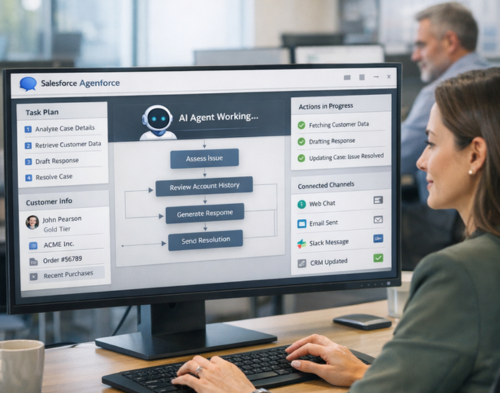
Salesforce has changed the conversation around AI in business. At the heart of this transformation sits Agentforce, a platform that moves beyond simple chatbots to deliver what Salesforce calls “the third wave of AI.” But how does Salesforce Agentforce work, and what makes it different from other AI tools?
Let’s break it down.
Salesforce Agentforce is a platform for building and deploying AI agents that work on their own. These agents can handle customer service enquiries, qualify sales leads, manage marketing campaigns, and complete tasks across any business function without constant human supervision.
Think of Agentforce as digital labour. Unlike copilots that need prompting at every step, these agents can retrieve data, build action plans, and execute tasks independently. They operate around the clock across multiple channels, including web chat, mobile, email, SMS, and Slack.
Salesforce launched the platform in October 2024, pricing it at $2 per conversation with volume discounts available. The system includes pre-built agents for common business roles and tools for creating custom agents tailored to specific needs.
Understanding how Salesforce Agentforce work requires looking at its key parts. The platform combines several elements to create truly autonomous agents.
The Atlas Reasoning Engine serves as the brain behind Agentforce. This proprietary system simulates human thinking and planning processes, setting Agentforce apart from traditional AI assistants.
Atlas uses “System 2” reasoning, which means it thinks deliberately rather than responding reflexively. When you ask an agent a question, Atlas doesn’t just pattern-match from training data. It evaluates the query, retrieves relevant information, builds an execution plan, refines that plan based on context, and then executes it.
The engine combines 8-12 specialised language models for each task. This multi-model approach allows agents to handle different aspects of a query with the right tools. For customer service applications, early pilots showed a 33% increase in accuracy and a twofold improvement in response relevance compared to DIY AI systems.
Atlas operates in what Salesforce calls an “agentic loop.” The system can pause, reflect, and loop back to gather additional information if the initial response isn’t satisfactory. This self-reflection capability allows agents to adapt their approach based on changing customer questions or new context.
Agentforce agents need access to information. Data Cloud gives them real-time connections to both structured and unstructured data without copying information from existing warehouses.
The system uses ensemble retrieval augmented generation (RAG), combining strengths from several RAG models to find highly specific, accurate data. When an agent needs information, it can search across multiple data sources simultaneously, pulling in customer records, product details, support articles, and more.
This approach reduces hallucinations because agents ground their responses in actual company data rather than making up information.
Every field, label, entry, and automation built on the Salesforce Platform gets tagged with metadata that Agentforce can read and understand. This metadata allows agents to know exactly how to use a workflow or what data they need to retrieve.
For businesses already using Salesforce, this creates a major advantage. Existing flows, prompt templates, Apex code, and APIs can become agent actions instantly, without rebuilding infrastructure from scratch.
Prompt Builder lets administrators create repeatable, tailored prompts that deliver the exact data an agent needs. These prompts retrieve both structured and unstructured data in real time, giving agents the knowledge they need to respond accurately.
Now that we’ve covered the components, let’s walk through how Salesforce Agentforce work in practice when an agent receives a task.
When a customer or employee interacts with an agent, the input first passes through the Einstein Trust Layer, which checks for abusive content. Atlas then determines if the input is a valid query or just casual conversation.
The reasoning engine refines the query by adding relevant context. If a customer asks about their order status, Atlas might expand that query to include the customer’s account details, recent order history, and current delivery information.
Atlas breaks down the refined query into smaller tasks. For a customer service inquiry about a broken product, the agent might need to:
At each step, the engine evaluates its progress and adjusts the plan. If troubleshooting steps don’t resolve the issue, the agent can automatically create a return authorisation or schedule a technician visit.
The system uses Large Action Models (LAMs) and function calling to connect with external tools and APIs. This allows agents to actually complete tasks, not just suggest them.
Agents can be triggered by multiple events, not just user inputs. They might activate when a case status updates, an email arrives, or a meeting starts in five minutes. This proactive capability makes them useful across both front and back office functions.
When agents need information, they tap into dynamic sources rather than relying on static grounding. They can pull current stock levels, check real-time pricing, verify account balances, and access the latest policy documents.
Creating agents in Agentforce happens through Agent Builder, which uses natural language instructions. Administrators can describe what they want an agent to do, and the system auto-generates the agent structure.
Five attributes define each agent:
The Agentforce 2.0 update introduced a library of pre-built skills spanning CRM, Slack, and Tableau. These ready-to-use skills simplify building tailored agents without starting from zero.
Companies have reported measurable results from Agentforce deployments. Wiley saw a 40% increase in case resolution during their busy back-to-school season. The company went live with their first agent and outperformed their previous bot significantly.
OpenTable is using Agentforce to deliver personalised support for restaurants and diners. Saks is exploring the platform to enhance personalisation in luxury retail experiences.
For businesses looking to implement Agentforce, working with certified Salesforce partners can accelerate deployment and maximise value. Sailwayz, a certified Salesforce consulting partner, helps organisations implement and customise Agentforce solutions tailored to their specific business needs.
Salesforce introduced the Testing Centre in December 2024, giving businesses tools to test agents before deployment. The centre verifies that agents follow instructions, stay factual, and work quickly.
Testing helps organisations catch potential issues early. Agents can be prototyped in secure Sandbox environments, then moved to production once validated.
The platform offers agent lifecycle management tools to automate testing, transparently manage usage at scale, and monitor performance across deployments.
What separates Agentforce from Einstein Copilot and similar tools?
Autonomy: Copilots need continuous direction. Agentforce agents can complete entire workflows independently.
Reasoning: Traditional chatbots follow pre-determined conversational flows. Agentforce agents adapt in real time using the Atlas Reasoning Engine.
Proactivity: Agents can initiate actions based on triggers and business rules, not just respond to queries.
Integration: The platform connects natively with the entire Salesforce Customer 360 ecosystem, plus external systems through MuleSoft.
Accuracy: The multi-model approach and deliberative reasoning significantly reduce hallucinations compared to single-model systems.
Agentforce includes several pre-built agents:
Service Agent: Handles customer service enquiries, replaces traditional chatbots, resolves cases autonomously
Sales Development Representative: Engages with leads 24/7, qualifies prospects, schedules meetings
Sales Coach: Provides training, joins calls, offers feedback to sales teams
Campaign Optimiser: Manages marketing campaign lifecycles, adjusts strategies based on performance
Buyer: Assists B2B customers with product discovery, purchases, and order tracking
Personal Shopper: Recommends products, helps with search, personalises shopping experiences
Merchant: Manages site operations, creates promotions, writes product descriptions
Organisations can use these out-of-the-box or build custom agents for any industry or use case.
Implementing AI agents requires more than just enabling features. Sailwayz works with businesses to assess their operations, identify opportunities for AI automation, and design Agentforce solutions that align with their goals.
The certified consultants at Sailwayz provide end-to-end support, from initial strategy through implementation and ongoing optimisation. Their approach focuses on practical results and measurable ROI, ensuring that Agentforce becomes a genuine business driver rather than just another technology purchase.
Salesforce aims to empower one billion agents with Agentforce by the end of 2025. The company has hired over 1,000 employees to meet demand for the platform.
Recent updates in Agentforce 2.0 include enhanced reasoning capabilities, improved data retrieval techniques, and voice capabilities across all channels. Agent Script brings hybrid reasoning that combines deterministic workflows with flexible language model reasoning.
The platform continues evolving rapidly. The Atlas Reasoning Engine receives regular updates to handle more complex interactions requiring deeper processing. New pre-built skills and workflow integrations arrive frequently, expanding what agents can do without custom development.
Agentforce shows genuine promise, but businesses should understand limitations. Agents remain only as good as the data they can access. Organisations need to invest in building out Data Cloud to give agents the information they need.
Usage-based pricing at $2 per conversation raises questions about cost-effectiveness at scale. Companies should model expected conversation volumes and compare costs against current solutions.
The platform requires businesses to define clear guardrails and escalation rules. Agents need boundaries to operate safely, particularly for actions involving spending, data access, or customer commitments.
Here’s how most organisations approach Agentforce implementation:
Working with experienced consultants like Sailwayz can smooth this process significantly. Their team helps businesses avoid common pitfalls and accelerate time to value.
What makes Agentforce different from traditional chatbots?
Traditional chatbots follow pre-programmed conversation flows and can only respond to queries they’ve been specifically trained to handle. Agentforce agents use the Atlas Reasoning Engine to understand context, build action plans dynamically, and adapt to changing situations in real time. They can complete entire workflows independently rather than just answering questions.
Can Agentforce integrate with systems outside Salesforce?
Yes, Agentforce can connect to external systems through MuleSoft APIs and workflow integrations. The platform works with CRM data, Slack, Tableau, and partner applications available through AppExchange. This flexibility allows agents to access information and take actions across your entire technology stack, not just within Salesforce.
How accurate are Agentforce agents compared to human workers?
Early pilot programmes showed 33% improvement in accuracy and 2x increase in response relevance compared to DIY AI solutions. Companies like Wiley reported 40% increases in case resolution during peak periods. Agents excel at routine tasks with clear parameters but should escalate complex situations requiring human judgment or emotional intelligence.
What kind of training do employees need to work with Agentforce?
Administrators need training on Agent Builder to configure agents, set guardrails, and monitor performance. End users typically require minimal training since agents handle most interactions automatically. The bigger change involves shifting employee roles from handling routine tasks to managing exceptions and complex cases that agents escalate.
Is Agentforce suitable for small businesses or just enterprises?
Agentforce works for organisations of any size, though the $2 per conversation pricing model and implementation effort mean it makes most sense for businesses with significant customer interaction volumes. Small businesses might start with pre-built agents for common scenarios, while larger organisations often build custom agents for specific processes and industries.

Joshua Eze is the Founder & Salesforce Architect at Sailwayz, a certified Salesforce Consulting Partner based in the UK. With over 6 years of experience leading CRM transformations, he is a certified Application & System Architect passionate about using technology to simplify business processes. Joshua helps companies unlock the full potential of Salesforce with strategic, scalable, and secure solutions.
