
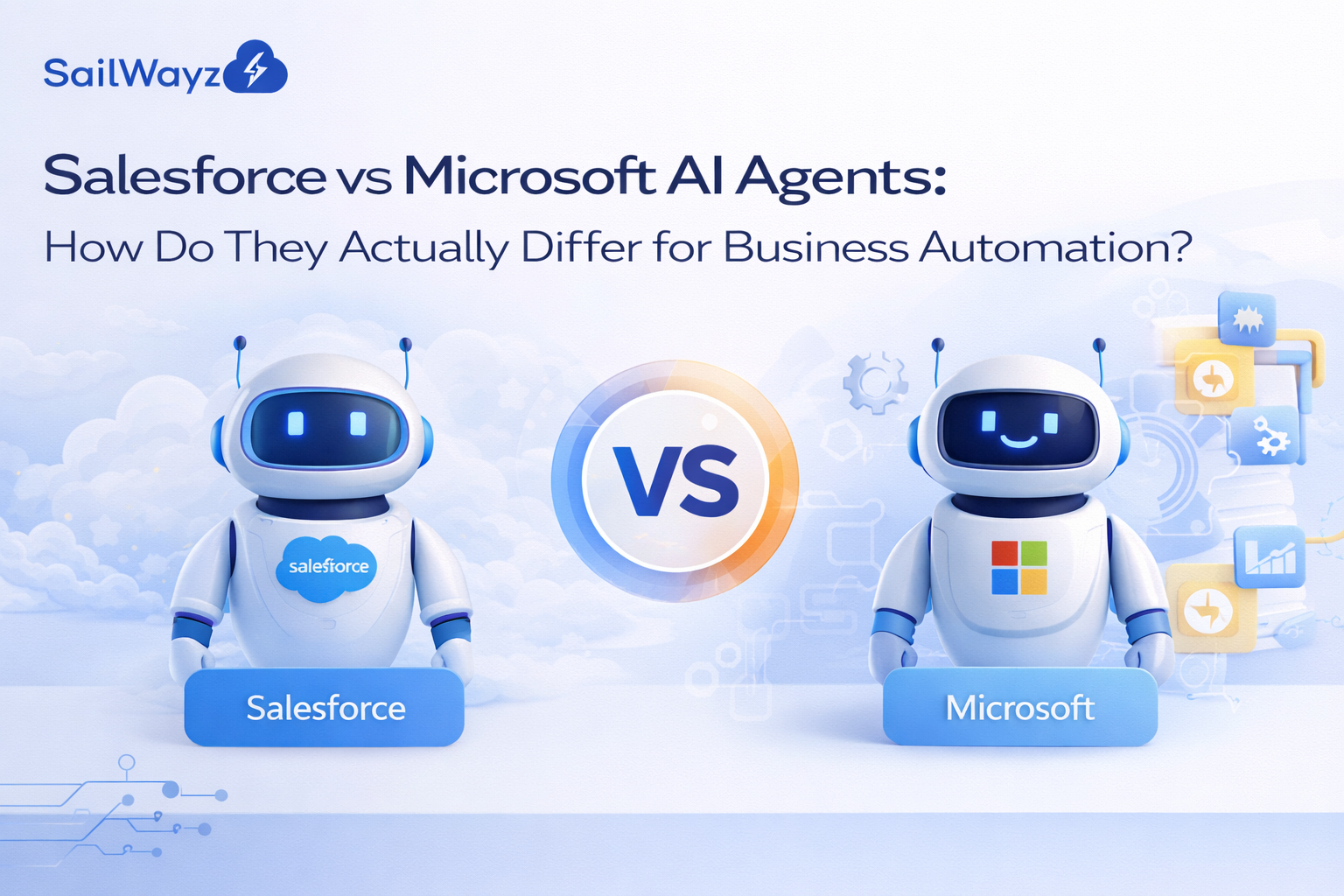
Every boardroom conversation about AI eventually lands on the same two names: Salesforce and Microsoft. Both have poured billions into autonomous AI agents. Both promise to change how businesses operate. And both will tell you they are the best option.
But when you strip back the marketing, the differences are significant and knowing them could save your business a lot of wasted time and money.
This post breaks down how Salesforce vs Microsoft AI agents compare when it comes to automating real business processes, so you can make a properly informed decision.
Before we compare the two platforms, it helps to be clear on what an AI agent actually is because the word gets thrown around loosely.
A true AI agent does not just respond to prompts. It takes autonomous action. It can assess a situation, decide what steps to take, execute those steps across multiple systems, and complete a task end-to-end without a human needing to supervise every move.
That is different from a copilot or assistant, which waits for you to ask it something and then helps you act on the answer.
Both Salesforce and Microsoft now offer tools that sit along this spectrum, but they land in very different places on it and that matters enormously when you are deciding which platform to build your automation strategy around.
Salesforce launched Agentforce in 2024, replacing its earlier Einstein Copilot product. The core idea is vertical depth agents that go deep into customer-facing processes rather than wide across every department.
Agentforce runs on what Salesforce calls the Atlas Reasoning Engine, sitting on top of the Einstein 1 Platform and Salesforce Data Cloud. That data layer is what gives it its edge. Because your customer records, sales history, service cases, and marketing interactions all live in Salesforce, an Agentforce agent can act on genuinely rich, real-time context without needing to pull data from anywhere else.
Here is what that looks like in practice:
One widely cited example: reMarkable, the tablet company, deployed an Agentforce service agent called “Mark” in three weeks. The agent handled over 18,000 service conversations, and customer satisfaction scores went up rather than down.
The key word with Agentforce is autonomous. These agents are designed to act without waiting for a human to start the conversation. They can proactively reach out to customers, trigger workflows, and update records all while Salesforce’s Einstein Trust Layer applies data masking and zero-retention policies to protect sensitive information.
Agentforce agents are also role-specific. Salesforce builds them around particular functions a Sales Coach agent behaves differently from a Personal Shopper or a Field Service agent. That specificity means less configuration work on your end, because the agent already understands the context it is operating in.
The trade-off? Agentforce is genuinely best when your business runs on Salesforce. If your customer data lives there, the agents are working with the freshest, most accurate information available. If it does not, you are introducing complexity.
Microsoft took a different route. Rather than going deep in one domain, Microsoft went wide across the entire enterprise stack.
Microsoft Copilot is woven into the Microsoft 365 suite Teams, Word, Excel, Outlook, SharePoint, and Dynamics 365. It works primarily as a smart assistant: you ask it something, and it helps you act on the answer. It can draft emails, summarise meetings, analyse spreadsheets, and surface relevant documents from SharePoint all within the apps your team already uses every day.
In 2024, Microsoft extended this with Copilot Agents and Copilot Studio, a low-code platform that lets businesses build custom autonomous agents on top of the Power Platform. These agents can handle tasks like processing customer returns, managing invoices, answering internal HR questions, or routing IT helpdesk tickets.
Here is what Microsoft’s approach looks like:
Microsoft reported that sales teams using Copilot achieved 9.4% higher revenue per seller and closed 20% more deals. Customer service teams resolved cases 12% faster.
Microsoft’s strength is breadth. A Copilot Studio agent can traverse the entire enterprise technology stack not just the CRM, but finance systems, HR platforms, databases, and productivity tools. If you need an agent that connects Excel to Teams to SharePoint to an ERP system, Microsoft’s architecture handles that more naturally than Salesforce’s.
The other distinction is philosophy. Microsoft’s design approach is built around human augmentation keeping people in control of decisions while the AI removes friction. That is genuinely useful for internal workflows. It does mean, though, that for anything requiring truly autonomous end-to-end execution without human sign-off, Copilot’s architecture is more limited than Agentforce.
Here is how the two platforms stack up across the dimensions that matter most for business automation:
Primary focus: Agentforce concentrates on customer-facing processes — sales, service, marketing, and commerce. Microsoft Copilot focuses on internal productivity and enterprise-wide workflows.
Autonomy level: Agentforce agents act independently and proactively. Copilot generally requires human initiation and keeps humans in the loop on decisions.
Data foundation: Agentforce draws on Salesforce Data Cloud for real-time, unified customer profiles. Copilot draws on Microsoft Graph, which connects data across the Microsoft 365 ecosystem.
Ecosystem fit: Agentforce is at its best when your core operations run on Salesforce. Copilot is at its best when your organisation is deeply embedded in Microsoft 365, Azure, and Teams.
Building experience: Copilot Studio requires more of a “builder” mindset, assembling components using Power Platform. Agentforce uses natural language to define topics and actions, which tends to be more accessible for non-technical teams.
Security model: Agentforce operates under the Einstein Trust Layer, which actively masks sensitive data before it reaches the AI model. Copilot treats AI access similarly to how it treats user access, without the same systematic pre-processing layer.
The honest answer is that the best choice depends on where your business data lives and what you are trying to automate.
Choose Agentforce if:
Choose Microsoft Copilot if:
Consider both if:
Here is something worth saying plainly: neither platform delivers results out of the box. The businesses getting strong returns from Agentforce are not the ones who switched it on and hoped for the best. They are the ones who mapped their data properly, defined clear agent actions, and configured the platform against real business objectives.
That is where specialist knowledge pays for itself. At Sailwayz, the team focuses entirely on Salesforce which means they understand not just how Agentforce works, but how to deploy it correctly for specific industries and business models. Whether you are starting fresh with Salesforce or looking to extend what you already have, getting the architecture right early saves significant rework later.
The salesforce vs microsoft AI agents debate is ultimately not about which company has the better technology. Both have built serious, enterprise-grade platforms.
It is about fit. Salesforce goes deep into the customer journey with agents that act autonomously on rich CRM data. Microsoft goes wide across the organisation with agents that connect every tool in the Microsoft stack and keep humans closely involved.
Businesses that know their data landscape, their current tech stack, and their specific automation goals will make better decisions here than businesses chasing headlines. The most successful AI deployments in 2025 are not the ones with the most tools — they are the ones where the right agent is doing the right job with reliable data behind it.
Agentforce operates as an autonomous agent that executes customer-facing workflows independently qualifying leads, handling service cases, and triggering campaigns without waiting for human instruction. Microsoft Copilot functions more like a smart assistant embedded in Microsoft 365 apps, helping users write, analyse, and summarise while keeping humans in control of most decisions.
Yes, and many do. The two platforms serve genuinely different functions. Agentforce handles customer-facing automation within Salesforce, while Copilot supports internal productivity across Teams, Word, and Excel. Running both in parallel lets businesses cover customer engagement and internal operations without compromise.
For sales automation specifically lead qualification, pipeline management, follow-up scheduling, and opportunity tracking Agentforce has a clear advantage because it works directly within Salesforce CRM where that data already lives. Copilot’s sales features through Dynamics 365 are capable but generally less deeply integrated with customer lifecycle data.
Agentforce is designed to be configured using natural language topics and actions, making it more accessible than many enterprise automation tools. That said, getting the most from it requires solid Salesforce data hygiene and a clear understanding of your business workflows. Working with a certified Salesforce partner like Sailwayz reduces setup time considerably.
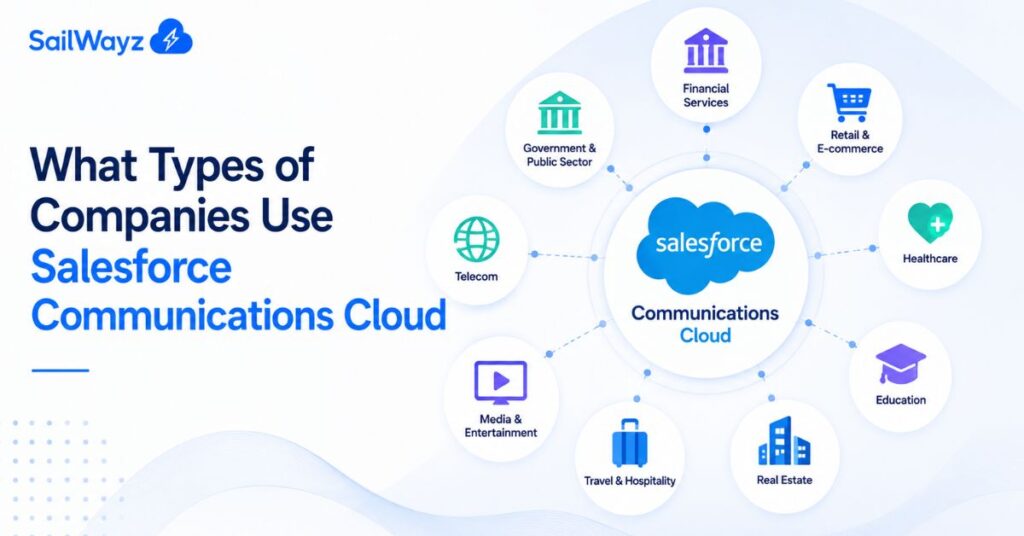
Agentforce works well across any sector with high volumes of customer interactions retail, financial services, manufacturing, professional services, and telecommunications all see strong results. The platform’s pre-built role-specific agents (service, sales, marketing) mean most businesses can deploy meaningful automation without building everything from scratch.

Joshua Eze is the Founder & Salesforce Architect at Sailwayz, a certified Salesforce Consulting Partner based in the UK. With over 6 years of experience leading CRM transformations, he is a certified Application & System Architect passionate about using technology to simplify business processes. Joshua helps companies unlock the full potential of Salesforce with strategic, scalable, and secure solutions.
