
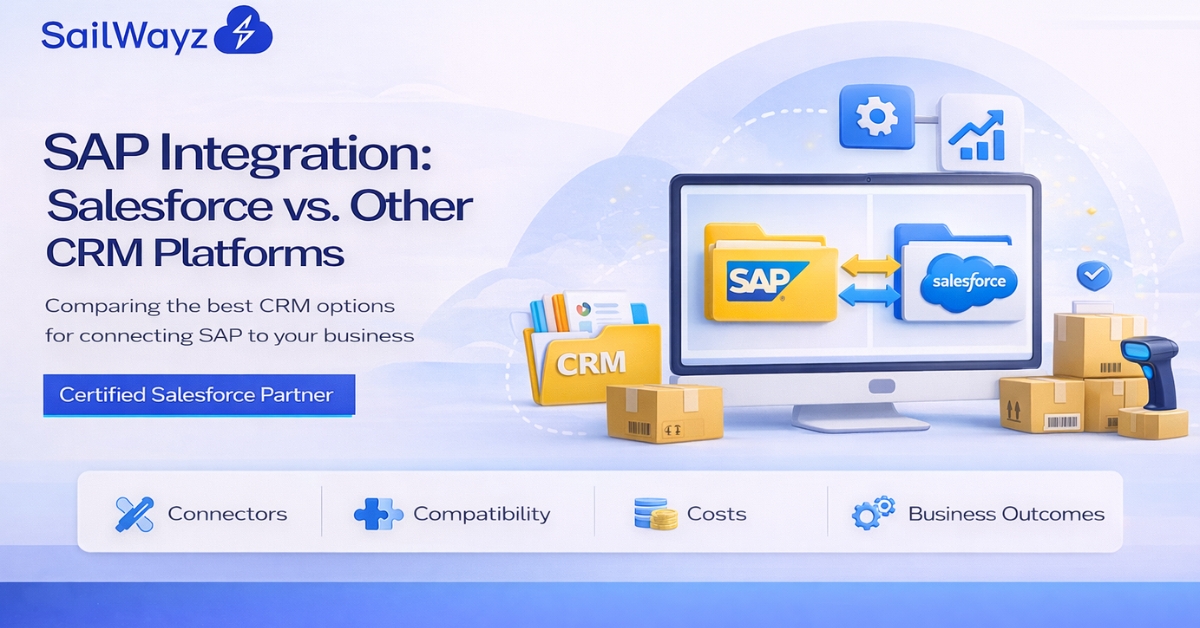
When businesses need to connect their ERP and CRM systems, choosing the right integration approach can make or break operational success. SAP, as a leading enterprise resource planning platform, needs to communicate smoothly with customer relationship management tools. But not all CRM integrations are created equal. If you’re weighing up whether to integrate SAP with Salesforce or another CRM platform like Microsoft Dynamics 365, HubSpot, or SAP’s own Sales Cloud, understanding the technical and practical differences is critical.
This guide explores how integrating SAP with Salesforce compares to other CRM options, looking at connectors, compatibility, costs, and real-world business outcomes.
Before diving into the comparisons, let’s establish what SAP-CRM integration actually means.
SAP handles back-office operations like finance, supply chain, manufacturing, and human resources. It’s the system of record for most enterprise data. CRMs like Salesforce focus on customer-facing activities such as sales pipelines, marketing campaigns, and service requests.
When these systems don’t talk to each other, teams end up copying data manually between platforms, which wastes time and creates errors. Sales reps can’t see invoice status from SAP. Finance teams lack visibility into Salesforce opportunities. Service staff don’t have access to delivery schedules.
Integration solves these problems by synchronising data bidirectionally, automating workflows, and creating a single source of truth across your organisation.
Salesforce holds over 20% of the global CRM market, making it the world’s most popular customer relationship platform. When paired with SAP, this combination offers several distinct advantages.
Salesforce benefits from extensive integration infrastructure. MuleSoft, owned by Salesforce, provides enterprise-grade connectors specifically designed for SAP integration. These pre-built adapters reduce development time and offer standardised approaches to common integration scenarios.
MuleSoft supports bidirectional data flows between SAP S/4HANA, SAP ECC, and Salesforce clouds including Sales Cloud, Service Cloud, and Marketing Cloud. The platform includes templates for typical business processes like quote-to-cash, order-to-delivery, and customer service workflows.
SAP Integration Suite also offers native Salesforce connectors through its Cloud Platform Integration service. This means you can approach the integration from either end, using either Salesforce’s tools or SAP’s native middleware.
Salesforce provides multiple API options for SAP integration. The REST API handles standard CRUD operations, whilst the Bulk API manages large data volumes efficiently. The Streaming API enables real-time updates when Salesforce data changes, which is particularly useful for time-sensitive scenarios like inventory checks or pricing updates.
This API flexibility means sales teams can access live SAP data directly within Salesforce. When a customer service rep opens an account record, they can see current order status, payment history, and delivery schedules pulled straight from SAP in real time.
As a cloud-first platform, Salesforce integrates more naturally with modern middleware solutions. SAP Cloud Platform Integration and MuleSoft both operate in cloud environments, reducing the complexity of connecting cloud-based Salesforce with either cloud or on-premises SAP systems.
This architecture supports hybrid deployments where your SAP system might be on-premises whilst Salesforce runs entirely in the cloud. The integration layer handles authentication, security, and data transformation between these environments.
The Salesforce-SAP integration has massive community support. Integration platforms like Dell Boomi, Jitterbit, and APPSeCONNECT all offer mature, tested connectors for this combination. At Sailwayz, we regularly implement Salesforce integrations with SAP for clients across manufacturing, retail, and financial services sectors.
This ecosystem means you’re not reinventing the wheel. Best practices exist, documentation is comprehensive, and specialists like Sailwayz have deep experience solving common integration challenges.
Microsoft Dynamics 365 represents Salesforce’s biggest competitor in the CRM space. Let’s look at how SAP integration differs when using Dynamics instead.
The primary advantage of Dynamics 365 lies in its tight coupling with other Microsoft products. If your organisation already uses Office 365, SharePoint, Teams, and Azure, Dynamics 365 provides seamless connectivity within this ecosystem.
For SAP integration specifically, organisations can use Azure Logic Apps or Azure Integration Services to build connections between Dynamics 365 and SAP. Microsoft also offers Power Platform connectors that work with SAP NetWeaver Gateway services.
What you gain in Microsoft-to-Microsoft integration, you may lose in SAP-specific capabilities. Whilst Dynamics 365 integrates well with other Microsoft tools, the SAP connectors often require more custom configuration compared to Salesforce’s mature MuleSoft adapters.
Dynamics 365 offers hybrid deployment options, allowing both cloud and on-premises installations. For organisations with strict data sovereignty requirements or those running older SAP versions, this flexibility can be valuable.
Some enterprises prefer keeping their CRM data on-premises alongside their SAP system. Dynamics 365 supports this scenario better than cloud-only Salesforce, though it adds complexity to the integration architecture.
Dynamics 365 pricing starts lower than Salesforce for basic tiers, but costs rise quickly when adding modules and users. Integration costs depend heavily on which middleware platform you choose. Azure-based integration may be more cost-effective if you’re already invested in Microsoft’s cloud infrastructure, whilst third-party tools like Boomi or MuleSoft might offer better value for complex scenarios.
According to industry comparisons, Dynamics 365 Sales Professional starts at approximately £50 per user monthly, whilst Salesforce Sales Cloud begins around £20 per user monthly for basic functionality. Advanced tiers for both platforms can exceed £200 per user monthly.
HubSpot takes a different approach as a marketing-led, small-to-medium business focused CRM.
HubSpot offers a more user-friendly interface than either Salesforce or Dynamics 365, which extends to its integration capabilities. For smaller organisations with straightforward SAP integration needs, HubSpot’s connectors provide faster initial setup.
The trade-off is depth. HubSpot’s integration capabilities are more limited than enterprise platforms. Complex data transformations, advanced workflow automation, and real-time bidirectional synchronisation may require custom development or third-party middleware.
Where HubSpot excels is connecting SAP data to marketing campaigns. If your primary integration goal is using ERP data to personalise marketing, HubSpot’s native tools are strong. You can segment contacts based on purchase history from SAP, trigger campaigns from order events, and track marketing ROI against actual SAP revenue data.
For broader integration needs that include sales forecasting, service ticket management, or complex quote-to-cash processes, HubSpot falls short compared to Salesforce or Dynamics 365.
HubSpot’s free CRM tier makes it attractive for small businesses, though meaningful SAP integration requires paid plans. Implementation tends to be faster than enterprise CRM projects, with basic integrations possible in 4-6 weeks compared to 3-6 months for complex Salesforce-SAP deployments.
SAP offers its own CRM solution, SAP Sales Cloud (formerly SAP C/4HANA), which presents unique integration characteristics.
The obvious advantage is that you’re connecting two SAP products. Integration uses SAP’s native protocols, reducing translation complexity. Data models align more naturally, and authentication is simplified.
SAP Integration Suite provides deep, out-of-the-box connectivity between SAP Sales Cloud and SAP S/4HANA. Pre-configured business content covers common scenarios without extensive customisation.
The challenge with SAP Sales Cloud is that it lacks the breadth and ecosystem of Salesforce or Dynamics 365. Its marketing automation capabilities are weaker, often requiring supplemental tools like HubSpot or Marketo. The partner ecosystem is smaller, and finding experienced consultants can be harder.
SAP Sales Cloud pricing starts around £100 per user monthly, positioning it as an enterprise-focused solution. For organisations deeply committed to SAP across their entire technology stack, this can make sense. For most businesses, the limited functionality compared to market leaders makes it a less compelling choice.
Independent reviews consistently note that SAP Sales Cloud’s mobile experience and user interface lag behind Salesforce and Dynamics 365. Sales teams often resist adoption due to usability issues, which can undermine integration benefits regardless of how technically sound the connection is.
Let’s compare the technical aspects across different CRM platforms when integrating with SAP.
Salesforce’s flexible data model allows easier field mapping from SAP. Custom objects and fields can be created quickly to match SAP structures. Dynamics 365 offers similar flexibility but within a more rigid entity framework. HubSpot’s data model is simpler, which speeds initial setup but limits complex mappings.
Salesforce supports REST, SOAP, and Bulk APIs with comprehensive documentation. Dynamics 365 uses OData and Web API standards, which align well with modern protocols. SAP Sales Cloud naturally uses SAP Gateway services and OData. HubSpot primarily uses REST APIs with some limitations on complex queries and batch operations.
Salesforce’s Streaming API enables true real-time integration for scenarios like inventory checks. Dynamics 365 supports real-time through webhooks and Power Automate flows. HubSpot and SAP Sales Cloud typically rely more on scheduled batch synchronisation, though real-time options exist with additional configuration.
Enterprise platforms like Salesforce and Dynamics 365 offer sophisticated monitoring dashboards, error logging, and retry mechanisms. Middleware platforms like MuleSoft and SAP Integration Suite provide centralised monitoring across integrations. HubSpot’s native monitoring is more basic, requiring third-party tools for production-grade oversight.
Beyond technical capabilities, think about which processes you need to integrate.
Integrating SAP with Salesforce for quote-to-cash processes is well-established. Salesforce CPQ connects to SAP pricing and inventory, opportunities sync to SAP sales orders, and invoices flow back to Salesforce for visibility. This workflow is mature, documented, and supported by numerous implementation partners like Sailwayz.
Dynamics 365 offers similar capabilities but requires more custom configuration. HubSpot lacks native CPQ functionality, making this scenario challenging without third-party apps.
Salesforce Service Cloud integrates with SAP to provide customer service teams with complete order history, delivery status, and warranty information. Case creation can trigger SAP service orders, and resolution updates sync back.
Dynamics 365 Customer Service offers comparable integration, particularly strong if you’re using Microsoft Field Service. HubSpot Service Hub is more limited for complex service scenarios requiring deep SAP integration.
For tracking marketing ROI against actual SAP revenue, both Salesforce and Dynamics 365 offer robust solutions. HubSpot excels here with its marketing-first approach, providing clearer attribution reporting with less configuration. SAP Sales Cloud’s marketing capabilities are the weakest of the group.
The availability of skilled consultants and implementation partners varies significantly.
Salesforce has the largest ecosystem of certified consultants and partners. Specialist firms like Sailwayz focus exclusively on Salesforce implementations, including complex SAP integrations. This specialisation means faster implementations, better practices, and more predictable outcomes.
Dynamics 365 partners are abundant but less specialised. Many Microsoft partners support the full suite of products, which can be an advantage if you need broader Microsoft expertise. For SAP integration specifically, you may need to carefully vet partners for relevant experience.
HubSpot partners are numerous but tend to focus on marketing rather than complex enterprise integrations. Finding a HubSpot partner with deep SAP experience is challenging.
SAP Sales Cloud implementations typically come through SAP consulting partners, who obviously have SAP expertise but may lack CRM-specific best practices that independent Salesforce or Dynamics specialists bring.
Choosing between integrating SAP with Salesforce versus other CRMs depends on several factors.
Choose Salesforce-SAP integration if you need comprehensive CRM functionality, extensive customisation, strong partner support, proven enterprise-scale integration patterns, and the flexibility to add advanced features like AI-powered insights and industry-specific solutions.
Choose Dynamics 365-SAP integration if you’re already invested in the Microsoft ecosystem, need on-premises or hybrid deployment, require tight integration with Office 365 and Teams, or prefer Microsoft’s AI capabilities through Copilot.
Choose HubSpot-SAP integration if you’re a small-to-medium business with straightforward needs, marketing automation is your primary goal, budget constraints favour lower initial costs, or quick implementation is more valuable than depth of features.
Choose SAP Sales Cloud-SAP integration if you’re committed to an all-SAP technology stack, have complex product configuration needs, operate in highly regulated industries where SAP’s compliance features matter, or require on-premises deployment with full data control.
What makes Salesforce-SAP integration different from other CRM integrations?
Salesforce-SAP integration benefits from mature, pre-built connectors through MuleSoft and SAP Integration Suite, extensive documentation and best practices from years of market leadership, real-time data synchronisation capabilities via Streaming API, and the largest ecosystem of experienced implementation partners like Sailwayz who specialise in this specific combination.
Can you integrate SAP with multiple CRMs simultaneously?
Yes, organisations can maintain integrations between SAP and multiple CRMs, though this approach adds complexity and cost. You’ll need a robust middleware platform to manage multiple connections, clear data governance to avoid conflicts, and strong master data management to maintain consistency. Most businesses find it more practical to consolidate on a single CRM platform.
How long does SAP-CRM integration typically take?
Integration timelines vary by scope and complexity. Basic Salesforce-SAP integrations with standard connectors may complete in 8-12 weeks. Complex, customised implementations often require 3-6 months. HubSpot integrations tend toward the faster end, whilst Dynamics 365 and SAP Sales Cloud projects typically fall in the 3-4 month range for meaningful functionality.
What are the main challenges when integrating SAP with any CRM?
Common challenges include mapping different data structures between SAP and CRM systems, handling real-time synchronisation for inventory and pricing, managing security and authentication across cloud and on-premises environments, training users on integrated workflows, and maintaining integrations as both systems evolve with updates. Working with experienced consultants significantly reduces these challenges.
Is cloud-based or on-premises SAP integration easier with different CRMs?
Cloud-based SAP systems generally integrate more easily with cloud-native CRMs like Salesforce and HubSpot. On-premises SAP requires additional components like SAP Cloud Connector, which adds security and configuration steps. Dynamics 365 offers more flexibility for on-premises scenarios due to its hybrid deployment options. The specific ease depends more on your middleware choice than the CRM platform itself.

Joshua Eze is the Founder & Salesforce Architect at Sailwayz, a certified Salesforce Consulting Partner based in the UK. With over 6 years of experience leading CRM transformations, he is a certified Application & System Architect passionate about using technology to simplify business processes. Joshua helps companies unlock the full potential of Salesforce with strategic, scalable, and secure solutions.
