
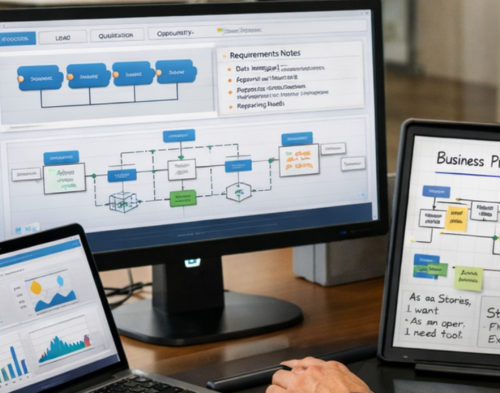
Getting the most out of Salesforce isn’t just about buying the software. It’s about making sure it actually works for your business. That’s where a Salesforce business analyst comes in.
Think of them as the translator between what your team needs and what the technology can do. Without one, companies often end up with overcomplicated systems, frustrated users, and implementations that miss the mark. With one, you get a CRM that actually helps people do their jobs better.
Let’s break down why having a salesforce business analyst on your team matters more than you might think.
Before we talk about benefits, let’s get clear on the role itself.
A salesforce business analyst helps guide businesses to improve processes and efficiency in Salesforce by gathering requirements around business challenges and producing data-driven solutions. They’re not administrators who handle day-to-day maintenance. They’re project-based professionals who bridge the gap between business stakeholders and technical teams.
The BA ensures everyone involved in a project is on the same page, facilitates communication between clients and technical teams, and clarifies ambiguities. They ask the right questions, document what matters, and make sure the solution you build actually solves your problems.
Here’s the thing about Salesforce implementations: they go wrong more often than they should. Incomplete requirements gathering, complex integrations, and lack of testing can cause go-live delays by months and lead to budget overruns.
A business analyst prevents this by doing the groundwork properly. They map out your current processes, identify what needs to change, and document requirements before anyone starts building. This saves you from expensive do-overs and keeps your project on track.
At Sailwayz, we’ve seen how proper business analysis transforms implementation outcomes. Instead of discovering problems after launch, you catch them early when they’re cheap to fix.
Business people and technical people often speak different languages. Sales teams talk about customer journeys and conversion rates. Developers talk about objects, fields, and API calls. Without someone to translate, things get lost.
A BA bridges communication gaps between business needs and technical requirements, understanding client workflows and ensuring technical teams capture these needs. They sit in meetings, ask clarifying questions, and make sure everyone understands what’s being built and why.
This matters more than you’d think. Poor communication is one of the main reasons Salesforce projects fail. A BA keeps everyone aligned.
Salesforce is powerful, but that power creates options. Lots of them. Too many, sometimes.
Customizing the platform without clear understanding of business needs can lead to complex and faulty implementation or over-customization of the system, making the platform harder to use. Companies either under-build and don’t solve their problems, or over-build and create something nobody can use.
A salesforce business analyst finds the sweet spot. They understand what you’re trying to accomplish and design solutions that match. Not too simple, not too complicated. Just right.
The BA has a unique and critical role because they sit between business stakeholders and technical builders and will govern the user experience. Part of that role involves testing.
Before anything goes live, a good BA makes sure it works. They create test cases based on real business scenarios, coordinate user testing, and catch problems before your team sees them. This prevents the frustration of launching something that technically works but practically doesn’t.
Six months after launch, someone will ask: “Why did we build it this way?” If you don’t have documentation, nobody knows. If you have documentation written by a BA, you have your answer.
Business analysts create comprehensive documentation including business requirements specifications, process maps, and user stories that guide development teams during implementation. This documentation becomes your reference guide for training, troubleshooting, and future improvements.
For businesses working with partners like Sailwayz, proper documentation means your internal team can take over confidently once the project wraps up.
Building a great system means nothing if people don’t use it. One of the largest impacts on Salesforce ROI is employee adoption, as Salesforce is only as good as the people who use it regularly.
A BA helps adoption in two ways. First, by designing solutions that actually make sense for how people work. Second, by creating training materials and supporting change management. When users understand the “why” behind changes and see how it helps them, they’re more likely to embrace the new system.
Yes, hiring a salesforce business analyst costs money upfront. But compare that to the cost of failed implementations, constant rework, poor adoption, and systems that don’t deliver ROI.
Well-documented business processes lead to better requirements with less ambiguity between end users, analysts, architects, and developers, resulting in less rework and less frustration. You build it right the first time, which is always cheaper than building it twice.
Business analysts deliver solutions that drive measurable business value by leveraging application domain knowledge to identify inefficiencies and help envision strategic solutions that align with business objectives.
They don’t just ask “what do you want?” They ask “what problem are you trying to solve?” and “how will we know if this works?” This keeps the focus on outcomes, not just features.
Not every Salesforce project needs a dedicated BA, but most should have one. Here’s when it’s especially important:
At Sailwayz, our Salesforce consulting services always include proper business analysis. We don’t just build what clients ask for. We dig deeper to understand what they actually need.
Our team works closely with your stakeholders to map current processes, identify pain points, and design solutions that make sense for your business. We document everything clearly, test thoroughly, and make sure your team knows how to use what we build.
Whether you need Salesforce implementation, integration services, or ongoing support, we bring the business analysis expertise that turns projects into successes.
“They’re the same as administrators” – No. Business analysis is a project-based, business-improvement role, while administration is an operational role. Admins maintain the system; BAs improve it.
“We can skip this role to save money” – You might save money upfront, but you’ll spend more fixing problems later. Without BA, you risk returning to the starting point and adding significant loss of time and financial resources.
“Our developers can handle this” – Developers are great at building solutions, but they need clear requirements. That’s what BAs provide. You wouldn’t expect a builder to also be the architect.
“It’s just about documentation” – Documentation matters, but BAs do much more. They facilitate discussions, identify opportunities, manage stakeholder expectations, and ensure solutions deliver business value.
Not everyone can be a good BA. The role requires a specific mix of abilities.
Communication skills – When thinking about communication, speaking and presenting matter, but listening is just as important. Good BAs ask great questions and really hear the answers.
Analytical thinking – They need to break down complex problems, spot patterns, and identify root causes rather than just symptoms.
Salesforce knowledge – Understanding what’s possible in the platform helps BAs design realistic solutions and know when customization makes sense.
Business acumen – They need to understand how businesses work, not just how Salesforce works. Industry knowledge helps here.
Project management – BAs often coordinate activities across teams, manage timelines, and keep projects moving forward.
If you’re about to work with a BA, here’s how to get the best results:
Be honest about problems – Don’t sugarcoat issues or pretend everything’s fine. BAs need the truth to design good solutions.
Make time for discussions – Requirements gathering takes time. Don’t rush it. The time you invest upfront saves time later.
Include the right people – Make sure stakeholders from all affected teams participate. Missing perspectives lead to incomplete solutions.
Ask questions – If you don’t understand something the BA suggests, ask. Good BAs welcome questions because they lead to better solutions.
Trust the process – Business analysis might feel slow sometimes, but it prevents bigger problems. Trust that the thorough approach pays off.
Salesforce customers report an average 37% increase in revenue after implementing Sales Cloud. But that’s only when implementations go well.
The ROI of a BA shows up in multiple ways:
ROI analysis helps justify investment, optimise resource usage, and make informed decisions about budget allocation and strategic planning. A BA directly contributes to better ROI by ensuring your Salesforce investment delivers real business value.
The role of the salesforce business analyst continues to grow in importance. As Salesforce adds more features, clouds, and capabilities, the platform becomes more powerful but also more complex. Companies need experts who can navigate that complexity and make smart decisions.
AI and automation are changing how BAs work, but they’re not replacing the role. Instead, tools handle repetitive tasks while BAs focus on strategy, stakeholder management, and business value.
At Sailwayz, we’re seeing increased demand for business analysis services as more companies realise its importance. The question isn’t whether you need business analysis anymore. It’s whether you do it properly or cut corners and deal with consequences later.
What’s the difference between a Salesforce business analyst and a Salesforce administrator?
A business analyst focuses on project-based improvements and business process analysis. They gather requirements, design solutions, and ensure implementations meet business goals. An administrator handles day-to-day operations like user management, security settings, and system maintenance. BAs work on changing the system; admins keep it running smoothly.
Do small businesses need a Salesforce business analyst?
It depends on your implementation complexity. Simple setups might not need a dedicated BA, but most small businesses benefit from at least some business analysis work. If you’re customising Salesforce, integrating with other systems, or have multiple departments using it, proper business analysis prevents costly mistakes regardless of company size.
How much does hiring a Salesforce business analyst cost?
Costs vary based on location, experience, and whether you hire full-time, contract, or through a consulting partner. While there’s an upfront investment, proper business analysis typically reduces total project costs by preventing rework, scope creep, and failed implementations. Most businesses find the ROI justifies the expense.
Can a developer or administrator also do business analysis work?
Some people have skills in multiple areas, but the roles require different mindsets. Developers focus on how to build things; administrators focus on maintaining systems; business analysts focus on what should be built and why. Trying to combine roles often means one area gets shortchanged, usually the business analysis.
When should a Salesforce business analyst get involved in a project?
Ideally, from the very beginning. Early involvement allows the BA to understand business context, identify stakeholders, and shape requirements before any building starts. Bringing in a BA midway through a struggling project is better than never, but starting with one from day one leads to better outcomes and smoother implementations.



Joshua Eze is the Founder & Salesforce Architect at Sailwayz, a certified Salesforce Consulting Partner based in the UK. With over 6 years of experience leading CRM transformations, he is a certified Application & System Architect passionate about using technology to simplify business processes. Joshua helps companies unlock the full potential of Salesforce with strategic, scalable, and secure solutions.
