
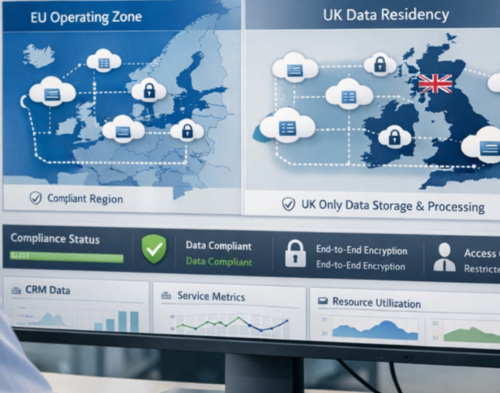
Understanding where your organisation’s data lives has never been more pressing. With data protection regulations tightening across Europe and the UK, businesses face mounting pressure to keep customer information within specific borders. The question is no longer whether you need to think about data residency, but how you can manage it without disrupting your operations.
The Hyperforce EU Operating Zone offers a pathway through this complexity. But what exactly does it deliver, and is it the right solution for your business? Let’s break it down.
Data residency refers to the physical location where your organisation stores and processes data. Think of it as your data’s home address. This matters because different countries have different rules about how personal information should be handled.
Under GDPR, both the nation where data is stored and the EU have the authority to regulate data. For businesses operating in Europe, this creates a web of requirements. You might need to ensure data stays within the EU, or even within specific countries, depending on your industry and customer base.
The stakes are high. Under GDPR, the European Union can levy fines of up to €20 million or 4% of the violating organisation’s annual revenues, whichever is higher. That’s enough to make any finance director sit up and take notice.
Brexit added another layer to data residency questions. The UK GDPR mirrors the EU framework, with data transfers to the EEA permitted, but transfers to other countries requiring appropriate safeguards.
Here’s what this means in practice: UK businesses can still transfer data freely to EU countries, and vice versa, because an adequacy agreement is in place. But both regions maintain strict standards about where data goes beyond those borders.
GDPR doesn’t mandate that all EU resident data must physically stay in Europe. What it does require is rigorous protection if data leaves the European Economic Area. International data transfers must receive protection that is essentially equivalent to GDPR standards.
This distinction is worth noting. You’re not locked into EU-only storage, but you are locked into EU-level protection standards wherever your data travels.
Salesforce Hyperforce represents a shift in how cloud platforms deliver services. Rather than relying solely on proprietary data centres, Hyperforce runs on public cloud infrastructure provided by Amazon Web Services, Google Cloud Platform, and Microsoft Azure.
Hyperforce moves the platform onto public cloud infrastructure, unlocking new possibilities for data residency, scalability, and performance whilst keeping the familiar Salesforce experience intact.
This isn’t just a technical detail. By partnering with major cloud providers, Salesforce can now offer data storage in specific geographic regions that weren’t previously available. This matters enormously for businesses that need to comply with local regulations.
The architecture is code-based rather than hardware-dependent. Hyperforce enables global service for employees and customers whilst maintaining control over data residency, ensuring compliance with regional regulations.
The Hyperforce EU Operating Zone takes the standard Hyperforce platform and adds specific commitments for European organisations. EU Operating Zone includes a select set of products and features vetted to meet strict obligations, spanning Sales Cloud, Service Cloud, the Salesforce Platform, and industries.
What makes this different from standard Hyperforce? Three things:
First, data processing happens strictly within EU borders. The EU Operating Zone processes and stores EU data strictly within the EU region.
Second, customer and technical support comes from EU-based personnel. The Hyperforce EU Operating Zone offers 24/7 support delivered by EU-based personnel.
Third, the service addresses specific EU regulatory requirements around data privacy and transfer restrictions.
For organisations using Sailwayz for their Salesforce consulting needs, this means clearer options when planning implementations. Companies like Sailwayz can guide clients through the decision-making process, helping determine whether the EU Operating Zone fits their specific compliance requirements.
The primary advantage is straightforward: you choose where your data lives. Hyperforce allows businesses to host their Salesforce data in specific geographic regions, ensuring compliance with local data protection laws such as GDPR in Europe.
This isn’t about restricting access to information. It’s about knowing your data’s physical location and ensuring it aligns with your legal obligations. For businesses operating across multiple European countries, this flexibility can simplify compliance significantly.
Public cloud infrastructure offers something traditional data centres struggle to match: elastic scaling. Hyperforce benefits from the flexibility to grow and scale your business as needed, supporting long-term sustainability.
During peak trading periods or business expansions, resources can scale dynamically. When demand drops, you’re not paying for unused capacity. This makes financial planning more predictable.
Hyperforce is secure by default with least-privileged control and zero-trust principles, limiting users to appropriate levels of access to customer data.
Zero-trust architecture means the system verifies every access request, regardless of where it comes from. Data encryption applies both at rest and in transit. These aren’t optional features you need to configure; they’re baked into how Hyperforce operates.
Cloud-native architecture brings development speed benefits. Hyperforce streamlines the creation and deployment of development and testing environments, enabling your team to iterate more quickly.
For businesses working with Salesforce partners like Sailwayz, this translates to faster implementations and quicker time-to-value from customisations.
Not every country has Hyperforce data residency yet. Hyperforce supports data residency across numerous countries, including Australia, Canada, France, Germany, India, Japan, the United Kingdom, and the United States.
This matters if you operate across multiple regions. A business with operations in both the UK and Singapore, for example, can manage UK data within British borders and Singapore data within Asia-Pacific infrastructure.
The coverage continues expanding. Salesforce has announced plans to bring Hyperforce to additional countries, but the rollout happens gradually. If you need data residency in a specific country, checking current availability is a necessary first step.
Should your organisation choose the EU Operating Zone? The answer depends on several factors.
Regulatory requirements top the list. If your industry faces strict data localisation rules, or if your customer contracts specify EU data residency, the choice becomes clearer. Financial services, healthcare, and government sectors often face these requirements.
Business expansion plans matter too. If you’re planning to grow your European operations, setting up data residency from the start can prevent complications later.
Customer expectations shouldn’t be overlooked. Some clients simply prefer knowing their data stays within EU borders, even when regulations don’t strictly require it. Meeting this preference can be a competitive advantage.
For organisations working with Salesforce consultants like Sailwayz, this decision-making process typically involves reviewing your current data flows, compliance obligations, and future business plans. Expert guidance can help you avoid over-engineering expensive solutions whilst ensuring adequate protection.
Moving to Hyperforce EU Operating Zone isn’t instantaneous. Migration to Hyperforce isn’t optional, with Salesforce declaring this architecture as its future, though the process happens over a period of time.
Salesforce manages migration scheduling based on various factors. You can work with your account team if the proposed timing doesn’t suit your business operations.
Your instance name and URL will likely change after migration. Salesforce provides new instance details in migration notifications, giving you time to update any integrations or bookmarks.
Most organisations experience a small window of downtime during migration, then operations resume normally. Services not yet hosted on Hyperforce will continue running without interruption.
Navigating data residency requirements whilst implementing or migrating Salesforce can feel overwhelming. This is where working with experienced Salesforce consultants becomes valuable.
Partners like Sailwayz bring expertise in handling these technical and compliance questions. They can help you assess whether the EU Operating Zone meets your needs, plan migrations to minimise business disruption, and configure your Salesforce environment to maintain compliance.
The right partner doesn’t just implement software; they help you understand the implications of architectural decisions and guide you toward solutions that balance compliance, cost, and functionality.
These terms often get used interchangeably, but they mean different things. Data sovereignty concerns the legal authority to regulate data, whilst data residency concerns the geographical location of stored data.
Data residency answers: Where is the data physically stored? Data sovereignty answers: Which legal framework governs the data?
Understanding this distinction helps when evaluating solutions. The Hyperforce EU Operating Zone addresses both, by keeping data physically in the EU and ensuring it falls under EU legal frameworks.
One common question about Hyperforce migration: Does it cost extra?
There are no additional costs for businesses transitioning to Hyperforce, with subscription and pricing structure remaining the same.
This makes the decision more straightforward. You gain benefits like improved scalability and data residency control without budget implications beyond your existing Salesforce investment.
The real costs come from migration planning and any customisation work needed to ensure compatibility. This is where working with experienced consultants helps avoid unexpected expenses.
No solution is perfect. Hyperforce EU Operating Zone has some limitations worth knowing about.
Regional availability remains limited compared to global coverage. If you need data residency in multiple countries outside the currently supported regions, you might need to wait for expansion or consider alternative approaches.
Hyperforce does not allow companies to manage data across multiple countries within a single instance, which can be an issue for international companies needing data localised in multiple countries.
Some technical considerations require attention. After migration, you might need to manually manage endpoints or update certain integrations. Planning for these tasks during migration prevents disruption.
Data residency requirements aren’t getting simpler. The number of laws and policies requiring digital information to be stored in a specific country has more than doubled since 2017.
This trend shows no signs of slowing. More countries introduce data protection regulations each year, often with unique requirements. Having infrastructure that can adapt to these changes becomes increasingly important.
The Hyperforce EU Operating Zone positions organisations to meet current requirements whilst providing flexibility for future regulatory changes. As Salesforce continues expanding Hyperforce to new regions, businesses gain more options for managing data residency globally.
Assessing whether the Hyperforce EU Operating Zone fits your needs starts with understanding your current situation. What data do you handle? Where do your customers and operations sit? What regulations apply to your industry?
From there, evaluate your future plans. Are you expanding into new European markets? Will your data volumes grow significantly? Do your customers increasingly request data residency commitments?
Working with a Salesforce consulting partner can accelerate this assessment. Partners like Sailwayz offer health checks that review your current Salesforce setup, identify compliance gaps, and recommend appropriate solutions.
Data residency might seem like a purely technical concern, but it connects directly to business risk, customer trust, and growth potential. Getting it right means choosing solutions that protect your organisation whilst supporting your business objectives.
The Hyperforce EU Operating Zone isn’t the only answer to data residency challenges, but it offers a robust option for organisations committed to the Salesforce platform and operating within Europe. Understanding what it delivers, and what it doesn’t, helps you make informed decisions about your data strategy.
What is the main difference between Hyperforce and the Hyperforce EU Operating Zone?
Standard Hyperforce provides cloud infrastructure and data residency options globally, whilst the Hyperforce EU Operating Zone specifically processes and stores all data within EU borders. The EU Operating Zone adds EU-based support personnel and focuses on meeting European regulatory requirements. Both run on the same underlying architecture, but the EU Operating Zone provides stronger guarantees about data location for organisations that need EU compliance.
Can I migrate back to traditional Salesforce infrastructure after moving to Hyperforce?
Migration to Hyperforce is part of Salesforce’s long-term platform strategy and isn’t designed as a reversible choice. Salesforce is gradually moving all customers to Hyperforce infrastructure over time. This shift brings benefits like improved scalability and data residency control, but organisations should plan for Hyperforce as their ongoing platform rather than a temporary solution.
Does the Hyperforce EU Operating Zone support all Salesforce products?
Not all Salesforce products are currently available in the EU Operating Zone. The service includes vetted products spanning Sales Cloud, Service Cloud, the Salesforce Platform, and various industry solutions. Product availability continues expanding over time. If you need specific products not yet available in the EU Operating Zone, you should check with Salesforce or your consulting partner about current availability and roadmap.
How long does migration to the Hyperforce EU Operating Zone typically take?
Migration timing varies based on your organisation’s complexity and customisation level. Most organisations experience a small downtime window during the actual migration, usually measured in hours rather than days. The preparation phase before migration takes longer, involving compatibility checks, endpoint updates, and integration reviews. Working with experienced Salesforce partners helps streamline this preparation and minimise disruption to business operations.
Will moving to the Hyperforce EU Operating Zone affect my Salesforce integrations?
Most integrations continue working after Hyperforce migration, but some require updates. Your instance URL will change, so any hardcoded references need updating. Some integrations might need endpoint adjustments or authentication updates. Conducting a thorough audit of your integrations before migration helps identify necessary changes. Salesforce provides migration documentation and tools to help with this process, and consulting partners can manage the technical details to ensure smooth transitions.



Joshua Eze is the Founder & Salesforce Architect at Sailwayz, a certified Salesforce Consulting Partner based in the UK. With over 6 years of experience leading CRM transformations, he is a certified Application & System Architect passionate about using technology to simplify business processes. Joshua helps companies unlock the full potential of Salesforce with strategic, scalable, and secure solutions.
